A Comprehensive Guide to 401k Max Contribution Limits
2026 401k Max Contributions at a Glance
In 2026, 401k max contributions start at $24,500 in employee contributions. If you're 50 to 59 or 64 or older, you can add an $8,000 catch-up contribution, for a total of $32,500. If you're 60 to 63, a higher catch-up may let you contribute $35,750, if your plan allows it. Employee and employer contributions together can reach $72,000, plus any eligible catch-up contributions.
I'm Christian Brim, and I'll help you see which limit applies to you and how it fits your retirement plan.
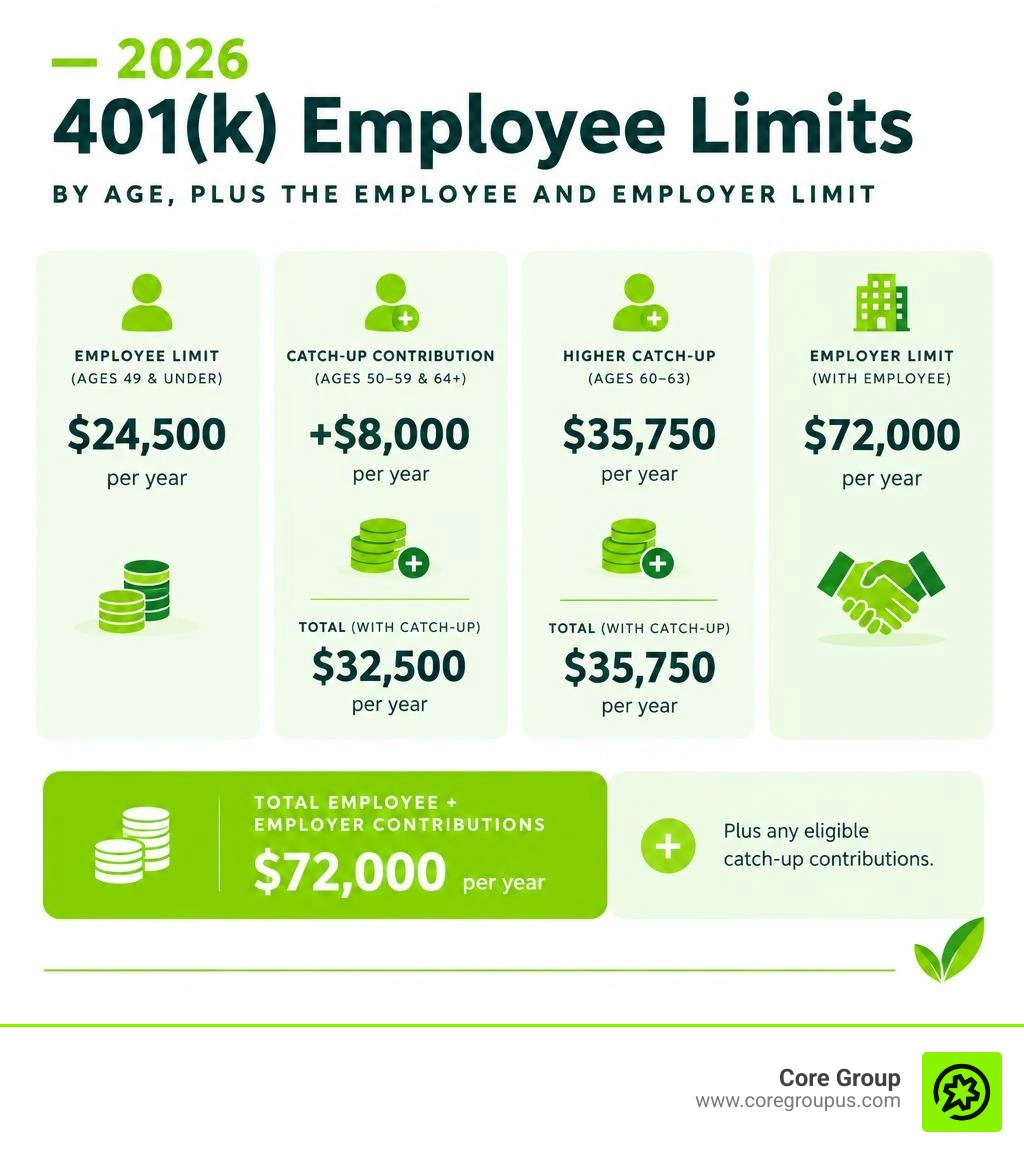
Important 401k max contributions terms include 401k contribution limits 2025, 401k maximum employer contribution, and 401k over 50 catch up.
Understanding 2026 401k Max Contributions and IRS Deferral Limits
Every autumn, the Internal Revenue Service reviews cost of living adjustments to update retirement plan thresholds based on inflation benchmarks. These annual updates keep your retirement contributions aligned with the real economy so your wealth does not lose purchasing power over time. For this tax year, workers gain more room to save across standard employee deferrals and total defined contribution plan additions.
Governed by Internal Revenue Code Section 415(c), annual additions limits apply to all defined contribution plans. Staying on top of these numbers ensures you never leave free money on the table while avoiding accidental over-contributions. Our comprehensive 2026 contribution guide explores how these limits fit broader tax strategies for growing businesses and creative professionals.
The table below breaks down historical annual adjustments across the past three tax years.
| Contribution Category | 2024 Limit | 2025 Limit | 2026 Limit |
|---|---|---|---|
| Employee Salary Deferral | $23,000 | $23,500 | $24,500 |
| Standard Catch-Up (Ages 50 to 59 and 64+) | $7,500 | $7,500 | $8,000 |
| Super Catch-Up (Ages 60 to 63) | N/A | $11,250 | $11,250 |
| Total Combined Limit (Employee + Employer) | $69,000 | $70,000 | $72,000 |
| Annual Compensation Cap | $345,000 | $350,000 | $360,000 |
Elective Deferrals vs. Total 401k Max Contributions
Understanding the difference between employee salary deferrals and overall annual additions is critical for clean financial planning. Your elective deferral represents money withheld directly from your paycheck. For 2026, you can stash up to $24,500 into your account, split between traditional pre-tax and designated Roth buckets in any ratio you prefer.
The total plan maximum is much higher. Under Section 415(c), the overall ceiling for combined employee deferrals, employer matching contributions, and employer profit-sharing allocations climbs to $72,000 in 2026. Official IRS contribution limits also set the maximum annual compensation considered for retirement calculations at $360,000. Any earnings past that threshold cannot be factored into percentage-based matching or profit-sharing formulas.
Managing Limits Across Multiple Employer Plans
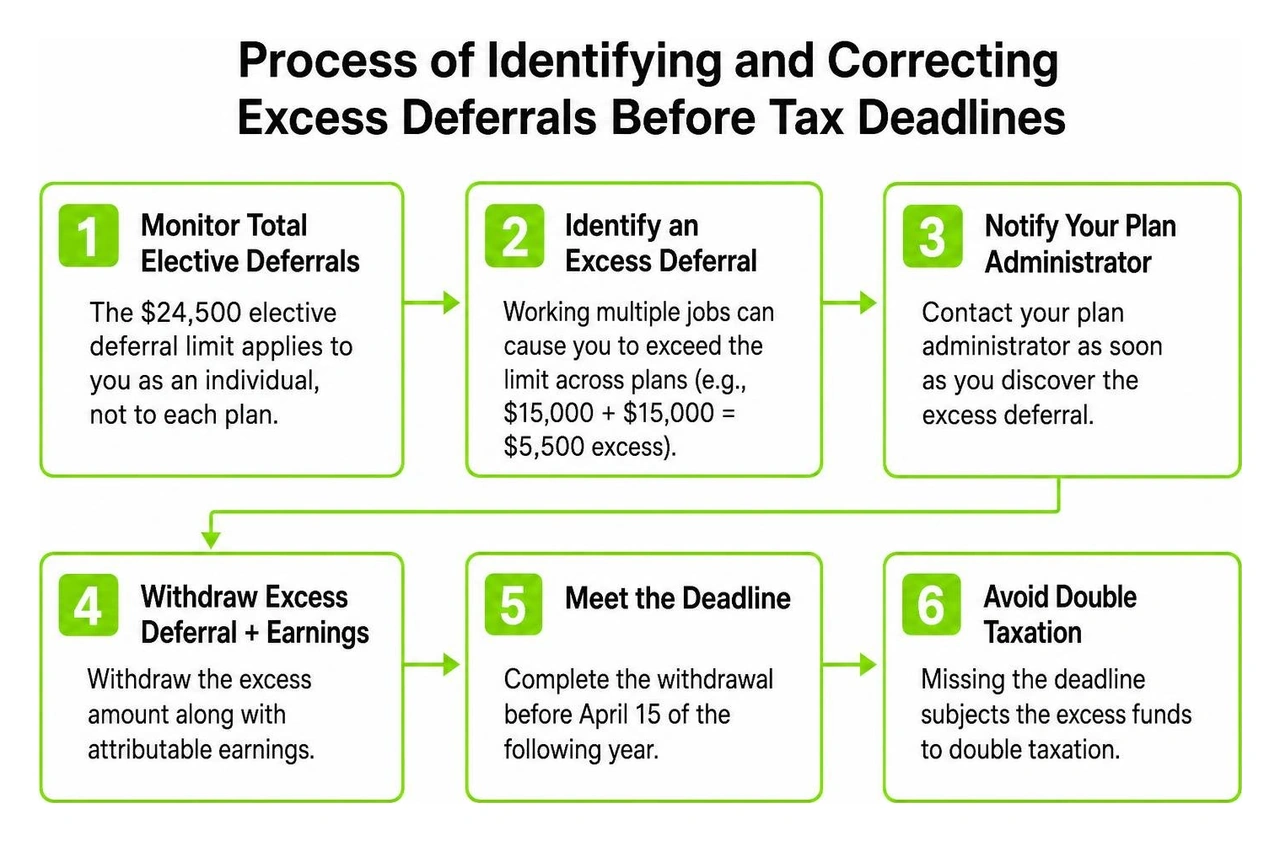
If you work multiple jobs or switch companies mid-year, keeping track of your retirement deductions requires extra care. The $24,500 elective deferral ceiling applies to you as an individual, not to each separate plan. While an employer plan administrator will automatically stop paycheck deductions once you hit $24,500 with their company, unrelated payroll systems do not communicate with one another.
Accidentally depositing $15,000 at one job and $15,000 at another creates an excess deferral of $5,500. You must notify your plan administrator and withdraw the excess amount along with attributable earnings before April 15 of the following year. Missing this deadline subjects those excess funds to double taxation, meaning you pay income tax in the contribution year and ordinary income tax again upon final distribution.
Age-Based Catch-Up Rules and the New High-Earner Roth Mandate

The SECURE 2.0 Act introduced significant reforms to help older workers supercharge their savings as they near retirement. These 2026 401(k) changes establish new age tiers and modify tax treatment rules for high-income wage earners.
Standard Age 50+ Catch-Up and the 60–63 Super Catch-Up
For savers reaching age 50 or older by the end of the calendar year, the standard catch-up allowance rises to $8,000 in 2026. This extra room brings the standard elective deferral maximum to $32,500. When combined with employer contributions, a participant age 50 to 59 or 64 and older can see total annual deposits reach $80,000.
Workers aged 60, 61, 62, and 63 gain access to the special super catch-up tier. If your plan supports this provision, you can contribute an enhanced catch-up of $11,250 instead of the standard $8,000. That brings your personal employee contribution limit to $35,750 and your overall plan ceiling to $83,250. Checking our guide on maximum contributions over 50 will help you confirm plan eligibility and setup details.
The Mandatory Roth Catch-Up Rule for High Earners
A major regulatory change taking effect this year involves the tax treatment of catch-up contributions for high-income earners. If your Social Security wages, reported in Box 3 of your prior-year Form W-2, exceeded $150,000, your catch-up contributions must be designated as after-tax Roth contributions.
While you lose the upfront tax deduction on that catch-up portion, these dollars grow tax-free and provide tax-free distributions during retirement. If you earn over this threshold and your employer does not offer a Roth 401(k) feature, you will be ineligible to make catch-up contributions until the plan document is amended.
Combined Plan Limits, Employer Match, and Advanced Contribution Strategies

Reaching the overall $72,000 limit rarely happens through employee payroll deferrals alone. Employers contribute substantial sums via matching programs and discretionary profit-sharing pools. Reviewing our employer match strategies helps you extract maximum value from corporate benefit structures without running into unexpected plan caps.
Reaching 401k Max Contributions with After-Tax Dollars and Mega Backdoor Roth
High earners looking to maximize their annual savings often turn to non-Roth after-tax contributions. This strategy bridges the gap between your $24,500 elective deferral, your employer match, and the aggregate $72,000 Section 415(c) limit.
Imagine you are 42 years old, contribute the full $24,500 elective deferral, and receive a $10,500 employer match, bringing your total to $35,000. If your company plan allows voluntary after-tax contributions, you can deposit up to $37,000 in additional after-tax funds to reach the $72,000 ceiling.
By pairing these after-tax 401(k) contributions with an immediate in-plan Roth conversion or in-service rollover, you execute a mega backdoor Roth strategy. This move bypasses standard Roth IRA income restrictions and shields vast sums of capital from future capital gains and income taxes. In-plan conversions also avoid the pro-rata aggregation rules that complicate external traditional IRA rollovers.
Tax Planning and How Maximum Contributions Impact Your Income
Deciding between traditional pre-tax and Roth contributions hinges on your current tax bracket compared to your expected retirement bracket. Maxing out pre-tax deferrals reduces your adjusted gross income, creating immediate cash-flow relief while helping you navigate phase-out thresholds for child tax credits, student loan interest deductions, and healthcare subsidies.
To refine your tax plan, explore our breakdown of MAGI reduction strategies. Structuring a healthy mix of pre-tax, Roth, and taxable investment accounts gives you the flexibility to manage future tax brackets efficiently when you start drawing retirement income.
Solo 401(k) and Profit-Sharing Rules for Business Owners
Creative entrepreneurs, consultants, and independent agency owners with no full-time employees other than a spouse have access to the Solo 401(k). This retirement vehicle combines employee and employer contribution roles into a single account, allowing you to build wealth far faster than an individual retirement account permits. Reviewing general 401(k) contribution limits 2026 highlights how dynamic these small business plans truly are.
Dual-Capacity Contributions for the Self-Employed
As a self-employed business owner, you wear two hats when calculating retirement deposits.
- Employee role allows you to defer 100% of your earned compensation up to the standard elective deferral limit of $24,500, plus applicable catch-up amounts.
- Employer role allows you to make a non-elective profit-sharing contribution. For businesses structured as S-Corporations or C-Corporations, this contribution can reach up to 25% of W-2 wages. For sole proprietors and single-member LLCs filing Schedule C, the effective limit is approximately 20% of net adjusted self-employment earnings.
The combined sum of your employee deferral and employer profit-sharing contribution cannot exceed $72,000, or up to $83,250 if you qualify for the age 60 to 63 super catch-up.
Annual Compliance, Filings, and Deadlines
Running an individual retirement plan involves straightforward operational rules. Under current tax laws, you can establish and fund a Solo 401(k) right up to your business tax filing deadline, including extensions, to claim deductions for the previous tax year.
Once your total plan assets across all accounts exceed $250,000 at the end of any plan year, you must submit an annual informational Form 5500-EZ to the IRS. Because owner-only plans cover no common-law employees, they remain exempt from complex annual non-discrimination testing.
Frequently Asked Questions About 401(k) Contribution Limits
What happens if you accidentally contribute too much to your 401(k)?
If your total elective deferrals across all jobs exceed the annual $24,500 threshold, you must notify your plan administrator immediately. The plan will issue a corrective distribution of the excess deferral plus any net earnings generated by those funds.
If removed before the April 15 tax filing deadline, the excess amount is reported as taxable income on Form 1099-R for the year deferred, while earnings are taxed in the year distributed. Failing to take out the excess on time results in double taxation, where the money is taxed in the contribution year and taxed again upon withdrawal.
How much should you aim to save in your 401(k) each year?
A dependable industry benchmark is setting aside at least 15% of your gross annual income for retirement, which includes any matching contributions provided by your employer. If saving 15% immediately strains your budget, start by contributing enough to capture your full employer match so you do not leave compensation behind.
From there, implement an automatic step-up strategy where you raise your contribution rate by 1% or 2% each time you receive a raise until you hit your savings target or max out the annual limit.
Do employer matching contributions count toward the $24,500 employee limit?
No, employer matching contributions and profit-sharing allocations do not count against your $24,500 personal elective deferral limit. Your personal salary deferral ceiling applies exclusively to dollars withheld from your paycheck.
Employer contributions instead count toward the overall Section 415(c) defined contribution plan limit of $72,000.
Conclusion
Securing your financial future requires deliberate planning and a clear understanding of annual IRS retirement guidelines. Whether you are maximizing standard paycheck deferrals, leveraging the enhanced catch-up tiers, or deploying mega backdoor Roth strategies, staying organized keeps your money working hard for you.
At Core Group, we provide comprehensive financial management, bookkeeping, and tax services tailored specifically for creative entrepreneurs. Our no-fluff, profit-first playbook delivers real peace of mind and saves you valuable time, backed by our MacBook Pro guarantee so you can focus on building a thriving business. Learn more about aligning 401(k) contributions with MAGI goals to keep your wealth plan on track.