Maxing Out Your Future: The Complete Guide to Yearly 401k Limits
How Much Can You Actually Put Into a 401k Each Year
Understanding the 401k max per year is simpler than it sounds. Here are the key 2026 limits at a glance.
| Saver Type | 2026 Contribution Limit |
|---|---|
| Under age 50 | $24,500 |
| Age 50-59 and 64+ | $32,500 ($24,500 + $8,000 catch-up) |
| Age 60-63 | $35,750 ($24,500 + $11,250 super catch-up) |
| Combined employee + employer (under 50) | $72,000 |
| Combined employee + employer (age 50+) | $80,000 |
| Combined employee + employer (age 60-63) | $83,250 |
The IRS sets these limits every year and adjusts them for inflation. In 2026, the standard employee limit rose by $1,000 from the previous year. That extra room can make a real difference over time when you factor in compound growth.
But the numbers alone don't tell the full story. There are catch-up rules for older workers, new Roth requirements for high earners, and penalties if you accidentally go over. Getting this wrong can cost you in taxes, twice over.
I'm Christian Brim, and in this guide I'll walk you through everything you need to know to make the most of your 401k this year.

401k max per year helpful reading includes the following resources.
Understanding the 401k Max Per Year for Employee Contributions
When you set out to build your retirement nest egg, the primary vehicle for most workers is the employee elective deferral. For the tax year 2026, the standard individual 401k max per year is $24,500 for anyone under the age of 50. This represents a notable jump from the $23,500 limit in 2025, giving you more tax-advantaged space to grow your wealth.
This employee limit applies to elective deferrals, which are the contributions you choose to deduct directly from your paycheck. Whether you decide to route your savings into a traditional pre-tax 401k, a post-tax Roth 401k, or a combination of the two, the total amount you contribute cannot exceed this $24,500 threshold.

Choosing between these accounts depends heavily on your current tax bracket and where you expect to be in retirement. Traditional contributions lower your adjusted gross income today, while Roth contributions allow you to withdraw your earnings completely tax-free later in life.
If you want to read more about how these caps are trending, you can review how The 401(k) contribution limit rises to $24,500 in 2026, up from $23,500 to understand the broader economic factors at play. To plan your personal contribution strategy for this year, check out our comprehensive breakdown on the 401k Maximum Contribution 2026.
How the 401k Max Per Year Changes for Older Workers
As you get closer to retirement, the IRS allows you to accelerate your savings through catch-up contributions. If you are age 50 or older, you can save even more. For 2026, the standard catch-up contribution limit is $8,000. This means eligible workers ages 50 to 59, as well as those age 64 and older, can contribute a grand total of $32,500.
The rules get even better for workers in their early 60s. Thanks to recent legislative updates, there is a special category known as the super catch-up contribution. If you are between the ages of 60 and 63 by the end of the calendar year, you can contribute an additional $11,250 instead of the standard $8,000 catch-up amount. This brings your personal employee contribution limit to a substantial $35,750 for 2026.
These age-based rules are designed to help savers make up for lost time or simply maximize their final working years. To learn more about how to structure your savings as you age, read our detailed guide on the 2026 Maximum 401k Contribution Over 50.
Comparing the 2026 Limits to Previous Years
Looking at how contribution limits have changed over time shows how the IRS uses cost of living adjustments to combat inflation. Over the last few years, the standard individual deferral cap has steadily climbed.
In 2024, the employee elective deferral limit sat at $23,000, with a catch-up limit of $7,500 for those age 50 and older. In 2025, the standard limit bumped up to $23,500, while the catch-up limit remained at $7,500. Now in 2026, we see a standard limit of $24,500 and a standard catch-up of $8,000.
These annual increases reflect a broader trend of expanding tax-advantaged limits to help Americans secure their financial futures. By keeping track of these adjustments, you can make sure your automatic payroll deductions are updated to capture every dollar of available space.
The Combined Employee and Employer Contribution Limits
While your personal paycheck deductions are capped at $24,500, the total amount of money that can enter your 401k plan is actually much higher. This is because the IRS places a separate, larger limit on the combined sum of both your employee contributions and your employer's contributions.
For the tax year 2026, this overall limit, often referred to as the Section 415 limit, is $72,000 for workers under the age of 50. If you qualify for catch-up contributions, this combined ceiling rises to $80,000 for those age 50 and older, and reaches $83,250 for those utilizing the super catch-up between ages 60 and 63.
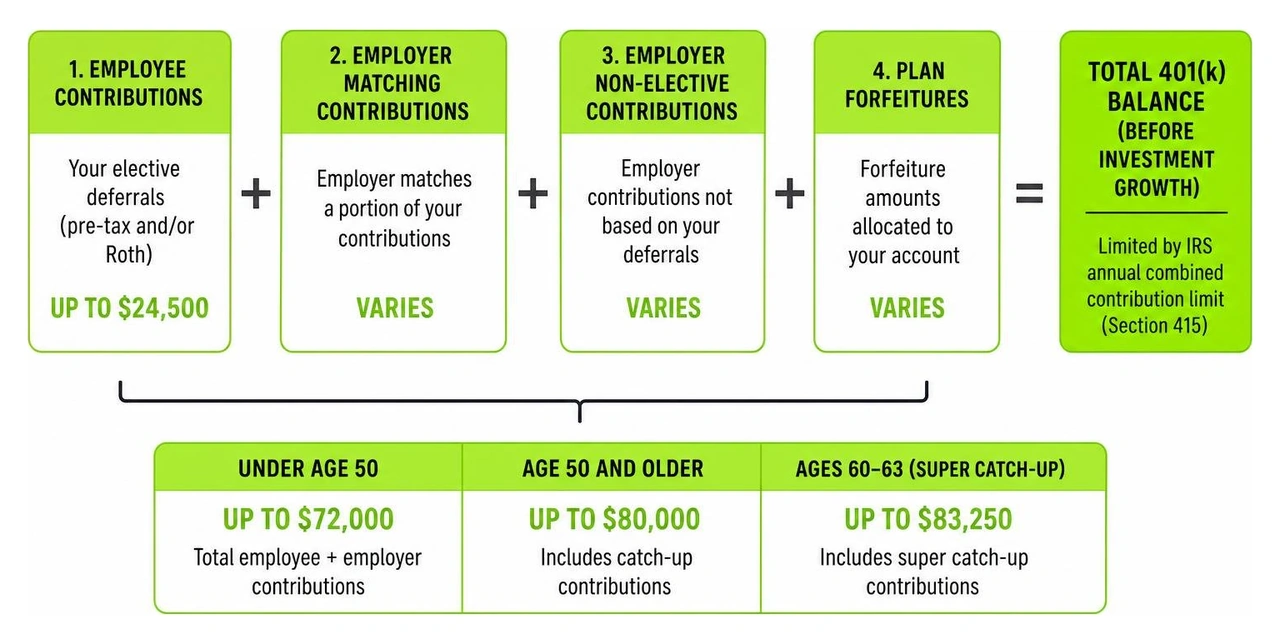
The combined limit includes your employee elective deferrals, employer matching contributions, employer non-elective contributions, and any plan forfeitures allocated to your account. For example, if you contribute the standard maximum of $24,500, your employer can contribute up to $47,500 in matching or profit-sharing contributions before hitting the $72,000 cap.
Understanding how these parts fit together is essential for maximizing your workplace benefits. You can explore how employer matching works alongside your personal goals by reading about the 401k Company Match Limit. For the official regulatory guidelines, you can also review the Retirement topics - 401(k) and profit-sharing plan contribution limits directly from the Internal Revenue Service.
New Secure 2.0 Rules for High Earners and Catch Up Contributions
The SECURE 2.0 Act introduced major changes to retirement planning, and one of the most critical updates takes effect in 2026. This rule specifically targets high-earning individuals who make catch-up contributions.
Starting in 2026, if your FICA wages from the previous calendar year exceeded $150,000, any catch-up contributions you make must be directed to a Roth 401k. This means you must fund these catch-up savings with after-tax dollars, rather than pre-tax dollars. The $150,000 threshold is based on your prior-year W-2 earnings, not your current-year income or your modified adjusted gross income.
This change represents a major shift because it prevents high earners from using catch-up contributions to lower their immediate taxable income. Furthermore, if your employer's retirement plan does not currently offer a Roth option, you will be completely barred from making any catch-up contributions until they add one.
Navigating these evolving regulations requires proactive tax management. If you are a high-performing professional or business owner, integrating these updates into your broader financial plan is vital. Discover how to optimize your overall plan by exploring our recommended Tax Planning Strategies.
What Happens If You Exceed the Annual Limits
With multiple limits to track, it is entirely possible to make a mistake and overcontribute to your retirement accounts. This most commonly happens when someone changes jobs mid-year. Because your new employer's payroll system does not know what you contributed at your previous job, it will not automatically stop your deductions when you hit the individual 401k max per year of $24,500.
If you contribute more than the allowed maximum, the IRS treats the excess amount as taxable income. If you do not correct the mistake quickly, you will face a double taxation penalty. This means you will pay income tax on the excess amount in the year you contributed it, and you will be taxed on it again when you eventually withdraw those funds in retirement.

To avoid this double tax penalty, you must notify your plan administrator as soon as you realize the error. You must request a corrective distribution of the excess deferral, along with any investment earnings associated with that excess money, before April 15 of the following year. Once the plan administrator returns the excess funds and issues a Form 1099-R, you can file your taxes accurately and keep your hard-earned money safe from unnecessary penalties.
Maximizing Your Retirement Savings Strategically
To build a secure financial future, you must look beyond the raw numbers and develop a strategic approach to your savings. Financial professionals often recommend aiming for a total retirement savings rate of at least 15% of your gross income, which can include both your personal contributions and your employer's match.
One of the most important rules of thumb is to always contribute at least enough to capture your employer's full matching contribution. Failing to do so is essentially leaving free money on the table.
You should also check if your workplace plan offers a true-up contribution. Some employers calculate their match on a pay-period basis. If you max out your 401k early in the year, you might miss out on matching contributions for the remaining months. A true-up feature ensures that the employer recalculates your match at the end of the year and deposits any missing funds into your account.
Strategic Ways to Hit Your 401k Max Per Year
If your goal is to reach the absolute 401k max per year, you can use several tactical methods to make the process seamless.
- Automate your savings by setting up a fixed percentage or dollar amount to be deducted from every paycheck.
- Utilize auto-escalation features, which automatically increase your contribution rate by 1% each year or whenever you receive a raise.
- Calculate your payroll deferrals precisely by dividing the $24,500 limit by the number of pay periods in the year to ensure you hit the cap exactly on your final paycheck.
- Avoid the front-loading match trap by pacing your contributions evenly throughout the year, unless you are certain your plan offers a year-end true-up.
By making small, systematic adjustments to your budget, you can gradually increase your savings rate without feeling a sudden squeeze on your monthly take-home pay.
Frequently Asked Questions About Retirement Limits
What is the maximum employee contribution for 2026
For the tax year 2026, the standard employee elective deferral limit is $24,500 for individuals under the age of 50. This limit applies to traditional pre-tax contributions, Roth contributions, or any combination of the two.
Can I contribute to both a traditional and a Roth 401k
Yes, you can split your contributions between a traditional pre-tax 401k and a post-tax Roth 401k if your employer's plan supports both options. However, your total combined contributions across both accounts cannot exceed the annual individual limit of $24,500 in 2026.
What happens if I overcontribute to my 401k
If you exceed the annual limit, you must request a corrective distribution of the excess amount and its earnings from your plan administrator before April 15 of the following year. If you fail to correct the overcontribution by this deadline, the excess funds will be subjected to double taxation.
Conclusion
Understanding the annual rules and limits of your retirement accounts is the foundation of long-term financial success. Whether you are aiming to hit the standard $24,500 limit, utilizing the enhanced catch-up caps, or navigating the new Roth requirements for high earners, staying informed helps you keep more of what you earn.
For creative entrepreneurs and small business owners, managing these rules alongside fluctuating business revenues can feel overwhelming. At Core Group, we specialize in helping creatives simplify their finances. Our no-fluff, profit-first playbook is designed to give you complete peace of mind and save you valuable time, allowing you to focus on your creative passion.
If you want to see how your retirement contributions impact your broader tax picture, learn more by reading our analysis on 401k and Magi. Let us help you build a clear, stress-free path toward your financial goals.