The No-Nonsense Guide to Bookkeeping and Payroll Services
Understanding Bookkeeping and Payroll Services
Bookkeeping and payroll services are two of the most essential financial functions any business needs to run smoothly. In short, bookkeeping tracks every dollar flowing in and out of your business, while payroll ensures your team gets paid accurately and on time, with the right taxes withheld.
Quick answer for busy readers
| Service | What It Does | Who Needs It |
|---|---|---|
| Bookkeeping | Records and organizes all financial transactions | Every business, from day one |
| Payroll | Calculates wages, files payroll taxes, and pays employees | Any business with employees or contractors |
| Both together | Gives you a complete financial picture and keeps you compliant | Growing businesses, especially those with multiple staff or locations |
You can handle these yourself, hire in-house staff, or outsource to a professional service. Most small and growing businesses find that outsourcing saves money and stress, since a full-time payroll administrator earns around $40,250 per year on average, and a payroll manager can exceed $75,000 annually.
If you're a creative entrepreneur, chances are your passion is your craft, not reconciling bank statements or calculating tax withholdings. That's completely normal. But ignoring the financial back office can quietly sink even the most talented studios and agencies.
This guide breaks down everything you need to know, from the difference between bookkeeping and payroll, to pricing, software, and how to pick the right financial partner for your business.
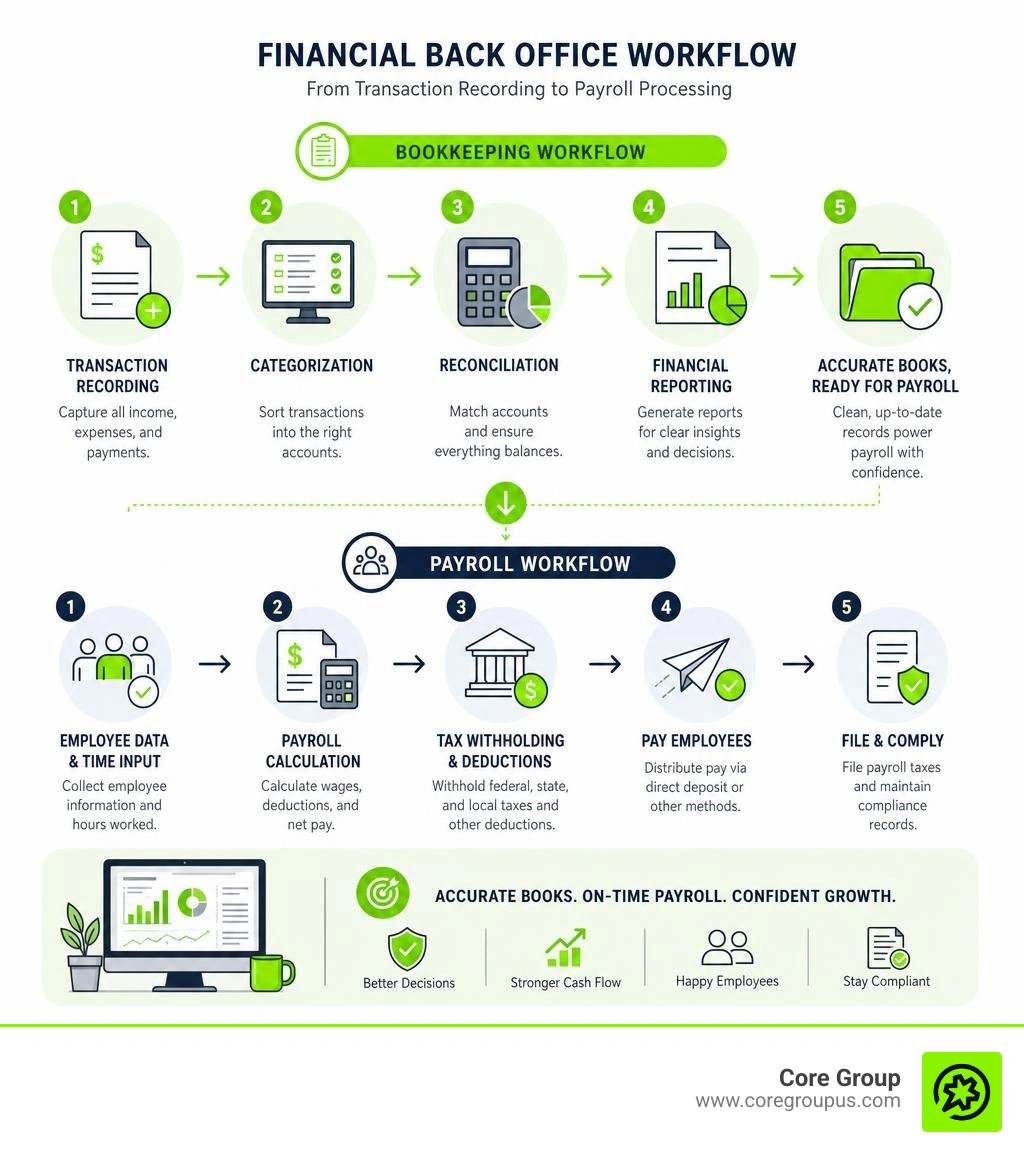
To keep your business financially healthy, you must understand how different back office functions support your growth. Many business owners lump bookkeeping, payroll, and accounting into one big bucket. However, they are distinct disciplines that handle different parts of your financial ecosystem.
When we look at the big picture, bookkeeping serves as the daily foundation. It is the systematic recording of every transaction that occurs within your business. Without accurate bookkeeping, you cannot have reliable accounting, and you certainly cannot make informed strategic decisions. To understand how these pieces fit together, you can read our guide on Bookkeeping and Financial Accounting.
| Financial Function | Primary Focus | Key Deliverables |
|---|---|---|
| Bookkeeping | Daily transaction recording and documentation | Reconciled bank accounts, organized receipts, and basic financial statements |
| Payroll | Employee and contractor compensation and compliance | Accurate paychecks, direct deposits, tax withholdings, and payroll tax filings |
By separating these roles, you ensure that your business has both a clear history of its spending and a reliable system for keeping your team happy.
Key Differences Between Bookkeeping and Payroll Services
While both services handle money, their core objectives are completely different. Bookkeeping is focused on documentation and categorization. It tracks the flow of funds from clients, vendors, utilities, and other business expenses. The ultimate goal of bookkeeping is to maintain an accurate general ledger that reflects the true financial state of the company.
Payroll is deeply transactional and highly regulated. It focuses specifically on calculating employee hours, processing wages, and managing tax withholdings. While bookkeeping looks at the entire financial landscape of your business, payroll zooms in on employee compensation. If you want a partner who can manage these systems seamlessly under one roof, you can explore our approach to Core Group Financial Management.
Typical Tasks Included in Bookkeeping
A professional bookkeeper keeps your financial house in order. They act as the daily guardians of your cash flow. Their routine responsibilities include reconciling bank accounts and credit cards to ensure your software matches your bank statements. They also manage accounts payable, which means organizing and paying vendor bills on time.
Additionally, bookkeepers handle accounts receivable by generating invoices and tracking down late payments from clients. At the end of each month, they compile financial statements like profit and loss reports and balance sheets. For a deeper look at what to expect from these services, check out our Bookkeeping Services Complete Guide.
Typical Tasks Included in Payroll
Payroll administrators handle the precise calculations required to pay your team. This involves setting up direct deposits and calculating gross wages, net pay, and voluntary deductions like health insurance or retirement contributions. They also manage the crucial task of tax withholding, ensuring that federal, state, and local taxes are accurately deducted from each paycheck.
Beyond the weekly or bi-weekly pay run, payroll services handle employee onboarding paperwork, track paid time off, and manage year-end tax reporting. To learn more about setting up these workflows, read our Payroll Services Small Business Guide.
Why Outsourcing Bookkeeping and Payroll Services Makes Sense for Growing Businesses
As a business grows, the administrative burden grows with it. Many founders start out managing their own books on weekends, but this quickly becomes a bottleneck. Outsourcing these tasks to experts allows you to reduce overhead, eliminate administrative errors, and scale your operations without hiring expensive in-house staff.

When you delegate these routine tasks, you free up valuable hours to focus on what you do best, whether that is designing beautiful spaces, building software, or serving clients. To see how other businesses scale their back office, you can review our insights on Outsourced Accounting Firms.
Financial Benefits and Cost Savings
Hiring full-time employees is expensive. In the financial sector, a payroll administrator earns an average salary of forty thousand two hundred fifty dollars per year, and experienced payroll managers often command salaries exceeding seventy five thousand dollars annually. When you add the cost of benefits, office space, and software licenses, the true cost of an in-house employee is much higher.
Outsourcing allows you to access top-tier talent at a fraction of the cost. You only pay for the services you actually need, whether that is a few hours of support each week or a comprehensive monthly package. To understand the typical investment required, you can consult our Bookkeeping Services Rates Guide 2026.
Tax Compliance and Regulatory Peace of Mind
The IRS and state tax agencies do not look kindly on administrative mistakes. Payroll tax compliance is notoriously complex, with rules that change frequently. A single late filing or incorrect tax withholding can result in steep penalties that drain your hard-earned profits.
Outsourced financial partners stay up to date on all federal and state tax laws. They ensure that your payroll tax deposits are made on time and that your quarterly filings are perfectly accurate. This proactive management keeps the tax collectors happy and gives you complete peace of mind. For more details on staying compliant, read our guide on Payroll Tax Compliance.
Support for Multi State and Multi Location Operations
In today's remote-first world, many businesses hire talent across state lines. While this opens up a massive pool of talent, it also creates a compliance nightmare. Every state has its own rules regarding payroll taxes, worker classification, and local withholdings.
An experienced payroll provider handles state registrations, manages remote hiring paperwork, and ensures that you comply with local labor laws in every jurisdiction where your team operates. If you are managing a distributed team, you will find useful strategies in our article on SME Payroll Solutions.
Comparing Bookkeeping Accounting and Fractional CFO Services
As your business matures, your financial needs will evolve. While bookkeeping and payroll keep the lights on, you will eventually need higher-level insights to drive your business forward. Understanding the difference between basic bookkeeping, full-service accounting, and fractional CFO services will help you hire the right level of support at the right time.
Each tier of financial service serves a unique purpose in your growth journey. For a comprehensive look at how we structure these services, you can visit Core Group Accounting Services.
Basic Bookkeeping Versus Full Service Accounting
Basic bookkeeping is historical. It records what has already happened in your business by tracking transactions, organizing receipts, and reconciling accounts. Accounting, on the other hand, is analytical.
An accountant takes the clean financial data provided by your bookkeeper and interprets it. They help with tax planning, analyze profitability, and ensure that your financial practices align with generally accepted accounting principles. To determine which level of service your business currently requires, read our Bookkeeping Small Business Guide 2026.
The Role of Fractional CFO Services
A fractional CFO, or Chief Financial Officer, is forward-looking. Instead of focusing on past transactions, they help you design your financial future. They provide strategic services such as cash flow forecasting, budgeting, KPI dashboards, and investor relations support.
If you are planning to raise capital, expand to new locations, or prepare your business for an exit, a fractional CFO provides the strategic roadmap you need. To explore how bookkeeping lays the groundwork for these advanced services, you can check out Core Group Bookkeeping Services.
Software Integrations Pricing and Special Requirements
Modern financial management relies heavily on technology. By integrating your financial systems, you can eliminate manual data entry, reduce human error, and get real-time visibility into your cash flow.
Choosing the right software stack and understanding the pricing models of your service providers will ensure that you get the best value for your investment. For a detailed breakdown of the top tools in the industry, read our guide on Bookkeeping Software.
Integrating with QuickBooks Xero and NetSuite
The best financial service providers do not work in isolation. They integrate seamlessly with your existing cloud accounting platforms, such as QuickBooks, Xero, or NetSuite.
These integrations allow your bank feeds, sales platforms, and payroll systems to communicate automatically. This means fewer spreadsheets, faster monthly closings, and instant access to your financial statements. To learn more about optimizing your software setup, explore our guide on Computerized Accounting Packages.
Understanding Pricing Models and Cost Considerations
When shopping for financial services, you will encounter several different pricing structures. Some providers charge hourly rates, while others offer flat monthly subscription packages based on your business volume or revenue.
For simple data entry tasks, wholesale rates can start as low as ten dollars per hour, but comprehensive, expert-led packages will require a larger investment. Finding a provider with transparent, predictable pricing helps you avoid surprise bills at the end of the month. To see how we structure our pricing, you can visit Core Group Payroll Solutions.
Handling Special Requirements Like Union Payroll and Ten Ninety Nine Filing
Not all payroll runs are created equal. If you work in construction, entertainment, or other industries with union contracts, you have to navigate complex wage scales, benefit allocations, and reporting requirements.
Similarly, businesses that rely on independent contractors must manage annual 1099 filings and track state-specific sales tax compliance. Your financial partner must have the specialized expertise to handle these unique scenarios. For a closer look at managing these complex tax landscapes, check out Bookkeeping and Tax Services New York.
How to Choose the Right Financial Partner
Selecting a bookkeeping and payroll provider is one of the most critical decisions you will make for your business. The right partner will feel like an extension of your team, while the wrong one can leave your books in a mess and expose you to tax penalties.
You want to look for a provider that understands your industry, communicates clearly, and uses modern technology to streamline your workflows. To learn more about our comprehensive service offerings, you can visit Core Group Financial Services.
Selecting the Best Bookkeeping and Payroll Services for Your Business
When evaluating potential providers, ask about their experience with businesses of your size and industry. Creative businesses, for example, have unique cash flow cycles and project-based accounting needs that generalist bookkeepers might not understand.
Look for a partner who offers platform-agnostic support, meaning they can work within your preferred software rather than forcing you into a proprietary system. Finally, ensure they offer response time guarantees so you are never left hanging when you have an urgent question. For more tips on choosing a provider, read our guide on Expert Bookkeeping Services.
Frequently Asked Questions about Financial Management
Managing your business finances can raise a lot of questions. We have compiled answers to some of the most common queries we hear from business owners. If you want to dive deeper into payroll management strategies, check out Core Group Payroll Management.
Can a virtual bookkeeper handle payroll
Yes, many virtual bookkeepers are fully equipped to handle your payroll needs. They can manage the entire cycle, including calculating wages, setting up direct deposits, tracking employee benefits, and filing payroll taxes.
By having the same partner manage both your books and your payroll, you ensure that your financial records are always perfectly in sync. To explore how virtual teams operate, read our guide on Virtual Bookkeeping Companies.
How much do bookkeeping and payroll services cost
The cost of these services varies widely depending on the size of your business, the complexity of your transactions, and the frequency of your reporting. Basic bookkeeping packages can start around seventy five dollars per month for very small operations, while comprehensive, full-service packages for growing businesses can range from several hundred to several thousand dollars per month.
Investing in professional support usually pays for itself by preventing costly tax errors and freeing up your time to generate revenue. To get a customized quote for your business, you can visit Core Group Bookkeeping and Payroll.
What is the difference between bookkeeping and accounting
Bookkeeping is the administrative process of recording and organizing daily financial transactions. Accounting is the analytical process of interpreting that data to help you make strategic business decisions, plan for taxes, and understand your overall financial health.
Both are essential, but they serve different purposes in your business. To learn more about how to leverage both functions, check out Core Group Outsourced Bookkeeping.
Conclusion
Managing your financial back office does not have to be a source of constant stress. By partnering with the right team, you can keep your books clean, your employees paid, and your business compliant with all tax regulations.
At Core Group, we specialize in providing tailored financial management, bookkeeping, and tax services for creative entrepreneurs. We understand that you want to spend your time creating, not wrestling with spreadsheets. That is why we offer our signature no-fluff, profit-first playbook, which is designed to save you time and guarantee total peace of mind.
We are so confident in our ability to streamline your financial systems that we back our services with our unique MacBook Pro guarantee. If you are ready to take control of your finances and scale your business with confidence, we are here to help.
Get started with the Payroll Services Small Business Guide 2026 today to build a stronger financial foundation for your business.