Everything Videographers Can Write Off This Year
What You Can Actually Write Off as a Videographer
Business expenses for videographers cover a wide range of costs — and knowing which ones are tax-deductible can make a serious difference to your bottom line.
Here are the main categories of deductible business expenses for videographers:
| Expense Category | Examples |
|---|---|
| Equipment and gear | Cameras, lenses, lighting, tripods, sound gear |
| Software and subscriptions | Adobe Creative Cloud, editing tools, cloud storage |
| Production costs | Studio rent, crew wages, stock footage, music licensing |
| Travel | Mileage, flights, accommodation for shoots |
| Marketing | Website, business cards, social media, promotional videos |
| Home office | Rent/mortgage portion, utilities, internet |
| Education | Workshops, courses, professional memberships |
| Financial fees | PayPal/Stripe processing fees, bank charges |
The IRS requires that every deduction be ordinary (common in your industry) and necessary (helpful for running your business). Most of the day-to-day costs of running a video business meet that bar — but only if you track them properly.
Whether you're a freelance videographer charging $600–$1,200 per shoot day or running a full production company, tax deductions reduce your taxable income dollar for dollar. That means more money stays in your pocket — not the IRS's.
This guide walks through every major deduction category so you don't leave money on the table this tax year.
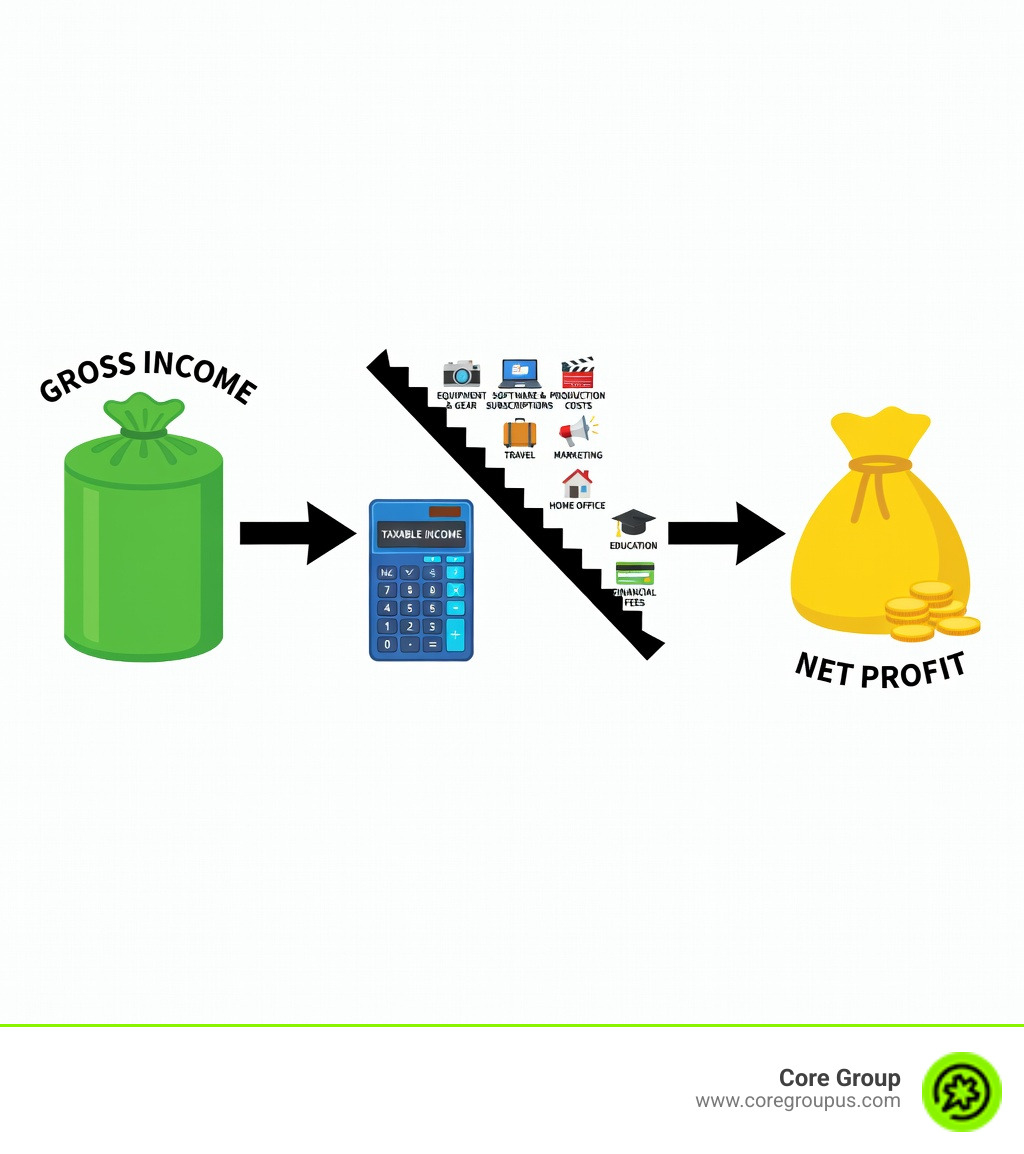
Common Business Expenses for Videographers
When we talk about taxes, the golden rule comes from the IRS: business expenses must be ordinary and necessary. But what does that actually mean for us in the video world?
An ordinary expense is one that is common and accepted in the film and video industry. For example, buying a gimbal or paying for a location permit is ordinary for a videographer, whereas buying a commercial-grade pizza oven probably isn't. A necessary expense is one that is helpful and appropriate for your trade. It doesn't have to be indispensable, but it does need to serve a clear business purpose.
At Core Group, we work with many Videographers who struggle to distinguish between a "hobby" and a "business." To the IRS, the difference lies in your profit motive. If you’ve turned a profit in three out of the last five years, the IRS generally presumes you are running a business. If you’re just starting out, you can still claim deductions, but you must demonstrate that you are operating in a professional manner—think separate bank accounts, active marketing, and accurate record-keeping.
One of the most powerful tools in your tax arsenal is deducting marketing and advertising costs. This includes everything from the Facebook ads you run to find new wedding clients to the high-end "sizzle reel" you produced to showcase your skills. Since video production is a primary tool for marketing in the modern age, these costs are generally 100% deductible.
Equipment and Gear Deductions

Equipment is usually the biggest hurdle for any video professional. Starting a basic production set can easily cost $10,000 or more when you factor in cameras, lenses, and lighting. The good news is that the tax code offers several ways to recoup these costs.
When you Finance Camera Equipment, you aren't just paying for gear; you're creating a paper trail for deductions. For high-ticket items like a Red or an Arri, you generally have two choices: Depreciation or the Section 179 Deduction.
Traditional depreciation spreads the cost of the equipment over its "useful life" (usually five years for cameras and computers). However, the Section 179 Deduction allows you to deduct the full purchase price of qualifying equipment in the year you buy it. This is a massive win if you’ve had a high-income year and need to lower your tax bracket quickly.
| Feature | Section 179 Expensing | Traditional Depreciation |
|---|---|---|
| Timing | Full deduction in year one | Spread over 5–7 years |
| Best For | High-profit years | Long-term steady growth |
| Limit | Adjusted for inflation (2026) | No specific dollar limit |
| Usage Requirement | Must be used >50% for business | Any business use percentage |
Don't forget the "small" stuff. Items like gaffer tape, ND filters, memory cards, and batteries might seem insignificant, but they add up. These are typically treated as "supplies" rather than capital assets, meaning you write them off entirely in the year you buy them.
Production Costs and Software Subscriptions
Your business doesn't stop once the "Record" button is hit. The post-production phase is loaded with business expenses for videographers.
First, let's talk software. Your Adobe Creative Cloud subscription is a textbook example of a deductible expense. Whether you pay monthly or annually, every penny is a write-off. This applies to other tools as well, like DaVinci Resolve Studio, Frame.io, or specialized plugins.
There are also many Filmmaker Tax Deductions associated with the physical act of production:
- Studio Rent: If you lease a space for filming or editing, the rent and utilities are fully deductible.
- Crew Wages: Payments to second shooters, sound mixers, or PAs are deductible. Just remember to handle the paperwork correctly (more on that later).
- Assets: Stock footage, music licensing fees (like Epidemic Sound or Artlist), and even hard drives are necessary costs of doing business.
- Digital Storage: In an era of 4K and 8K video, we all need massive amounts of space. Subscriptions for Onedrive, Google Drive, or Dropbox are all fair game for deductions.
Travel and Marketing Business Expenses for Videographers
Whether you’re driving across town for a corporate shoot or flying to a destination wedding, travel expenses are a major part of the job.
The IRS offers two ways to handle vehicle expenses: the standard mileage rate or actual expenses. For 2026, the IRS standard mileage rate provides a simple way to calculate your deduction based on business miles driven. If you choose actual expenses, you can deduct a percentage of your gas, insurance, and repairs based on how much you use the car for business. Most of our clients find that using a mileage tracking app is much easier than hoarding gas receipts.
When it comes to IRS travel expense rules, you can also deduct:
- Airfare and Lodging: If you are traveling away from your "tax home" for a shoot or a conference.
- Client Meals: You can generally deduct 50% of the cost of meals with clients or crew, provided there is a clear business discussion involved.
- Industry Events: Tickets and travel for festivals or trade shows like SXSW or NAB are deductible as professional development and networking.
Marketing doesn't just happen at festivals, though. Your online presence—including website hosting, domain names, and social media ad spend—is a vital business expense. Even the cost of business cards (which, surprisingly, still rank high as an "unsung" deduction) can be written off.
Deducting Home Office and Education Business Expenses for Videographers
If you edit your footage in a dedicated room at home, you may qualify for the Home office deduction. The key here is exclusive use. Your editing suite can't also be the guest bedroom or the kids' playroom.
You can use the "Safe Harbor" method, which allows you to deduct $5 per square foot (up to 300 square feet), or the actual expense method, where you deduct a percentage of your rent, mortgage interest, and utilities. Along with the space itself, don't forget the Business Phone Deduction. If you use your cell phone for client calls and coordination, you can deduct the business portion of your monthly bill.
Education is another area where videographers often miss out. The industry moves fast, and staying relevant is a business necessity. Deductible items include:
- Workshops and Courses: Whether it’s an online color grading masterclass or an in-person cinematography workshop.
- Professional Memberships: Dues for organizations like the Guild or local film commissions.
- Research Subscriptions: This is a "pro tip" for many. If you need to stay current on industry trends or research specific styles, subscriptions to IMDB Pro or even streaming services (if used for research) can be partially deductible.
Financial Management and Record Keeping
You can have all the deductions in the world, but if you can't prove them, they won't help you during an audit. This is where a solid Bookkeeping for Creatives Complete Guide becomes your best friend.
Many videographers overlook the "hidden" costs of doing business. For example, every time a client pays you via credit card, you’re likely losing about 3% to fees. These payment processing charges from platforms like Stripe or PayPal are fully deductible. The same goes for monthly bank fees or interest on business loans.
To keep things organized, we highly recommend using professional tools. Integrating Quickbooks with your bank account allows you to categorize expenses in real-time. If you use Square for invoicing, you can easily track which payments have come in and what fees were taken out.
For those running a solo operation, Bookkeeping for Solopreneurs is all about simplicity. The goal is to separate your personal life from your business life completely. Use a dedicated business credit card for every lens, hard drive, and coffee meeting. This makes tax time a breeze and provides a layer of audit protection that is invaluable.
Frequently Asked Questions about Videography Tax Deductions
Can I deduct my Netflix or streaming subscriptions?
This is a common question. The answer is: it depends. If you are using these services to research specific directing styles, camera techniques, or industry trends for a project you are working on, you can justify a portion of the cost as a business expense. However, you must document how this research directly benefits your business. You can't simply write off your entire entertainment budget; usually, a percentage based on business vs. personal use is the safest bet.
What is the difference between a hobby and a business?
The IRS looks at several factors, but the primary one is the "profit presumption." If you show a profit in three out of five years, you're generally considered a business. Other factors include whether you carry out the activity in a businesslike manner (keeping clean books), the time and effort you put into it, and whether you depend on the income for your livelihood. Transitioning from a hobbyist to a pro means getting serious about your documentation.
How do I handle payments to freelance crew members?
When you hire a crew, you are responsible for more than just writing a check. If you pay a contractor $600 or more in a year, you generally need to issue them a Form 1099-NEC. Understanding HR and Payroll for Small Business is crucial here. Misclassifying an employee as a contractor can lead to hefty fines, so it’s always best to consult with a professional to ensure your crew paperwork is airtight.
Conclusion
Navigating business expenses for videographers doesn't have to be a nightmare. By staying organized and understanding what the IRS considers "ordinary and necessary," you can significantly reduce your tax bill and reinvest that money back into your craft.
At Core Group, we specialize in helping creative entrepreneurs like you take control of their finances. Our "no-fluff, profit-first playbook" is designed to give you peace of mind, so you can stop worrying about spreadsheets and get back behind the lens. We’re so confident in our ability to streamline your business that we even offer a MacBook Pro guarantee to our clients.
Ready to stop overpaying the IRS and start growing your production company? Check out our More info about photographer and videographer services to see how we can help you achieve financial peace this year.