Seeing a Negative Balance on IRS Code 806? Here is Why You Should Celebrate
Seeing a Negative Amount Next to IRS Code 806? Here Is What It Actually Means
If you have pulled up your IRS account transcript and spotted a code 806 IRS with negative amount next to it, here is the short answer you need right now. You can access your transcript directly through the official IRS website to verify these details.
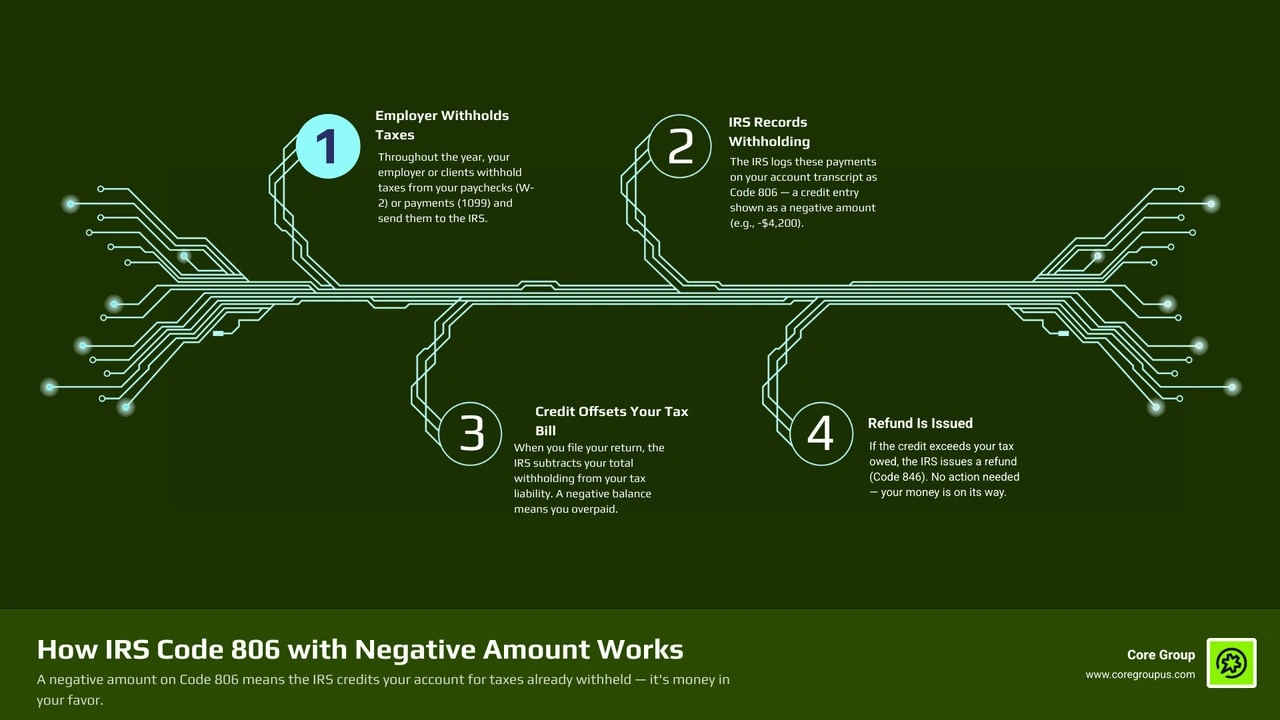
A negative amount on Code 806 is good news. It means the IRS has credited your account for taxes already withheld from your paychecks, W-2s, or 1099s throughout the year. You are not being charged. The IRS owes you that amount against your tax bill.
Here is a quick breakdown.
| What you see on your transcript | What it actually means |
|---|---|
| Code 806 with a negative amount | Withholding taxes credited to your account |
| Negative number (e.g. -$4,200) | Money in your favor, reducing what you owe |
| Positive number | Amount owed to the IRS |
In IRS accounting, negative means credit. It is the opposite of how most bank statements work, which is exactly why so many people panic when they see it.
Many creative entrepreneurs and freelancers see this code and immediately worry something went wrong. It has not. Your employer or clients withheld taxes from your pay, sent that money to the IRS all year long, and Code 806 is simply the IRS confirming it received those funds.
I am Christian Brim, and in this guide I will walk you through exactly what this code means, how it affects your refund, and when you actually do need to pay closer attention to it.
Learn more about code 806 irs with negative amount below.
Understanding the Code 806 IRS with Negative Amount on Your Transcript
When you log into the IRS portal to check on your refund, downloading your Account Transcript can feel like reading a foreign language. The IRS uses a complex network of numbers called transaction codes to track every single action on your tax return.
Among these, the tax code 806 is one of the most common codes you will encounter. It represents the total amount of federal income tax withheld from your income. This includes money taken out of your regular paychecks, your freelance gigs, and even any excess social security taxes you paid if you worked multiple jobs.
In the standard accounting system used by the IRS, any negative number is actually a credit to your account. Unlike your personal bank account where a negative balance means you are overdrawn, the IRS Master File system treats a negative number as money already paid in your favor. When you see the code 806 IRS with negative amount listed on your transcript, it means the IRS has successfully logged the taxes you paid throughout the year and is ready to apply them to your total tax bill.
Why Does the Code 806 IRS with Negative Amount Appear
The main reason this transaction code appears on your transcript is to verify your withholding credits. Every time an employer sends in your W-2 information, or a client files a Form 1099 showing backup withholding, those amounts are tracked under this transaction code.
For creative entrepreneurs who juggle multiple clients, this code is incredibly important. You might have several different sources of income, and keeping track of all those micro-withholdings can be a massive headache. When the IRS processes your Form 1040, they pool all of these withholdings together.
The resulting sum is placed right next to Code 806 as a negative amount. This indicates that the money has already been sent to the government by your employers or clients, and it is officially credited to your tax module. It also accounts for any excess Federal Insurance Contributions Act, or FICA, withholding. If you worked multiple jobs and your combined earnings exceeded the social security wage limit, you likely overpaid your FICA taxes. The IRS automatically converts that overpayment into a credit under Code 806.
How to Calculate Your Refund Using the Code 806 IRS with Negative Amount
If you want to figure out your exact refund before the IRS officially issues it, you can use the numbers on your transcript to do some simple math. You will need to look at three main numbers on your document.
First, locate Code 150, which shows your total tax liability for the year. This is a positive number because it represents what you technically owe the government based on your income.
Next, find all the codes that represent credits. This includes the tax code 806 with negative balance and other tax credit codes like Code 766 or Code 768.
To find your estimated refund, add all of your negative credit amounts together, then subtract the positive tax liability from Code 150. If the resulting number is negative, that is the exact refund amount you should expect to receive.
| Transcript Code | Transaction Type | Number Format | Impact on Refund |
|---|---|---|---|
| Code 150 | Tax Assessed | Positive | Decreases your refund |
| Code 806 | Withholding Credit | Negative | Increases your refund |
| Code 766 | Tax Credits Applied | Negative | Increases your refund |
| Code 768 | Earned Income Credit | Negative | Increases your refund |
Let us look at a quick example. If your Code 150 tax liability is $3,000, and your Code 806 withholding is -$5,000, you have a credit balance of -$2,000. If you also have a Code 766 credit of -$1,000, your total credit balance becomes -$3,000. This means you are owed a $3,000 refund.
How Code 806 Interacts with Other Common Transcript Codes
Your tax transcript tells a chronological story of how your tax return is processed. Code 806 does not exist in a vacuum. It works alongside several other transaction codes to show the IRS progress on your file. If you want to understand when your refund will arrive, you need to understand how these codes interact.
You can read more about these relationships in our guide on irs code 150 806 and 570.
The Role of Code 150 and Code 846
The journey of your tax return begins when the IRS processes your paperwork and posts Code 150. This code simply means your tax return has been officially filed and your tax liability has been calculated. Many taxpayers panic when they see Code 150 because it shows a positive dollar amount, thinking they suddenly owe money. However, this is just the baseline tax assessment before any credits are applied.
Once Code 150 is established, the IRS applies your Code 806 withholding credits and any other tax credits to offset that liability. If your credits are larger than your liability, the system prepares to send you a refund.
The final step in this process is Code 846. When you see Code 846 on your transcript, it means your refund has been officially approved and issued. The date listed next to Code 846 is the day the IRS plans to deposit the money into your account or mail your check. You can find more details about this in our article on 846 refund issued.
Understanding Code 766 and Code 768
While Code 806 represents the money that was directly withheld from your earnings, you might also qualify for other types of credits. These are represented by Code 766 and Code 768.
Code 766 represents refundable tax credits, such as the Child Tax Credit or education credits. You can learn more about how this works by reading about irs code 766.
Code 768 represents the Earned Income Tax Credit. Both of these codes will appear as negative numbers on your transcript because they increase your total credit balance.
If you claim the Earned Income Tax Credit under Code 768, your refund will be subject to the PATH Act. This federal law prevents the IRS from issuing refunds on returns claiming these credits before mid-February, even if your Code 806 withholding credits have already been verified and processed.
Troubleshooting Discrepancies and Delays with Your Withholding Credit
For most taxpayers, the amount listed next to Code 806 matches their tax return perfectly. However, discrepancies can occur, and they can cause significant delays in your refund processing. If the IRS system detects a mismatch between what you claimed and what your employers reported, your return may be flagged for manual review.
What to Do If Your Withholding Does Not Match
If you notice that the negative amount next to Code 806 does not match the total federal income tax withholding listed on your W-2 or 1099 forms, you need to investigate. This mismatch usually happens for one of three reasons.
First, an employer or client may have filed a corrected form that you did not receive. Second, the IRS may not have processed all of your W-2 or 1099 forms yet, especially if you filed early in the season. Third, there might have been a simple data entry error when you filed your return.
To resolve this, start by gathering all of your physical W-2 and 1099 documents. Add up the amounts in Box 2 of your W-2s and Box 4 of your 1099s. If your calculations match your tax return but not the transcript, the IRS may still be processing some of your documents.
In this scenario, it is best to wait for the IRS to update your file or send you an official notice. For a deeper look at what this code means during filing, check out our resource on what does code 806 mean on irs transcript.
When to Check Your IRS Cycle Code
If your refund is taking longer than expected, you should look at your IRS cycle code. This is an eight-digit number listed next to Code 150 on your transcript. The cycle code tells you exactly when your return was processed within the IRS calendar.
The cycle code can help you determine if your account is updated weekly or daily. If your cycle code ends in 05, your account is processed on a weekly cycle, meaning your transcript will only update once a week, usually on Friday mornings. If it ends in 01, 02, 03, or 04, your account is on a daily cycle.
Understanding this cycle can save you from checking your transcript multiple times a day. For a complete breakdown of how to read these codes, you can read our irs cycle code complete guide, learn what is an irs cycle code, or explore how to track your cycle code irs.
Frequently Asked Questions about IRS Transcript Codes
Is a Negative Amount on Code 806 Always a Good Sign
Yes, seeing a negative amount next to Code 806 is almost always a positive sign. It is the official confirmation from the IRS that they have credited your account for the taxes you paid throughout the year. It shows that your withholdings have been recorded and are being used to reduce your tax liability.
However, the only time it could lead to an issue is if the amount is incorrect. If you accidentally claimed more withholding than you actually paid, the IRS will eventually catch the error during their reconciliation process. This can lead to a freeze on your account while they verify the details. You can read more about this in our article on the irs code 806 meaning.
What to Do If You See Code 806 But No Refund Has Been Issued
If you see Code 806 with a healthy negative amount but Code 846 has not appeared, your return is still in the processing pipeline. The IRS may be verifying your identity, checking for matching W-2 documents, or processing other parts of your return.
If you also see Code 570 on your transcript, it means there is a temporary hold on your account. The IRS uses this freeze to review discrepancies, often related to withholding amounts or tax credits. In most cases, you do not need to do anything. The IRS will either resolve the issue on their own and lift the hold, or they will send you a letter requesting more information.
Can a Negative Code 806 Amount Indicate an Error by the IRS
While rare, the IRS can make mistakes when processing your return. If they adjust your withholding credits during their review, you might see an adjustment code on your transcript.
One code to watch out for is Code 290, which represents an additional tax assessment. If the IRS believes your Code 806 withholding was over-reported, they might use Code 290 to adjust your tax liability and reduce your refund. You can learn more about this by reading our guide on 290 additional tax assessed.
Conclusion
Understanding your tax transcript is the first step toward taking control of your financial life. When you see a code 806 IRS with negative amount, you can rest easy knowing that your hard-earned money has been successfully credited to your account.
For creative entrepreneurs, managing taxes, bookkeeping, and cash flow can feel like a distraction from your actual passion. At Core Group, we specialize in helping creative business owners navigate the complexities of tax planning and business growth. We use a no-fluff, profit-first playbook that guarantees peace of mind and saves you valuable time, all backed by our MacBook Pro guarantee.
If you want to stop stressing over IRS transcript codes and start focusing on growing your creative business, we are here to help. You can learn more about how we can support your business by reading our detailed breakdown of the irs code 806 meaning. Let us handle the numbers so you can focus on your craft.