Payroll for SMB: A Painless Guide to Paying Your People
Why Getting Payroll Right Can Make or Break Your Small Business
Payroll for SMB owners is one of those tasks that sounds simple until you're actually doing it, which includes calculating withholdings, tracking hours, filing quarterly taxes, and making sure everyone gets paid correctly and on time.
Here is a quick summary of what you need to know
- What it is - Payroll for small businesses covers calculating wages, withholding taxes, filing with federal and state agencies, and distributing pay to employees or contractors
- Why it matters - The IRS fines 40% of small businesses every year for payroll tax errors, with an average penalty of $845 per mistake
- Main options - Do it yourself manually, use payroll software, or outsource to a full-service provider
- Typical cost - Most software starts at $20 to $55 per month plus $4 to $8 per employee
- Biggest benefit - Automation handles tax filings, direct deposit, and compliance so you can focus on your actual work
If you run a creative business, you already know the feeling. You built something you love, and then payroll shows up on your to-do list like an uninvited guest who speaks only in IRS forms and tax deadlines.
The good news is that modern payroll tools have made this much less painful. The hard part is knowing which option fits your business and budget.
This guide walks you through everything you need to make a confident decision.
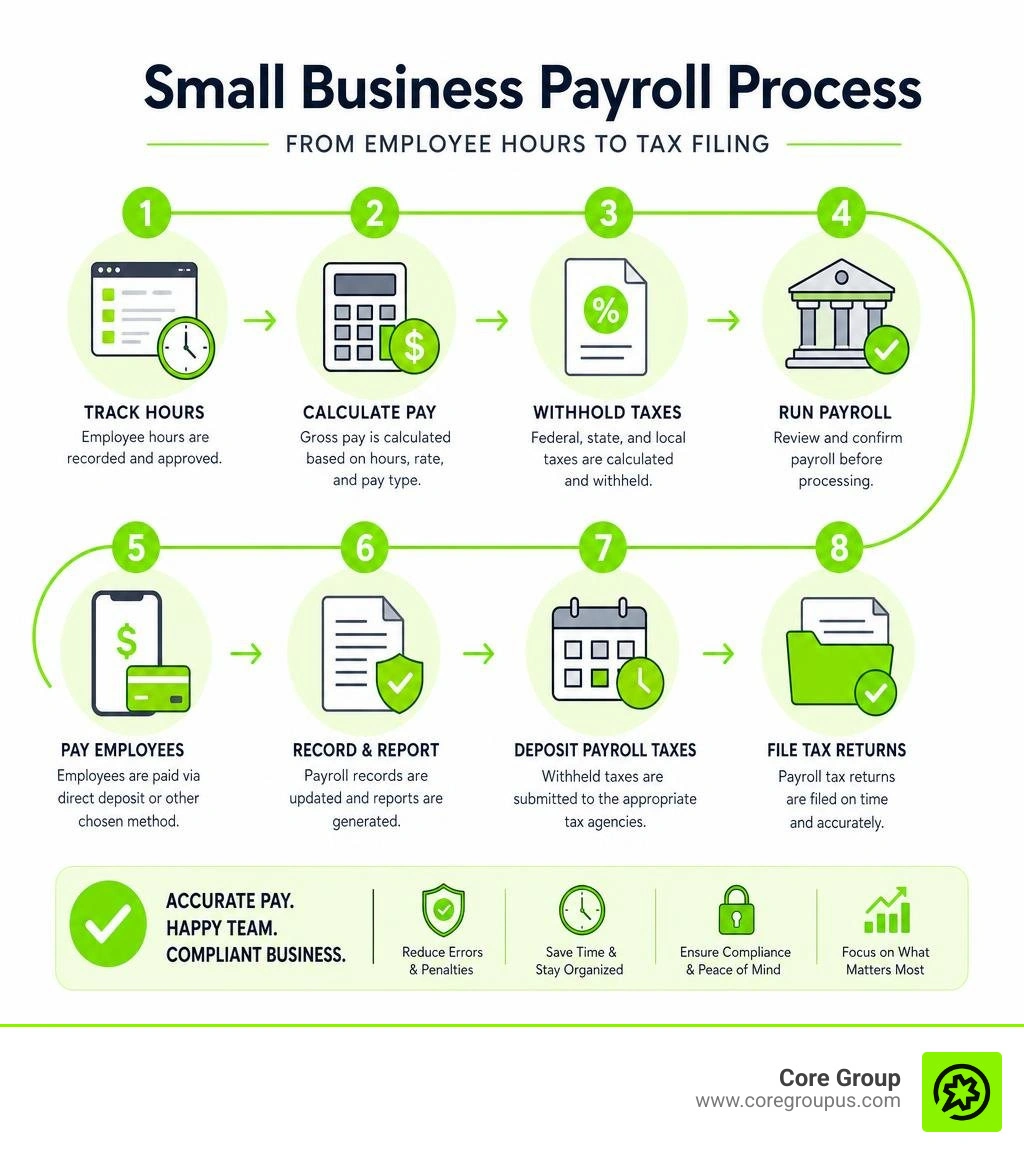
Payroll for smb terms made easy
The Essentials of payroll for smb and Why It Matters
When we talk about managing compensation, we are looking at the financial heartbeat of your company. Your team works hard to bring your creative vision to life, and paying them accurately is the foundation of trust. Beyond keeping your team happy, setting up a reliable system keeps regulatory agencies at bay.
The concept of payroll for smb involves calculating gross wages, subtracting the correct taxes, managing withholdings for benefits, and distributing the final funds. Many modern businesses use electronic distribution to simplify this process. If you want to dive deeper into how online systems work, check out our Online Payroll Guide Small Business 2026.

To keep your business running smoothly, you need to understand the difference between employees and independent contractors. Employees require you to withhold federal, state, and local taxes, and pay payroll taxes like FICA. Contractors handle their own taxes, but you still need to track their payments and file annual forms. Making a mistake in this classification can lead to heavy fines.
When you partner with a professional service, you can rest easy knowing these details are handled. For creative teams looking to streamline their operations, exploring Core Group Small Business Services is a great first step to regain your peace of mind.
Key Features to Look For in Small Business Payroll Software
Choosing the right platform can feel overwhelming with so many options on the market. The best software acts as an automated assistant that runs in the background. When evaluating different platforms, look for systems that integrate your workflows and scale as your team grows. If you are starting your search, our Payroll Services Small Business Guide offers a great roadmap.

The right platform should connect with your accounting software to avoid manual data entry. It should also support multi-state payroll if you have remote team members in different parts of the country. Let us look at the most critical features you should prioritize.
Automated Tax Calculations and Compliance
The most important feature of any system is automated tax management. Every time you run payroll, the software must calculate federal withholdings, FICA taxes, and state-specific taxes. It should also handle your quarterly filings and year-end forms automatically.
Staying compliant is a major challenge because tax rules change constantly. Utilizing a dedicated platform helps you maintain Payroll Tax Compliance without spending hours reading tax codes. This automation protects your business from penalties and gives you hours of your time back every month.
Employee Self Service and HR Tools
A great payroll platform benefits your employees just as much as it benefits you. Modern systems include a self-service portal where team members can download their own paystubs and tax forms. This means they do not have to email you every time they need to verify their income for a loan.
Many platforms also combine payroll with onboarding tools and benefits administration. When you hire a new team member, they can enter their own direct deposit details and sign tax forms digitally. If you want to explore how these features work together, read our guide on HR and Payroll for Small Business.
The Challenges of Managing Payroll In House
Many business owners start out trying to run payroll themselves using spreadsheets. While this might work when you only have one or two team members, it quickly becomes a massive headache as you hire more people.
The biggest risk of manual management is the high rate of errors. IRS statistics show that 40% of small businesses face payroll-related fines every year. These penalties average $845 per year, which often costs more than a software subscription. Manual payroll is also incredibly time-consuming, pulling you away from the creative work that actually generates revenue.
If you are currently running a very small operation, you might want to look into Micro Business Payroll solutions that keep things simple. For growing teams, outsourcing this administrative burden to Core Group Payroll Solutions allows you to focus entirely on scaling your business.
How to Choose and Transition to a New Payroll Solution
When you decide to move away from manual spreadsheets, you need to choose a platform that fits your specific workflow. Look for solutions that offer transparent pricing and reliable support. If you are ready to make a change, our guide on SME Payroll Solutions can help you compare your options.
Evaluating the Cost of payroll for smb Platforms
Most payroll providers use a pricing model that includes a flat monthly base fee plus a small monthly fee per active employee. For example, popular platforms start at around $40 to $49 per month as a base, plus $6 per employee.
When comparing costs, watch out for hidden fees. Some providers charge extra for running off-cycle payrolls, filing taxes in multiple states, or generating year-end tax forms. To understand the financial landscape of these services, check out our Payroll Services Small Business Guide 2026.
Best Practices for Implementing payroll for smb Systems
Transitioning to a new platform requires careful planning to avoid payment delays. It is usually easiest to switch at the end of a quarter or the end of the fiscal year because tax records are clean. However, you can switch mid-year if you have accurate historical payroll data.
Make sure you gather all employee tax forms and bank details before you start the migration. You will also need to register for state tax accounts in your home state and any states where remote employees live. Once your system is configured, setting up Small Business Direct Deposit ensures your team gets paid fast.
Frequently Asked Questions About Small Business Payroll
We hear many of the same questions from business owners who are trying to navigate the complexities of payroll. Here are the answers to some of the most common queries.
Can a small business do its own payroll
Yes, you can manage payroll yourself using manual spreadsheets, but it exposes your business to significant compliance risks. Even if you are just managing a Small Business Payroll One Employee setup, a single calculation error can lead to IRS penalties. Utilizing an automated tool is generally the safest and most efficient path.
How do payroll providers handle tax filings
Full-service payroll providers automatically calculate, withhold, and deposit your payroll taxes with local, state, and federal agencies. They also file your quarterly Form 941 and generate year-end W-2 and 1099 forms. Many top-tier platforms even offer a tax accuracy guarantee, meaning they will pay any fines if they make a calculation error.
Is it difficult to switch payroll providers
Switching providers is much easier than it used to be. Most modern services have specialized migration teams that will import your historical data and employee details for you. If you want to learn more about making a seamless transition, read our article on Payroll HR Services Small Business.
Conclusion
Managing payroll does not have to be a source of constant stress. By moving away from manual spreadsheets and adopting a modern, automated system, you can protect your business from costly tax penalties and give your team a professional payment experience.
At Core Group, we help creative entrepreneurs simplify their financial management, bookkeeping, and tax services. Our no-fluff, profit-first playbook is designed to guarantee peace of mind and save you time so you can focus on growing your business. We even back our commitment with a MacBook Pro guarantee.
If you are ready to take payroll off your plate and partner with experts who understand your creative business, explore our Core Group Payroll Services today.