Detailed Guide to LLC 1099 Compliance Requirements
Mastering LLC Get 1099 Compliance Rules for Business Owners
Whether an LLC must receive Form 1099 depends entirely on its federal tax classification rather than its state legal formation. Single-member LLCs treated as disregarded entities and multi-member LLCs taxed as partnerships require Form 1099 reporting when nonemployee service payments meet statutory thresholds. Conversely, LLCs taxed as S corporations or C corporations are generally exempt from standard information returns, with mandatory exceptions for legal fees and medical payments. Achieving complete LLC get 1099 compliance requires verifying vendor tax classifications on Form W-9, tracking cumulative disbursements, and accounting for payment channels properly.
Managing independent contractors, creative agencies, and freelance specialists keeps your operations moving forward. However, federal tax law evaluates the underlying tax election chosen by the business rather than its legal formation status. When we work with growing businesses across our locations in states like California, Florida, Texas, New York, and Ohio, we emphasize that tax compliance hinges on connecting the payee tax identity to the type of payment made and the method used to send the funds.
How Tax Classification Impacts LLC Get 1099 Compliance
An LLC acts as a flexible structure for tax purposes. By default, a single member limited liability company is treated as a disregarded entity. For federal income tax purposes, the IRS treats the business the same as a sole proprietor. When an individual sole proprietor or single member LLC get 1099 forms, the reporting is tied directly to the owner's personal tax obligations. For a deeper breakdown of how single owners file, you can reference our overview on single member LLC 1099 reporting as well as the complete single member LLC 1099 guide 2026.
When two or more individuals establish an LLC, the IRS treats the entity as a partnership by default. According to the reporting rules outlined by LegalClarity on LLC partnerships, payments made to partnership-classified LLCs are fully subject to information return reporting when statutory thresholds are met.
However, limited liability companies can also elect corporate tax treatment. To understand whether an entity falls into these buckets, business owners often ask is an LLC a sole proprietorship or corporation under federal guidelines. If an LLC submits Form 8832 or Form 2553 to elect taxation as an S corporation or C corporation, it falls under the general corporate exemption rules for federal income tax LLC reporting.
Here is how common LLC tax classifications align with standard reporting requirements for nonemployee services.
- Single Member LLC (Disregarded Entity) requires Form 1099 reporting when payments meet statutory minimums.
- Multi-Member LLC (Partnership) requires Form 1099 reporting for service payments.
- LLC Taxed as an S Corporation is generally exempt from Form 1099 reporting for standard services.
- LLC Taxed as a C Corporation is generally exempt from Form 1099 reporting for standard services.
Corporate Status Exceptions for Legal and Medical Payments
While corporate tax status generally shields an entity from receiving information returns, statutory carve-outs override this exemption. Business owners often assume that paying an incorporated law firm or healthcare provider means no tax paperwork is required, but the tax code creates mandatory exceptions.
Under IRS Publication 1099 General Instructions, payments made to attorneys and medical service providers must be reported regardless of whether the business is organized as an S corporation, C corporation, or partnership. If you hire an incorporated legal firm to draft client agreements or manage intellectual property, those professional fees must be reported on Form 1099-NEC. If you pay gross proceeds to an attorney in connection with legal settlements, those amounts must be reported on Form 1099-MISC Box 10, even if the law firm operates under a corporate structure.
Similarly, payments made to LLCs providing medical or healthcare services must be tracked and reported on Form 1099-MISC Box 6, bypassing standard corporate exemptions.
Understanding 1099 Forms Thresholds and Payment Methods
Navigating which form to file and tracking cumulative annual spend prevents filing duplicate or unnecessary paperwork with state and federal agencies.
Comparing Form 1099 NEC and Form 1099 MISC
The IRS maintains separate forms for nonemployee compensation and miscellaneous business disbursements. Understanding the distinction between these forms ensures accurate reporting and helps track LLC 1099 income guide 2026 alongside your annual LLC 1099 expenses guide 2026.
Form 1099-NEC is dedicated strictly to nonemployee compensation for independent contractors, freelancers, and service-based LLCs. For tax years beginning after 2025, the minimum threshold amount for reporting certain payments on information returns and performing backup withholding increases to $2,000, with annual inflation adjustments scheduled to begin in 2027. This replaces the historical $600 threshold for qualifying nonemployee service disbursements. You can explore how these thresholds function in our resource on the LLC get 1099 minimum as well as the LLC get 1099 tax maximum guide 2026.
Form 1099-MISC covers specific non-service payments. For instance, commercial office rent paid to an unincorporated landlord or property manager requires Form 1099-MISC Box 1 reporting. Royalties of $10 or more are reported in Box 2.
| Form Type | Primary Purpose | Common Payment Categories | Standard Threshold |
|---|---|---|---|
| Form 1099-NEC | Nonemployee compensation for professional services | Consulting, design, copywriting, software development, legal fees | $2,000 for qualifying service payments |
| Form 1099-MISC | Miscellaneous business payments | Commercial rent, royalties, medical payments, gross attorney proceeds | $2,000 for rent and medical; $10 for royalties; $600 for attorney proceeds |
For a full breakdown of specific boxes, read our detailed overview where 1099 NEC explained covers the mechanics of filing.
Payment Card and Third Party Settlement Network Exclusions
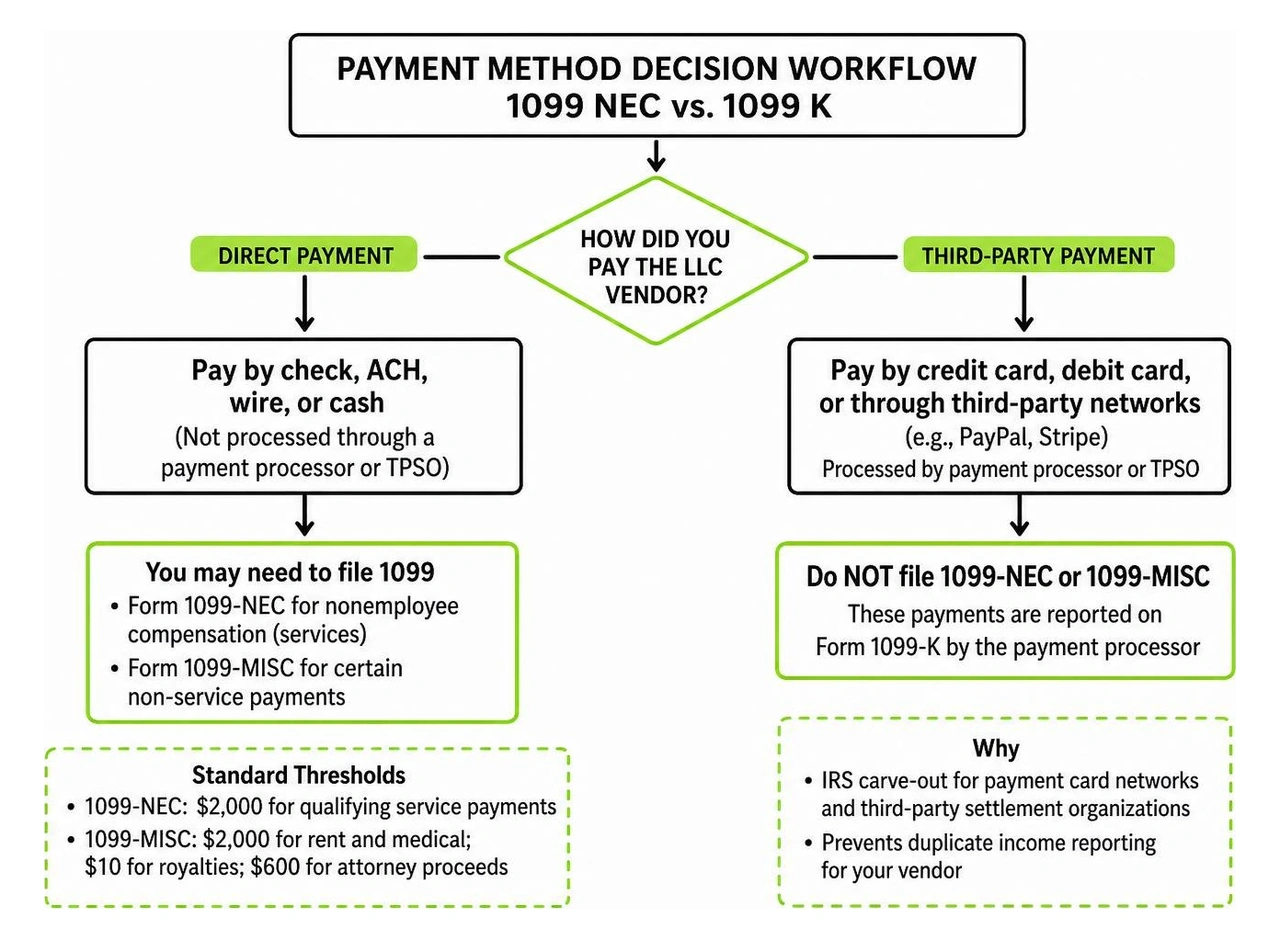
How you deliver payment to a vendor directly affects your reporting obligations. The IRS established specific carve-outs for transactions settled through payment card networks and third-party settlement organizations (TPSOs).

When you pay an LLC vendor using a credit card, debit card, or third-party payment network such as PayPal or Stripe, you do not include those amounts on Form 1099-NEC or Form 1099-MISC. Under federal tax law, the merchant acquiring entity or payment processor is responsible for reporting those electronic transactions on Form 1099-K.
Filing a Form 1099-NEC for transactions processed over third-party platforms causes duplicate income reporting for your contractors, triggering automated IRS reconciliation notices. To learn how to structure vendor payouts cleanly, refer to our LLC 1099 payments complete guide.
Critical Documentation Deadlines and IRS Filing Mandates
Maintaining an accurate filing schedule protects your business from unnecessary penalties and audit risk.
Form W 9 Verification and TIN Matching Best Practices
The cornerstone of vendor compliance is collecting a signed Form W-9 before issuing the first payment. Trying to collect tax documents from contractors in mid-January is a major source of administrative stress. Adopting a firm policy where no invoice is paid until a completed Form W-9 is on file eliminates this vulnerability.
When reviewing a vendor Form W-9, verify these details carefully.
- Confirm Line 1 lists the legal name of the owner or entity that files the tax return.
- If the vendor is a single-member disregarded LLC, Line 1 must show the individual owner's legal name, while Line 2 contains the LLC trade name.
- Check Box 3 for federal tax classification to verify if the entity is an individual/sole proprietor, partnership, C corporation, or S corporation.
- Verify that Part I provides the correct Taxpayer Identification Number (TIN), whether an Employer Identification Number (EIN) or Social Security Number (SSN).
For practical steps on maintaining these records, see our checklist on LLC get 1099 documents and our guide on managing single member LLC taxes. Utilizing the IRS online TIN Matching system allows businesses to verify vendor details in advance, preventing backup withholding notices known as IRS CP2100 B-Notices. If a payee refuses to provide a valid TIN, your business may be legally required to execute backup withholding on future payments.
Penalties for Noncompliance and Mandatory Electronic Filing
Filing deadlines are strict. Form 1099-NEC must be filed with the IRS and furnished to recipients on or before January 31 following the close of the tax year. Unlike other information returns, Form 1099-NEC does not offer an automatic 30-day filing extension. Understanding when are 1099s due ensures you submit filings on time.
The IRS enforces tiered financial penalties under Internal Revenue Code Sections 6721 and 6722 for late, incomplete, or missing information returns.
- $60 per form for returns filed within 30 days of the deadline.
- $130 per form for returns filed more than 30 days late but before August 1.
- $340 per form for returns filed after August 1 or not filed at all.
- $680 per form with no maximum limit for intentional disregard of the filing rules.
Penalties apply separately to the IRS filing copy and the payee copy, meaning an unfiled return can double your exposure per vendor. Beyond direct penalties, failing to file information returns can jeopardize legitimate expense deductions during an audit, as outlined in our LLC tax deductions guide 2026.
State level mandates also apply across the country. For example, the Connecticut DRS filing requirements detail mandatory electronic submissions and state threshold rules. Additionally, Treasury Decision 9972 mandates that businesses filing 10 or more information returns in aggregate must file electronically through modern systems like the IRS Information Returns Intake System (IRIS), as legacy platforms like FIRE are phased out.
Operational Workflows and Automation for Business Filers
Establishing clear bookkeeping routines simplifies end of year compliance, turning a stressful tax season into a routine administrative check.
Modern Systems to Automate LLC Get 1099 Compliance
Manual spreadsheets and paper records frequently lead to missed forms and transposition errors. Integrating automated onboarding software with your accounting software ensures that vendor details are captured directly during setup.
By implementing 1099 contractor expense tracking and utilizing a 1099 contractor profit tracking guide, your team can monitor cumulative payments by category in real time. For solopreneurs and agency owners, reviewing a single member LLC tax software guide can help you select tools that automatically separate payment processor disbursements from direct bank transfers, keeping your general ledger balanced and audit-ready.
Resolving Common LLC Reporting Mistakes

Many business owners run into simple, avoidable errors when filing information returns. Identifying these issues early helps protect your deductions and keeps your records accurate. You can review common traps in our guide on LLC get 1099 mistakes.
Common pitfalls include the following mistakes.
- Reporting payments made via credit cards or third-party merchant platforms on Form 1099-NEC.
- Guessing an entity's tax status based on its legal trade name rather than checking Form W-9 Box 3.
- Inverting Line 1 and Line 2 on Form W-9 for single-member LLCs, triggering IRS name-control mismatch notices.
- Misclassifying internal team members, an issue we address in can a single member LLC have 1099 employees.
- Marking paper forms with VOID incorrectly when submitting corrections, which can cause IRS optical scanners to overlook amendments.
If you spot a filing error after submitting, file an official corrected return promptly. Addressing corrections within 30 days significantly reduces potential penalty assessments.
Frequently Asked Questions About LLC 1099 Reporting
Does an LLC automatically receive a 1099 based on its name
No. The letters LLC in a company name indicate a state legal entity structure, not a federal tax classification. Single-member LLCs treated as disregarded entities and multi-member LLCs taxed as partnerships generally receive Form 1099-NEC for service payments. Limited liability companies that have elected S corporation or C corporation status are exempt from standard nonemployee service reporting, with statutory exceptions for legal fees and medical payments.
What is the updated dollar threshold for issuing a 1099 to an LLC
For tax years beginning after 2025, the minimum threshold amount for reporting qualifying nonemployee service compensation on Form 1099-NEC increases from $600 to $2,000, with inflation adjustments scheduled to begin in 2027. Payments below this statutory threshold do not require an information return, although the recipient LLC is still legally required to declare all business revenue on its tax returns.
Do you send a 1099 if you pay an LLC through PayPal or Stripe
No. Payments settled through third-party settlement networks, payment card processors, or credit card platforms are excluded from Form 1099-NEC reporting. Those electronic transactions fall under IRC Section 6050W and are reported by the payment processor on Form 1099-K when statutory requirements are met. Issuing a Form 1099-NEC for card or processor payments creates double income reporting for your contractor.
Conclusion
Managing information return obligations does not have to overwhelm your creative business. By implementing a systematic vendor onboarding process, collecting Form W-9 prior to issuing payment, and accurately tracking payment channels, you can maintain seamless IRS compliance while protecting your business deductions.
At Core Group, our no-fluff, profit-first playbook delivers complete bookkeeping and tax peace of mind, freeing creative entrepreneurs to focus entirely on growth and client delivery, backed by our MacBook Pro guarantee. Whether you need assistance reviewing vendor tax classifications or building an automated compliance system, we help you stay ahead of filing deadlines and regulatory updates. For deeper insights on single-owner entities, explore our comprehensive guide on single member LLC 1099 reporting and take control of your business finances today.