Single-Member LLC 1099 Rules: A Complete Guide to Disregarded Entities
Are Single Member LLC 1099 Reportable and How Does the IRS Classify Them
Are single member LLC 1099 reportable? Yes, in most cases. If your single-member LLC is taxed as a disregarded entity (the default), any client or business that pays you $600 or more for services during the calendar year must send you a Form 1099-NEC.
Here is a quick breakdown.
| LLC Tax Classification | Receives a 1099-NEC? |
|---|---|
| Single-member LLC (disregarded entity) | Yes |
| Multi-member LLC (partnership) | Yes |
| LLC taxed as S-Corp | Generally no |
| LLC taxed as C-Corp | Generally no |
| Any LLC paid for legal or medical services | Yes, always |
Most single-member LLCs fall into the first row by default, without ever making any formal election.
This matters more than many creative entrepreneurs realize. Over half of small business owners admit to making mistakes in year-end tax prep, and 1099 rules are one of the most common trouble spots. Getting this wrong can trigger IRS penalties, complicate your deductions, and create a stressful tax season.
The good news is that once you understand how the IRS classifies your LLC, the rules become straightforward to follow.
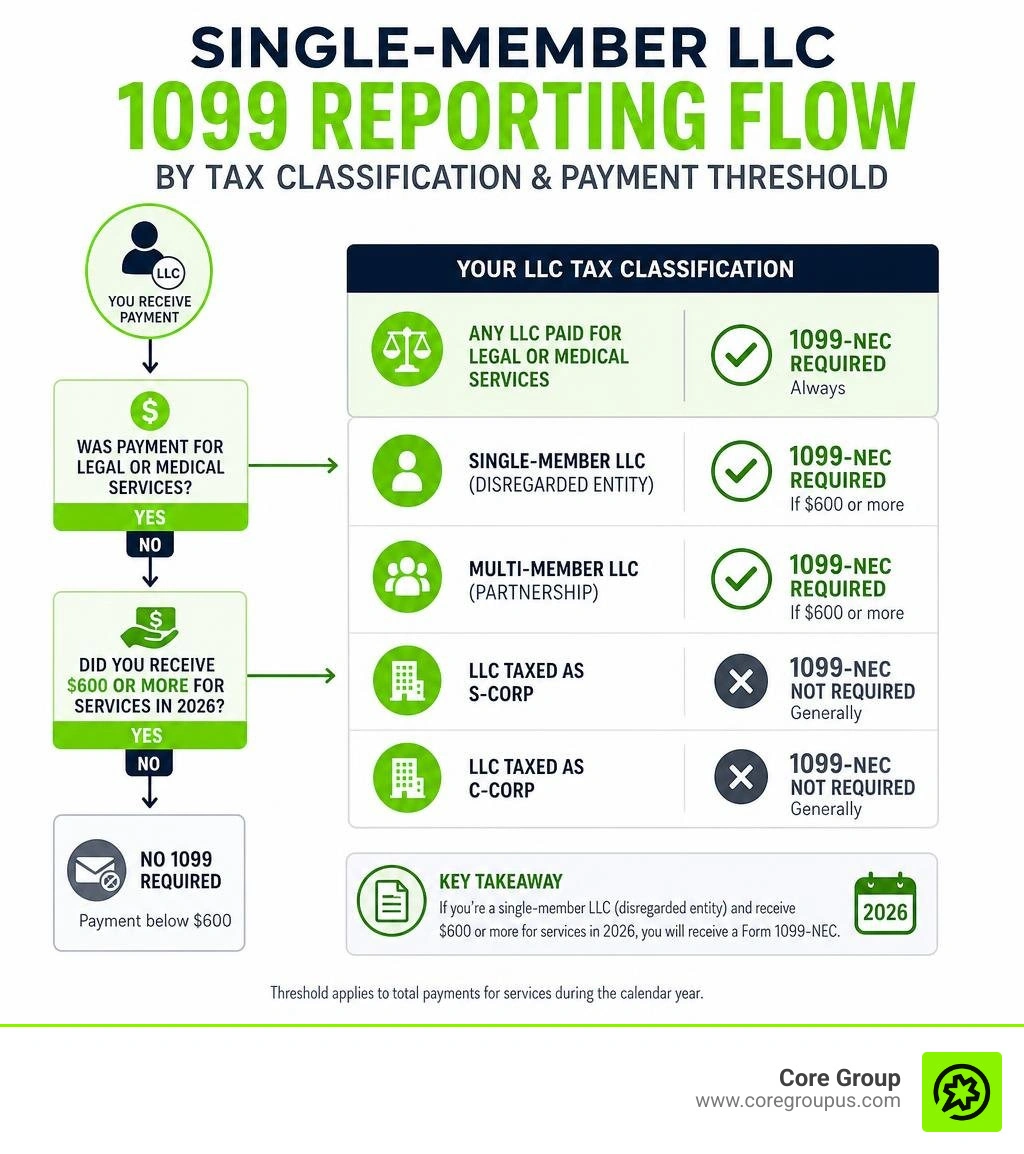
Basic are single member llc 1099 reportable glossary.
- individual sole proprietor or single member llc get 1099
- single member llc 1099 reporting
- single member llc taxes
Understanding how the Internal Revenue Service views your business structure is the first step in mastering year-end compliance. Many business owners believe that forming a Limited Liability Company automatically changes how they are taxed. However, the IRS does not actually recognize an LLC as a distinct federal tax classification. Instead, a Limited Liability Company is a legal structure created by state statute, and the federal government views it as a chameleon that takes on different tax classifications based on ownership and elections.
By default, the IRS treats a single-member LLC as a disregarded entity. This means that for federal income tax purposes, the business entity is completely invisible. The IRS treats the business activities, revenues, and expenses as if they belong directly to the individual owner. This pass-through taxation simplifies your filing process because the business itself does not file a separate federal income tax return. All your business financial activity passes directly through to your personal tax return.
Understanding these default rules is essential for managing your single member llc taxes properly. The federal government outlines these specific entity classifications in detail on the official page for Single member limited liability companies | Internal Revenue Service. By remaining a disregarded entity, you maintain simple administrative requirements while enjoying the personal asset protection that state-level legal registration provides.
Why Are Single Member LLC 1099 Reportable by Default
Because a single-member LLC is classified as a disregarded entity, the IRS treats it identically to a sole proprietorship for income tax purposes. When a client hires you, they are technically hiring your legal entity, but the tax reporting flows directly to you as an individual. This is why you must understand how an individual sole proprietor or single member llc get 1099 forms at the end of the year.
Your business net income or loss is reported on Schedule C, which is attached to your personal Form 1040. Since the IRS tracks this income at the individual level, payers are required to report any nonemployee compensation paid to you. If your business were a corporation, the paying business would generally be exempt from sending a 1099. But because you are a disregarded entity, you do not qualify for the standard corporate exemption, making your single-member LLC fully reportable.
When Are Single Member LLC 1099 Reportable to the IRS
The requirement to issue a Form 1099-NEC is triggered when a business pays your single-member LLC $600 or more for services rendered during a single calendar year. This threshold is cumulative, meaning it applies to the total amount paid to you by a single client across the entire year, rather than individual payments. If a client pays you three separate payments of $250 for design services, the total is $750, which surpasses the reporting limit and requires them to issue a form.
You can read more about how these payment minimums operate in our guide on the LLC get 1099 minimum. It is also important to note that state-level tax departments may have their own filing thresholds and reporting requirements. For example, some states require separate filings or have unique rules regarding how single-member entities report their state income. You can find state-specific guidance through resources such as the FAQ on Is a single member LLC required to file a separate ... or the Limited Liability Company FAQs - Delaware Division of Revenue.
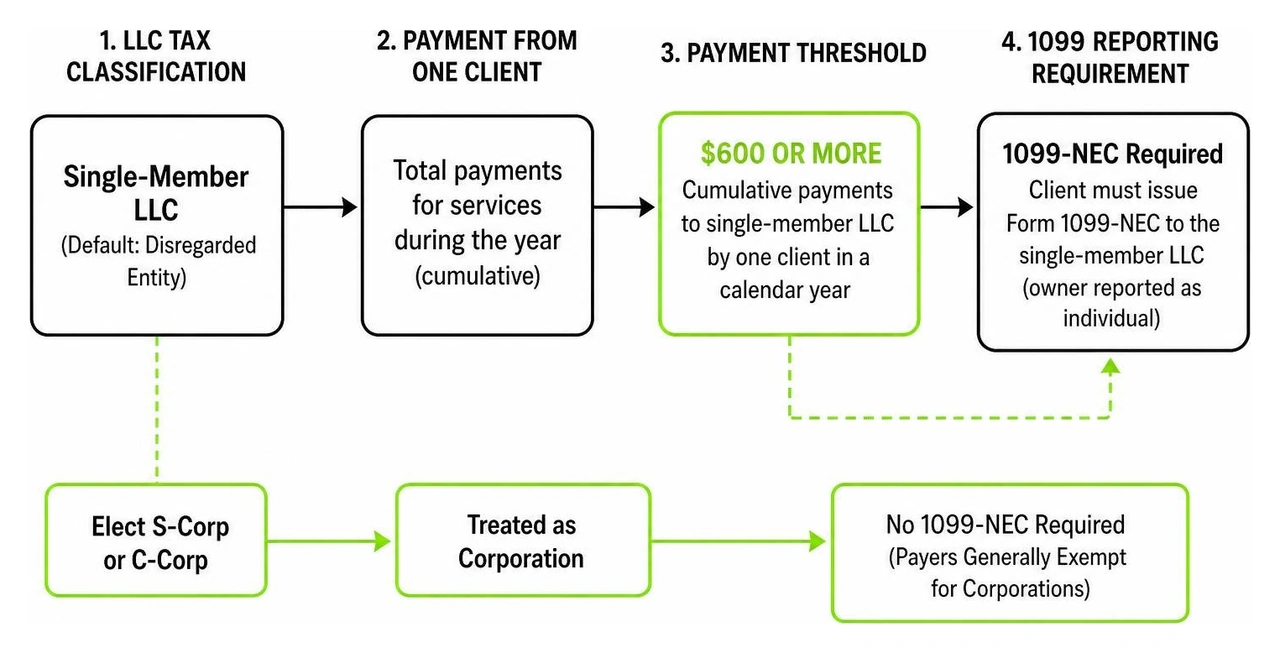
How Tax Classification Affects 1099 Requirements for LLCs
While the default classification for a single-member LLC is a disregarded entity, you have the option to change how your business is taxed. You can elect to have your LLC taxed as an S-Corporation or a C-Corporation by filing specific forms with the IRS. Making this election changes your tax status from a disregarded entity to a corporation, which fundamentally alters your 1099 reporting requirements.
Once your LLC elects corporate status, businesses that hire you are generally no longer required to issue you a Form 1099-NEC for services. The IRS exempts corporations from receiving 1099 forms for standard business transactions because corporations have strict filing requirements that make additional information returns redundant. To make this election, you must file Form 8832 for C-Corporation status or Form 2553 for S-Corporation status.
For a comprehensive breakdown of how these different classifications change your reporting landscape, you can consult the guide on Do I Need to Send a 1099 to an LLC? A Complete Guide | Salestaxcel alongside our detailed LLC 1099 income guide 2026.
The S-Corp Election and Corporate Exemptions
Electing S-Corporation status is a popular strategy for growing businesses because it can reduce your overall self-employment tax burden. When your single-member LLC is taxed as an S-Corp, you are treated as an employee of your own business. You must pay yourself a reasonable salary, which is subject to standard payroll taxes, while the remaining business profits can be distributed to you as shareholder distributions.
These distributions are not subject to self-employment tax, which can lead to substantial savings. Because your business now files a corporate tax return using Form 1120S, your entity is recognized as a corporation for tax purposes. Consequently, your clients will see that you are classified as an S-Corp on your Form W-9 and will know they do not need to issue you a 1099-NEC. You can read more about maximizing these tax benefits in our LLC get 1099 tax maximum guide 2026.
Exceptions for Legal and Medical Payments
While corporations are generally exempt from receiving 1099 forms, the IRS enforces a few strict exceptions to this rule. The most common exceptions involve payments made for legal services and healthcare services. If your LLC provides legal services, such as attorney fees, or medical and healthcare services, clients must still issue you a 1099 regardless of your corporate status.
For legal fees, payers must issue a Form 1099-NEC for professional legal services, or a Form 1099-MISC for settlements or gross proceeds paid to an attorney. Healthcare and medical payments are reported in Box 6 of Form 1099-MISC. This means that even if you have elected S-Corp or C-Corp status for your law practice or medical consulting firm, your clients must still send you the appropriate 1099 form if payments exceed the $600 threshold.
Understanding Form 1099-NEC and Form 1099-MISC Differences
Navigating tax season requires understanding the specific forms used to report different types of income. The IRS utilizes two primary forms for reporting payments to independent contractors and unincorporated businesses, which are Form 1099-NEC and Form 1099-MISC. Prior to the 2020 tax year, all of these payments were grouped together on a single form, but the IRS reintroduced Form 1099-NEC to separate nonemployee compensation from other miscellaneous payments.

Form 1099-NEC is dedicated strictly to reporting nonemployee compensation, which includes payments for services performed by someone who is not your employee. If your single-member LLC is hired to design a website, write copy, or provide business consulting, the payments you receive are nonemployee compensation and belong on Form 1099-NEC.
Form 1099-MISC is now used for miscellaneous income, such as rent payments, royalties, prizes, awards, and legal settlements. If your business rents a commercial office space from a landlord, you would report those rent payments on Form 1099-MISC rather than Form 1099-NEC. For a thorough breakdown of how these forms differ, view our article on 1099 NEC explained. Keeping these forms organized is a vital part of 1099 contractor expense tracking.
The Role of Form W-9 in Verifying Tax Status
The Form W-9 is the administrative foundation of the 1099 reporting process. As a business owner, you should make it a strict policy to collect a completed Form W-9 from any contractor or vendor before you issue their first payment. This form collects the vendor's legal name, business name, address, tax classification, and Taxpayer Identification Number, which can be either a Social Security Number or an Employer Identification Number.
When you fill out a Form W-9 for your own single-member LLC, you must follow specific IRS guidelines to avoid matching errors. If your LLC is a disregarded entity, you must enter your individual name on Line 1, and you can place your business name on Line 2. On Line 3, you should check the box for "Individual/sole proprietor or single-member LLC" rather than the "Limited liability company" box.
For the Taxpayer Identification Number, the IRS prefers that you use your personal Social Security Number, though you can also use your individual Employer Identification Number if you have one. Providing incorrect information on a W-9 can lead to processing delays or trigger backup withholding requirements, which forces payers to withhold 24 percent of your payments and send it directly to the IRS.
Third-Party Payment Processor Exemptions and Form 1099-K
A common source of confusion for small business owners is how payments made through credit cards or online payment processors affect 1099 reporting. The IRS rules state that payments made via credit cards, debit cards, or third-party payment networks such as PayPal, Stripe, and Venmo are exempt from standard Form 1099-NEC reporting.
Instead, these transactions are tracked and reported by the payment processor on Form 1099-K. This rule exists to prevent duplicate reporting, ensuring that you do not have the same income reported on both a 1099-NEC from your client and a 1099-K from your payment processor. If a client pays your single-member LLC $1,000 via credit card, they do not need to issue you a 1099-NEC for that transaction, as the reporting burden shifts entirely to the payment processor.
Issuing 1099s and Managing Compliance as an LLC Owner
As a single-member LLC owner, you operate on both sides of the tax equation. While you receive 1099 forms from your clients, you may also need to issue 1099 forms to the independent contractors, freelancers, and service providers you hire to help run your business. Managing this process efficiently is critical to maintaining a healthy, compliant business.

To stay compliant, you must track your payments throughout the year and ensure you meet all state and federal filing deadlines. The deadline to furnish Form 1099-NEC to your contractors and file Copy A with the IRS is January 31 of the following year.
For other forms, such as Form 1099-MISC, the paper filing deadline is February 28, and the electronic filing deadline is March 31. The IRS has transitioned away from its older electronic filing systems, replacing them with the user-friendly Information Returns Intake System, also known as IRIS. To streamline your year-end preparation, you can utilize our 1099 contractor profit tracking guide and learn more about federal income tax LLC rules.
When an LLC Must Issue 1099s to Others
You are required to issue a Form 1099-NEC to any individual, sole proprietor, partnership, or single-member LLC that you paid $600 or more for business-related services during the calendar year. This includes payments made to freelance designers, copywriters, accountants, IT specialists, and even your business attorney.
This rule only applies to payments made in the course of your trade or business. Personal payments, such as hiring someone to clean your personal home or repair your personal vehicle, do not trigger a 1099 requirement. Always keep detailed records of your business expenses and verify the tax classification of every service provider to determine if they are exempt from receiving a form.
Penalties for Failing to File Required 1099 Forms
Treating tax compliance as optional can lead to significant financial consequences. The IRS enforces strict penalties for businesses that fail to file required 1099 forms or file them late. These penalties apply per form and increase based on how late the return is submitted.
Late filing penalties start at $60 per form if you file within 30 days of the deadline, and can rise to $310 per form if filed after August 1 or not filed at all. If the IRS determines that you intentionally disregarded your filing requirements, the penalty can increase to $580 or more per form, with no maximum limit.
Failing to file 1099s can also trigger an IRS audit, potentially putting your business expense deductions at risk. For a deeper look into maintaining your legal and financial protections, check out the Single-Member LLC Complete 2026 Guide | OnlineLLCGuide.com. You can also review state-specific filing mandates through official portals like the Filing Requirements - 1099 and W-2G ... and the [PDF] 1099 FAQ for Tax Year 2025 | Arkansas.gov.
Frequently Asked Questions About Single-Member LLC 1099 Rules
Does a single-member LLC need an EIN to receive a 1099
Technically, a disregarded single-member LLC without employees is not required by the IRS to have an Employer Identification Number for federal income tax purposes. The owner can use their personal Social Security Number on Form W-9 to receive 1099 forms.
However, obtaining an EIN is highly recommended for privacy and security. Using an EIN instead of your personal SSN on W-9 forms keeps your personal data secure when sharing tax information with clients and vendors. Additionally, most banks require an EIN to open a business bank account, and many states require one for local tax registration.
What are the most common 1099 mistakes made by LLC owners
One of the most common mistakes is commingling personal and business funds. Running personal expenses through your business account or paying contractors from a personal account complicates your bookkeeping and can jeopardize your personal liability protection.
Another frequent error is failing to collect a Form W-9 before issuing the first payment to a contractor. Trying to track down tax information in January for a contractor you hired in April can be incredibly difficult and stressful. Finally, many owners mistakenly assume that all LLCs are exempt from receiving 1099s, leading them to miss required filings for vendors who operate as disregarded single-member entities.
How does self-employment tax work for a disregarded entity
As a disregarded single-member LLC, your business profits are subject to self-employment tax, which covers Social Security and Medicare taxes. The current self-employment tax rate is 15.3 percent, which consists of 12.4 percent for Social Security and 2.9 percent for Medicare.
This tax is calculated on 92.35 percent of your net business profit using Schedule SE, which is attached to your personal tax return. Unlike standard employees who have these taxes withheld from their paychecks by their employers, you must calculate and pay this tax yourself, typically through quarterly estimated tax payments to avoid underpayment penalties.
Conclusion
Navigating the complexities of are single member llc 1099 reportable rules does not have to be a source of stress for your business. By understanding how the IRS classifies your single-member LLC and staying proactive with your paperwork, you can ensure a smooth, penalty-free tax season every year.
At Core Group, we specialize in offering financial management, bookkeeping, and tax services tailored specifically for creative entrepreneurs. Our goal is to take the administrative burden off your shoulders so you can focus on doing what you love.
We deliver our services through a no-fluff, profit-first playbook that guarantees peace of mind and saves you valuable time, all backed by our MacBook Pro guarantee. If you are ready to simplify your business finances and secure your peace of mind, reach out to us today to learn more about our Single Member LLC 1099 Reporting services and financial solutions.