How to Handle 1099 Income Without Making the IRS Mad
What It Means When an LLC Gets 1099 Income
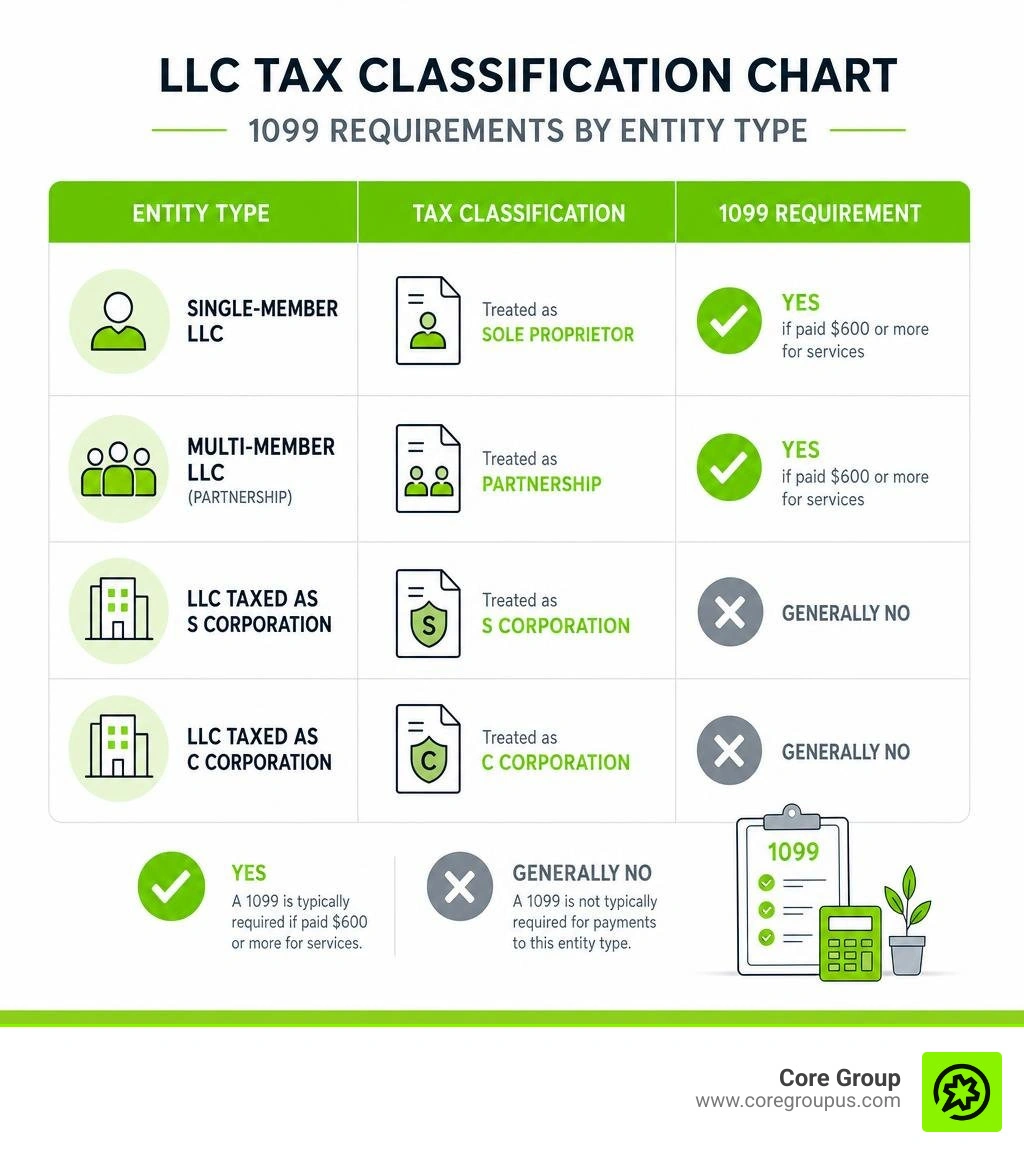
Whether your llc gets 1099 income depends almost entirely on how your LLC is taxed, not just the fact that it's an LLC.
Here is the quick answer.
| LLC Type | Does It Receive a 1099? |
|---|---|
| Single-member LLC | Yes, if paid $600 or more for services |
| Multi-member LLC (partnership) | Yes, if paid $600 or more for services |
| LLC taxed as S corporation | Generally no |
| LLC taxed as C corporation | Generally no |
Tax season is already stressful enough when you're running a creative business. Add 1099 forms to the mix and it can feel like you need a law degree just to stay out of trouble with the IRS.
The good news is that the rules are actually pretty straightforward once you understand one key idea. The IRS does not care what your business is called, but it cares how your business is taxed.
A single-member LLC is treated like a sole proprietor for tax purposes. A multi-member LLC is treated like a partnership. Both of those structures mean clients who pay you $600 or more in a year are required to send you a 1099. An LLC that has elected S corporation status is a different story.
This guide walks you through everything you need to know, from which 1099 forms apply to your LLC, to how to report that income correctly, to what happens when you need to issue 1099s to others.
Rules for When an LLC Get 1099 Income

When we set up a Limited Liability Company, we often do it for the legal liability protection. However, the IRS does not recognize an LLC as a distinct tax class. Instead, they look at how many owners the business has and what tax election the owners have made. This means that when your llc gets 1099 income, the rules that apply to you are dictated by your federal tax classification.
To make sense of these rules, we have to look closely at how the IRS treats different business structures. If you want a detailed breakdown of how these rules apply across different entities, you can read the Do LLCs Get a 1099 Complete Answer by LLC Type in 2026 guide. Generally, the default tax status of your LLC will determine whether your clients are legally required to send you a form at the end of the year.
Do All Types of LLC Get 1099 Income
The short answer is no, not all LLCs receive 1099 forms. If your LLC is a single member LLC or a multi member LLC taxed as a partnership, you will likely receive 1099 forms from clients who pay you for services.
On the other hand, if your LLC is taxed as an S corporation or a C corporation, you are generally exempt from receiving 1099 forms. This corporate exemption exists because corporations have stricter reporting requirements and the IRS already has plenty of ways to track their income. If you are operating a multi member business, you can find more specific details in this article on Does an LLC Partnership Get a 1099 and What You Need to Know for Taxes.
The Six Hundred Dollar Threshold for LLC Payments
The magic number for 1099 reporting is six hundred dollars. If a client pays your LLC six hundred dollars or more during the calendar year for services, they must issue you a 1099 form. This threshold is cumulative, meaning it applies to the total amount paid to you over the entire year, not just a single invoice.
For example, if a client pays you two hundred dollars in March, three hundred dollars in July, and one hundred and fifty dollars in November, the total is six hundred and fifty dollars. Because the total exceeds the six hundred dollar limit, they must send you a form. To understand how states track these limits, you can review the 1099 Guidelines and Instructions from the Arkansas Department of Finance which details regional compliance rules.
Single Member LLC and Partnership Rules
If you run a single member LLC, the IRS views your business as a disregarded entity. This means your business income and expenses are reported directly on Schedule C of your personal tax return. Because you are treated similarly to a sole proprietor, clients must send you a 1099 for payments over the six hundred dollar threshold.
For partnerships or multi member LLCs, the business must file Form 1065 to report its annual financial activity. The partnership itself does not pay federal income tax. Instead, the profits and losses pass through to the owners via Schedule K1. Even though partnerships file an informational return, they are still subject to receiving 1099 forms from their clients. For a deeper dive into this specific setup, check out our guide on Single Member Llc 1099 Reporting.
S Corporation and C Corporation Exemptions
Once your LLC elects to be taxed as an S corporation or a C corporation, the landscape changes. The IRS corporate exemption rules state that businesses do not need to issue 1099 forms to corporations for services rendered.
If you make an S corp election, you are required to pay yourself a reasonable salary through W2 wages. Your business income is no longer reported on Schedule C, and your clients do not have to worry about tracking your payments for 1099 purposes. You can read more about how these corporate exclusions function in this guide on Do LLCs Get a 1099 Complete Guide to IRS Reporting Rules.
Key Differences Between 1099 NEC 1099 MISC and 1099 K
Not all 1099 forms are created equal. Depending on how you get paid and what type of work you do, you might receive different versions of this form.
| Form Type | Primary Purpose | Common Use Case |
|---|---|---|
| Form 1099-NEC | Nonemployee Compensation | Payments for professional services |
| Form 1099-MISC | Miscellaneous Income | Rent payments or legal fees |
| Form 1099-K | Payment Card and Third Party Network Transactions | Credit card, PayPal, or Stripe payments |
Understanding these distinctions helps us keep our books clean and avoids double-reporting our income.
Nonemployee Compensation and Miscellaneous Payments
Form 1099-NEC is the standard form used to report nonemployee compensation. If a client hires your LLC to design a website, write copy, or consult on a project, they will use this form to report those service fees. You can learn more about how this form works by reading our article on 1099 Nec Explained or our overview of Nonemployee Compensation.
Form 1099-MISC is reserved for other types of miscellaneous income. For example, if your LLC receives rent payments for leasing office space, or if you receive royalties, those payments are reported on Form 1099-MISC. It is also used for legal service payments, which are a major exception to the corporate exemption rule.
Payment Processors and Third Party Transactions
If your clients pay you through credit cards, PayPal, Stripe, or other third party payment processors, you should not receive a 1099-NEC from them. Instead, the payment processor is responsible for tracking those transactions and issuing a Form 1099-K if you meet the federal reporting thresholds.
This is a critical distinction because it prevents duplicate reporting. If a client pays you one thousand dollars via credit card, and they also send you a 1099-NEC, the IRS might think you earned two thousand dollars. We always recommend keeping close track of your payment methods to catch these issues early.
How to Report When Your LLC Get 1099 Income

Once the tax year ends, you will start receiving these forms in the mail or in your inbox. Reporting this income accurately is essential to stay compliant and avoid triggering an IRS audit. If you want to understand the foundations of this process, we recommend reading our resource on Single Member Llc Taxes.
Filing Schedule C for Disregarded Entities
For a single member LLC operating as a disregarded entity, all of your 1099 income is reported on Schedule C of your Form 1040. You will list your total gross receipts, which includes all the money your business earned, regardless of whether you received a 1099 form for it.
After listing your gross receipts, you can deduct your ordinary and necessary business expenses to calculate your net profit. This net profit is what you will actually pay income tax and self-employment tax on. For more details on this process, you can read our article on Federal Income Tax Llc.
Partnership and Corporate Tax Returns
If your LLC has multiple members and is taxed as a partnership, you will report your income on Form 1065. The partnership does not pay direct income tax, but it issues a Schedule K1 to each partner. This form shows each owner their share of the profits, which they then report on their personal tax returns.
If your LLC is taxed as an S corporation, you will file Form 1120S. If it is taxed as a C corporation, you will file Form 1120. In both cases, the corporate entity handles the income reporting, and the owners are compensated through W2 wages, distributions, or dividends.
When Your LLC Must Issue 1099 Forms to Others
As an LLC owner, you are not just on the receiving end of tax forms. If you hire independent contractors, freelancers, or other service providers to help run your business, you might have to issue 1099 forms to them.
If you make payments in the course of your trade or business to an unincorporated entity or individual totaling six hundred dollars or more, you must file a 1099-NEC. To see how different states manage these filings, you can check the 1099-NEC Filing with the Alabama Department of Revenue guidelines.
Collecting Form W9 From Contractors
The easiest way to determine if you need to send a contractor a 1099 is to ask them to fill out Form W9 before you make your first payment. This form collects their legal name, business entity type, and Taxpayer Identification Number or Social Security Number.
If a contractor refuses to provide a W9, you may be required to perform backup withholding at a flat rate of twenty-four percent and send those funds directly to the IRS. Keeping a completed W9 on file for every vendor protects your business and ensures you have all the information you need when tax season arrives.
Deadlines and Electronic Filing Requirements for 2026
The IRS has strict deadlines for information returns. For the 2026 tax year, you must provide the 1099-NEC to both the recipient and the IRS by January 31. Failing to meet this deadline can result in costly penalties. To keep track of these dates, you can read our post on When Are 1099S Due.
Additionally, the IRS requires electronic filing if you are submitting ten or more information returns in a calendar year. This threshold includes 1099s, W2s, and other informational forms combined. Filing electronically is faster, reduces errors, and helps ensure your business remains fully compliant.
Frequently Asked Questions About LLC Tax Reporting
Navigating business taxes often brings up specific questions about owner compensation, penalties, and exemptions.
Can you 1099 yourself from your LLC
Generally, you cannot issue a 1099 to yourself from your own LLC. If you run a single member LLC, you pay yourself through owner draws, which are simple transfers of funds from your business account to your personal account. These draws are not considered deductible business expenses.
If you run an S corporation, you must pay yourself through payroll as a W2 employee. Attempting to use a 1099 to pay yourself to avoid payroll taxes is a major red flag for the IRS. For a complete guide on how to handle these payments legally, read Can You Yourself From Your LLC for Owner Payments Taxes and Compliance.
What are the penalties for failing to file 1099 forms
Failing to file required 1099 forms can lead to automatic IRS penalties. These fees start at sixty dollars per form if filed slightly late and can quickly climb to over three hundred dollars per form for long delays.
If the IRS determines that you intentionally disregarded the filing requirements, the penalty can jump to nearly six hundred dollars per form or ten percent of the total amount of the payments, whichever is greater. You can read more about these rules on the Important Information About the 1099-NEC from Colorado Taxes page.
Are there exceptions where an LLC does not need a 1099
Yes, there are several common exceptions. You do not need to issue a 1099 for merchandise or goods purchases. If you buy office furniture or computer hardware, no form is required.
Additionally, payments made to corporations are exempt, except when those payments are made for legal or medical services. Attorneys must always receive a 1099, regardless of whether their firm is incorporated. For more official guidelines, you can review the 1099-MISC independent contractors and self employed information from the IRS portal.
Conclusion
Managing your taxes does not have to be a source of constant anxiety. When you understand how your business is classified and how to handle your 1099 income, you can make decisions with confidence.
At Core Group, we specialize in providing financial management, bookkeeping, and tax services for creative entrepreneurs. We use a simple, no-fluff, profit-first playbook that guarantees you financial peace of mind. We stand behind our work with our MacBook Pro guarantee, which means we keep your books accurate and save you time so you can focus on doing what you love.
If you are ready to take the stress out of tax season, let us help you get organized. For more details on managing your business taxes, check out our resource with More info about single member LLC 1099 reporting and take the first step toward stress-free compliance.