How to Understand LLC Liability for Contractors on a Budget
Will an LLC Get a 1099 as a Contractor
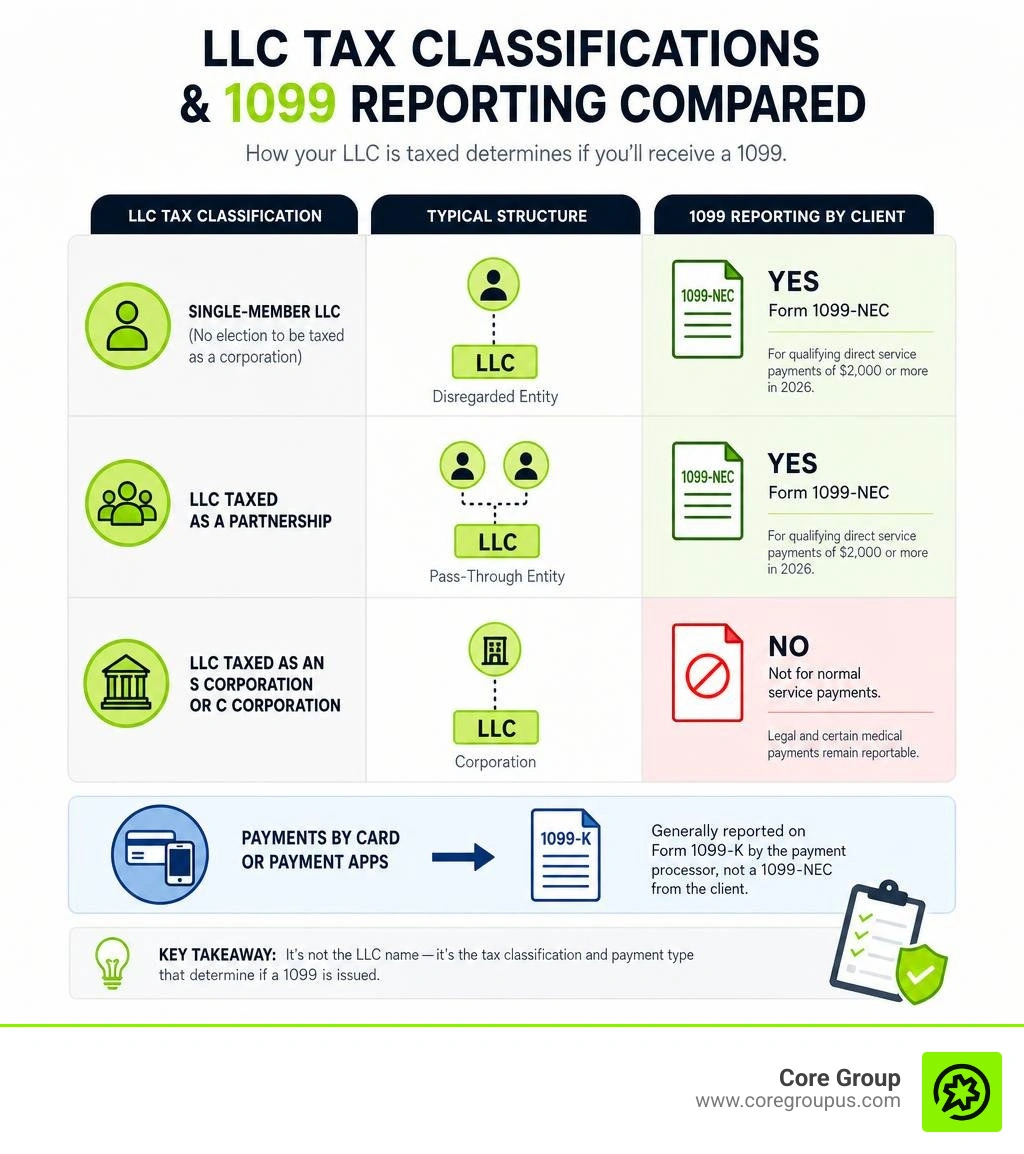
An LLC can get a 1099 as a contractor, but its legal name alone does not decide the answer. A client should check the LLC's signed Form W-9 and payment method.
- A single-member LLC that has not elected corporate tax treatment and an LLC taxed as a partnership generally receive Form 1099-NEC for qualifying direct service payments totaling $2,000 or more in 2026.
- An LLC taxed as an S corporation or C corporation is usually exempt for normal service payments, though legal and certain medical payments remain reportable.
- Payments by credit card or qualifying payment apps generally belong on Form 1099-K from the processor, not a 1099-NEC from the client.
For creative contractors, an LLC can add a layer of personal asset protection and offer tax options, but it also brings filing costs, recordkeeping, and compliance work. I’m Christian Brim, and I’ll help you weigh the protection, 1099 rules, and tax tradeoffs before you choose a setup.
Key llc get 1099 contractor vocabulary:
Why an LLC Get 1099 Contractor Setup Protects Personal Assets

When running a solo business, mixing up your tax status with your legal identity is easy. Being an independent contractor merely defines your working and tax relationship with a client. It means you work project by project, control your own schedule, buy your own tools, and handle your own tax payments. An LLC is a formal legal entity registered with the state that erects a legal shield around your personal life.
Operating without that formal entity leaves your personal wealth directly exposed to business liabilities. If a client sues you over a disputed creative project, a commercial copyright issue, or a property damage incident, an unincorporated sole proprietor risks losing their personal savings, vehicle, or private home. Forming a limited liability company creates a legal barrier known as the corporate veil. This legal separation means business debts and judgments stay inside the company, protecting your private family assets.
Maintaining this shield requires diligent habits. You must establish strict separate banking and avoid commingling business and personal funds. Implementing organized 1099 contractor expense tracking ensures every business deduction is documented properly and clean accounting records back up your business standing. State agencies, including the California Department of Industrial Relations, closely monitor worker classification standards, making clear operational separation essential for independent contractors.
Personal Asset Protection Versus Sole Proprietorship Exposure
Sole proprietorships are appealing because they involve zero state registration paperwork and no initial setup fees. However, that lack of upfront friction comes with unlimited personal liability. An LLC limits your financial exposure to the assets held inside the business entity.
| Comparison Feature | Sole Proprietorship | Limited Liability Company (LLC) |
|---|---|---|
| Legal Separation | None, owner and business are identical | Distinct legal entity separate from owner |
| Personal Liability | Unlimited personal risk for business debts | Limited to business assets and capital |
| Upfront State Fees | $0 in most jurisdictions | $50 to $500 depending on state |
| Ongoing Maintenance | Basic personal tax filing | Annual reports and state franchise fees |
| Professional Image | Sole proprietor or basic DBA | Added credibility with corporate clients |
While commercial liability insurance is valuable, insurance policies contain specific coverage limits, deductibles, and fine print exclusions. Relying solely on insurance without an LLC leaves structural gaps. Combining a business liability policy with an LLC gives you comprehensive defense against unexpected legal claims.
Maintaining the Corporate Veil on a Tight Budget
Protecting your personal assets does not require spending thousands of dollars on complex corporate setups. Creative contractors on a budget can maintain their liability shield with simple, disciplined steps.
First, draft an operating agreement even if you are the only member. This internal governing document demonstrates that your business operates as a distinct legal organization rather than an informal hobby. Second, secure a dedicated business checking account and credit card immediately. Pay all business operating costs exclusively from these accounts and never pay personal living expenses directly from company revenue.
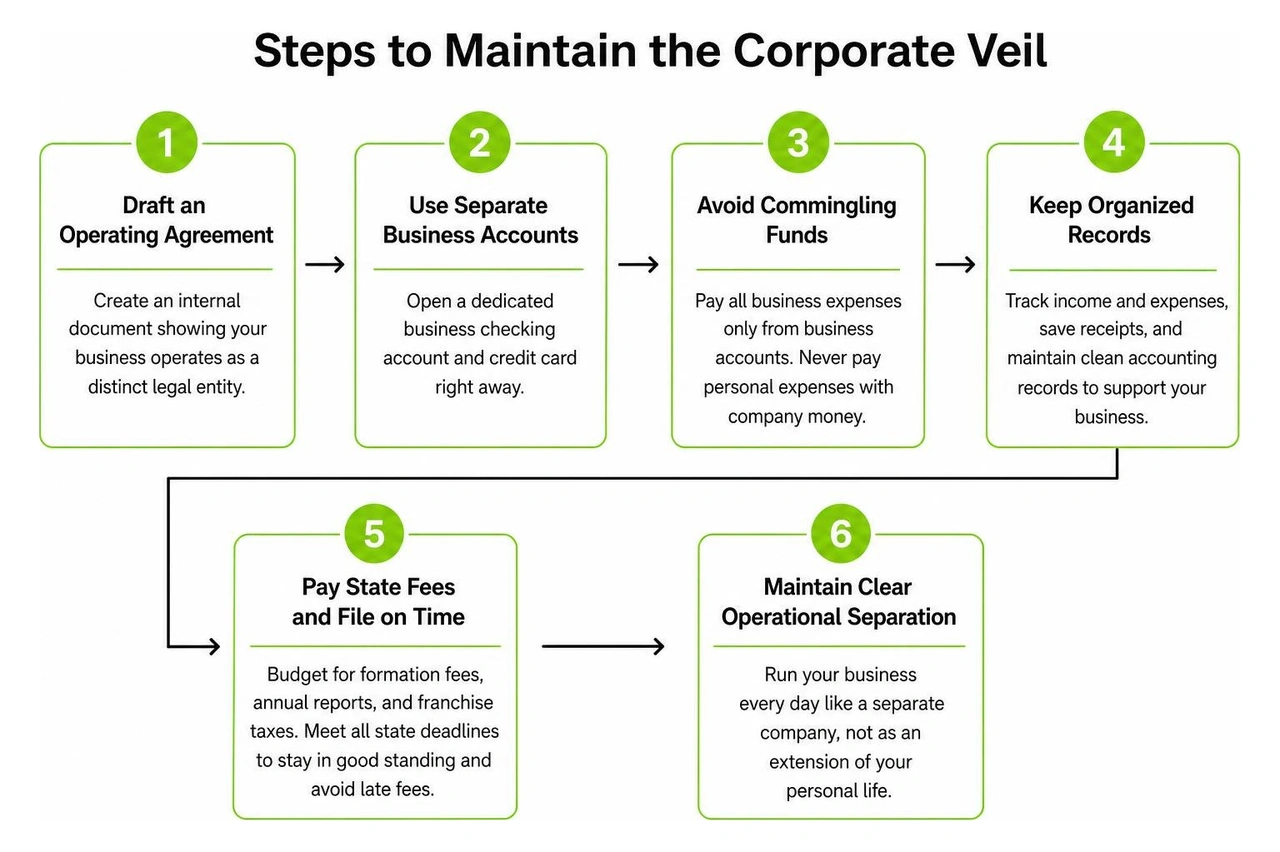
Budget for mandatory state recurring costs. Initial formation fees range widely across states, from around $50 in Michigan up to $500 in Massachusetts. Additionally, states impose annual reporting fees or franchise taxes. For example, California requires a minimum annual franchise tax of $800 simply for the privilege of operating in the state. Tracking these recurring dates ensures your entity remains in good standing without accruing costly state late fees.
How Federal Tax Classification Affects 1099 Reporting

Many business owners mistakenly believe that adding the letters LLC to a company name instantly eliminates all 1099 paperwork. The Internal Revenue Service does not determine 1099 reporting requirements based on state entity registration. Instead, information reporting depends entirely on the entity's federal tax classification as declared on Form W-9.
Before issuing compensation to an independent contractor, payers must obtain a completed Form W-9 to confirm the payee's legal name, federal tax status, and Taxpayer Identification Number. For detailed instructions on managing single-member filings, explore our comprehensive single member LLC 1099 guide 2026 to ensure your tax paperwork is accurate.
When an LLC Get 1099 Contractor Must Receive Form 1099-NEC
Under default federal tax rules, the IRS treats a single-member LLC as a disregarded entity. This means the business entity is ignored for federal income tax purposes, and the owner reports business earnings directly on Schedule C of their personal Form 1040. For a multi-member LLC, the default tax status is a partnership, which files an informational Form 1065.
Both disregarded single-member LLCs and multi-member partnerships are reportable payees. If your business hires an LLC contractor with either of these default classifications and pays them directly via cash, paper check, or direct bank transfer (ACH), you must issue Form 1099-NEC when total compensation meets statutory thresholds. The official IRS instructions for Forms 1099-MISC and 1099-NEC require payers to report nonemployee compensation by January 31 following the payment year.
When completing Form W-9 for a disregarded single-member LLC owned by an individual, IRS rules require placing the individual owner's name on Line 1, the LLC business name on Line 2, and the owner's Social Security Number or individual Employer Identification Number in Part I. Using the LLC's separate EIN can trigger IRS name and TIN mismatches resulting in backup withholding notices.
Corporate Exemptions and Mandatory Reporting Exceptions
When an LLC elects to be taxed as a C corporation or an S corporation, it qualifies for the general corporate exemption from Form 1099-NEC. Payers working with corporate LLCs do not need to issue annual nonemployee compensation forms for standard creative, consulting, or technical services.
However, federal regulations establish strict exceptions where even corporate-taxed LLCs must receive 1099 forms:
- Legal Services and Attorney Fees: All payments made to attorneys or law firms for professional legal services must be reported on Form 1099-NEC Box 1, regardless of whether the legal practice is organized as an S-Corp, C-Corp, or LLC.
- Gross Proceeds to Attorneys: Settlement payouts or gross legal proceeds paid to an attorney in connection with legal matters must be reported on Form 1099-MISC Box 10, regardless of entity structure.
- Medical and Health Care Payments: Payments made in the course of trade or business for medical or health care services require reporting on Form 1099-MISC Box 6, even when paid to incorporated medical providers.
Smart Tax Strategies to Lower Self-Employment Obligations
Independent contractors face substantial self-employment taxes. As a self-employed individual or default single-member LLC owner, you pay both the employer and employee portions of Social Security and Medicare taxes, totaling 15.3% on all net business profits. For Social Security, the tax applies at 12.4% up to statutory annual caps ($168,600 baseline reference), while Medicare applies a 2.9% tax with no income ceiling, plus an additional 0.9% Medicare surcharge on earnings exceeding $250,000.
Navigating these obligations requires calculating your exact tax liabilities in advance. Utilizing a dedicated LLC get 1099 tax estimator helps contractors project their tax burdens accurately across different business income tiers.
How an LLC Get 1099 Contractor Can Elect S-Corp Taxation
Once an independent contractor's net profit reaches substantial levels, usually around $75,000 or more, electing S corporation tax status by filing IRS Form 2553 can yield major tax savings.
Under an S-Corp election, the LLC owner becomes a shareholder-employee. You pay yourself a reasonable salary through W-2 payroll, which remains subject to standard FICA payroll taxes. The remaining profit can be distributed to you as shareholder distributions, which are completely exempt from the 15.3% self-employment tax.
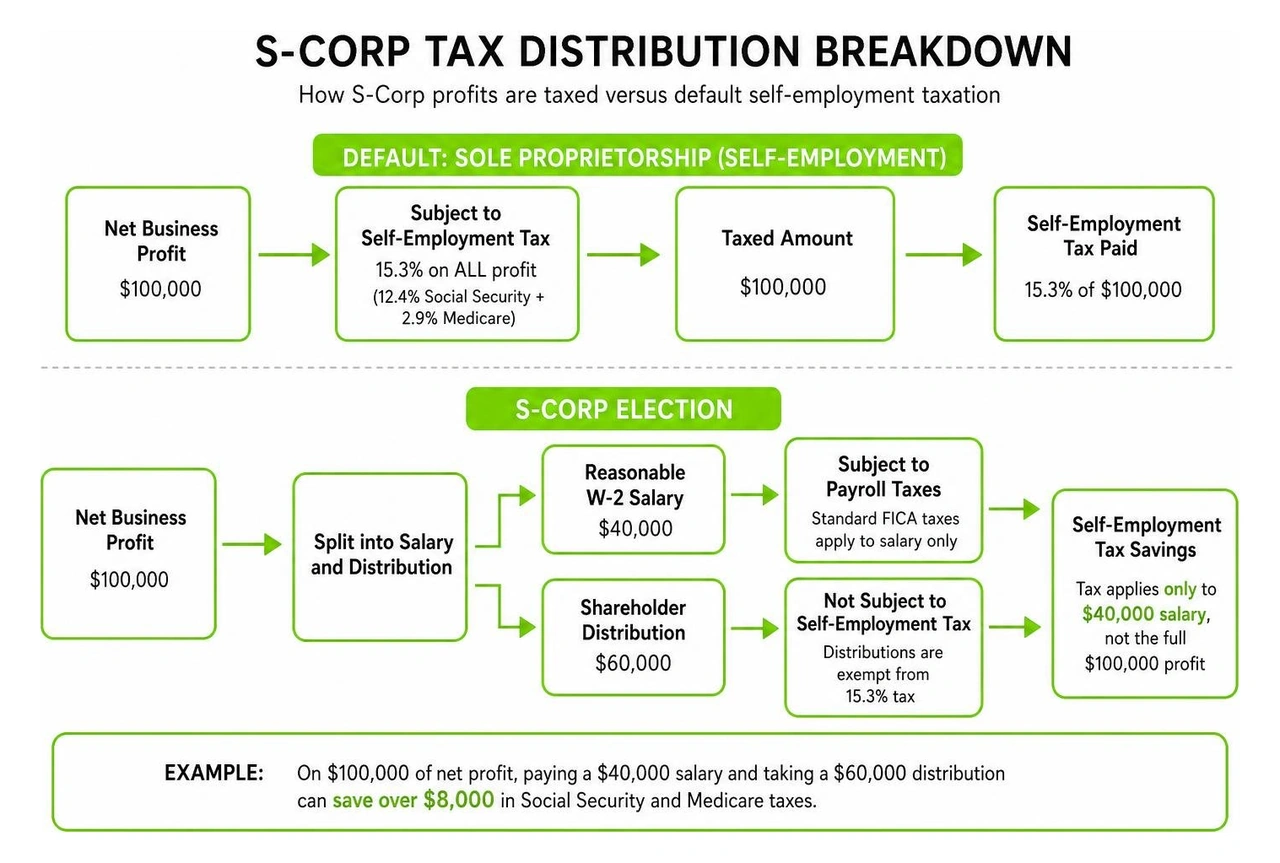
Consider a solo creative consultant generating $100,000 in net profit. Under default sole proprietorship taxation, the full $100,000 is subject to self-employment taxes. By electing S-Corp status and taking a reasonable W-2 salary of $40,000 while receiving the remaining $60,000 as profit distributions, the contractor can save over $8,000 in Social Security and Medicare taxes in a single year. High-earning professionals, such as independent physicians making $310,000 who pay themselves a $100,000 salary, can save upwards of $15,136 in annual payroll taxes.
To evaluate whether this tax structure fits your current revenue, refer to our 1099 contractor profit tracking guide to monitor net margins and build an organized growth framework.
The 2026 Reporting Threshold and Payment Processor Rules
For calendar year 2026 payments, the federal reporting threshold for nonemployee compensation on Form 1099-NEC increased from $600 to $2,000. Clients are required to issue a 1099-NEC only when cumulative direct payments to an unincorporated LLC contractor reach $2,000 or more within the tax year.
Payment channels fundamentally determine who issues tax documentation:
- Direct Payments (ACH, Cash, Paper Checks): Clients track payments toward the $2,000 threshold and file Form 1099-NEC directly with the IRS and the recipient contractor.
- Payment Settlement Entities (Credit Cards, PayPal, Stripe): When a client pays an LLC via credit card or third-party payment networks, federal reporting responsibility shifts under Section 6050W to the payment processor. The processor reports gross transactions on Form 1099-K.
Clients must never issue a Form 1099-NEC for transactions processed over payment cards or electronic merchant networks. Doing so creates duplicate income reporting that complicates tax filing and can trigger unnecessary IRS inquiries.
Frequently Asked Questions About 1099 Rules for LLCs
Does a single-member LLC automatically receive a 1099 form?
Not automatically. A single-member LLC receives Form 1099-NEC only if the services were paid in the course of a trade or business, the LLC has not elected corporate tax status, the cumulative payments met the $2,000 reporting threshold for 2026, and the funds were transferred via direct payment methods like check or direct deposit. Personal payments, such as paying a contractor to design a personal family website, are never reportable on Form 1099.
What happens if a client fails to issue a required 1099 to an LLC?
If a client fails to file a required 1099-NEC by the statutory deadline, the payer faces IRS late filing penalties. For 2026, penalties scale from $60 per return for corrections within 30 days to $340 per return for forms unfiled past August, with penalties assessed separately for the IRS copy and payee copy. Intentional disregard carries severe penalties with no maximum cap.
Contractors must remember that receiving no 1099 does not mean zero taxable income. All business earnings must be declared on your tax return. Review our guide on when are 1099s due to ensure your business stays ahead of annual filing deadlines and avoids audit risks.
How do credit card payments change 1099 reporting for an LLC?
When an LLC contractor accepts payments through credit card processors or third-party merchant platforms, those receipts fall under Form 1099-K reporting rules. The hiring client is legally exempt from issuing a Form 1099-NEC for those card payments. The merchant processor handles the year-end reporting, allowing the contractor to reconcile gross payment receipts against merchant processing fees directly in their bookkeeping ledger.
Conclusion
Structuring your contracting business with an LLC offers the ideal balance of personal asset protection and flexible tax strategies. While managing state filing requirements, separate bank accounts, and annual W-9 compliance takes diligence, the peace of mind and tax advantages make the effort well worth it for growing creative businesses.
At Core Group, we provide tailored financial management, bookkeeping, and tax planning services designed specifically for creative entrepreneurs. Our no-fluff, profit-first playbook eliminates the stress of business compliance, keeping your books spotless and maximizing your tax savings so you can focus entirely on growing your craft, backed by our signature MacBook Pro guarantee.
Take control of your business structure and tax obligations today. Master your filings and protect your business with this extensive guide to single member LLC 1099 reporting.