1099 Tax Calculator: The LLC Guide to Estimating What You Owe the IRS
What Every LLC Owner Needs to Know About 1099 Tax Estimation
If you are an LLC owner trying to use an LLC get 1099 tax estimator, here is the quick answer on what you owe
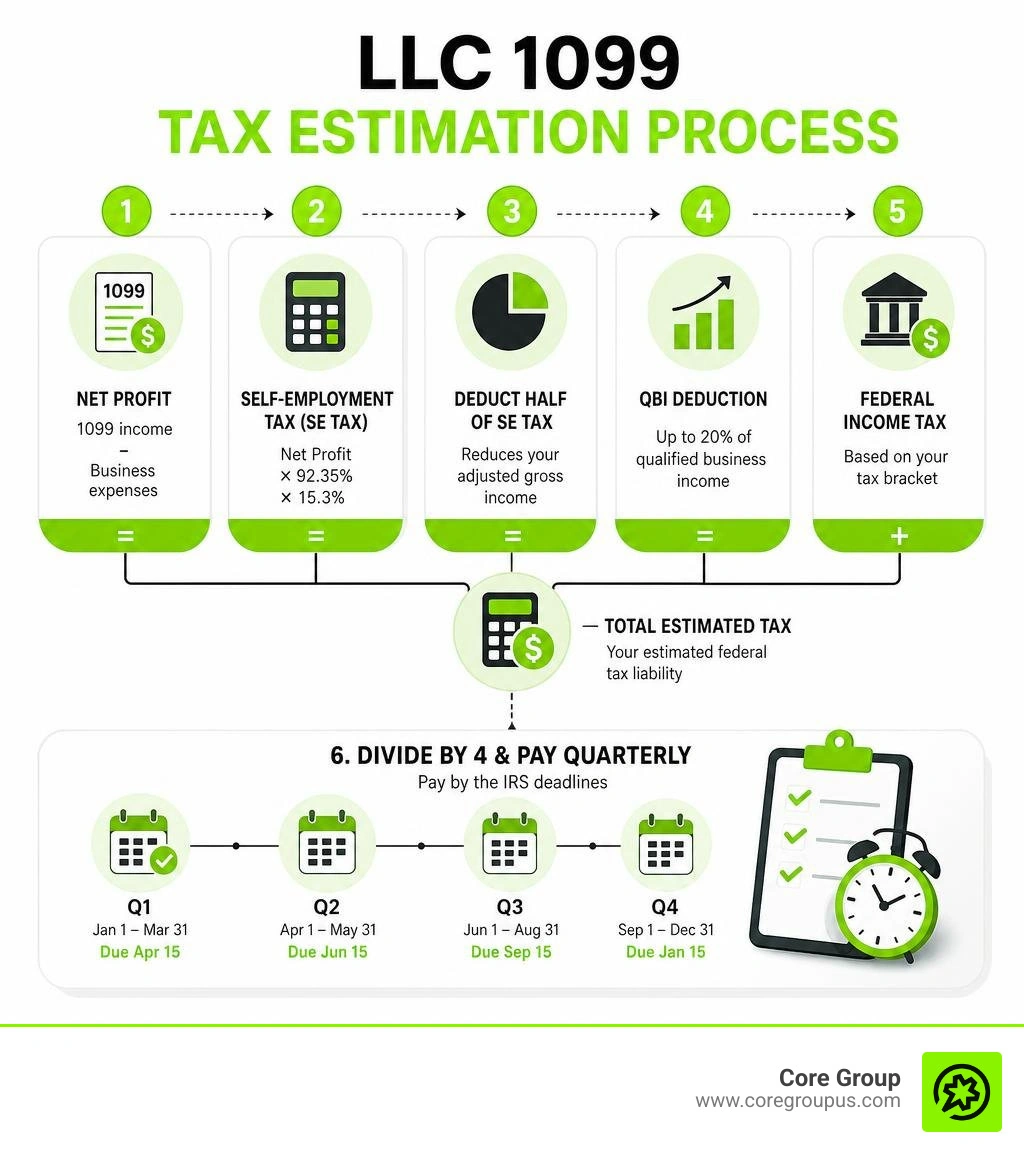
| Step | What to Do |
|---|---|
| 1. Find your net profit | Gross 1099 income minus business expenses |
| 2. Calculate self-employment tax | Net profit x 92.35% x 15.3% |
| 3. Deduct half of SE tax | Reduces your adjusted gross income |
| 4. Apply QBI deduction | Up to 20% of qualified business income |
| 5. Add federal income tax | Based on your tax bracket |
| 6. Divide by 4 | Pay quarterly by the IRS deadlines |
For most LLC owners earning $100,000 in 1099 income, the effective federal tax rate lands around 21.5%, meaning you should set aside roughly 25-30% of every payment you receive.
Tax season hits creative entrepreneurs especially hard. You are focused on your craft, not spreadsheets. But the IRS does not care about that, and underpaying your estimated taxes comes with real penalties.
The good news is that estimating your 1099 tax liability as an LLC is more straightforward than it looks once you understand the moving parts. This guide breaks down exactly how the math works, what deductions reduce your bill, and when it makes sense to rethink your LLC tax structure entirely.
We are Core Group, and we help creative entrepreneurs take control of their finances so they can get back to doing what they love.
Llc get 1099 tax estimator terminology is listed below
How LLCs Calculate Self Employment Tax on 1099 Income
When you transition from a traditional W-2 job to running your own business, the way you pay taxes changes completely. As an employee, your employer quietly withholds your taxes from every paycheck. As an LLC owner receiving 1099 income, you are responsible for calculating and paying these taxes yourself.
The first major component of your tax bill is self-employment tax. This tax is the freelancer equivalent of the FICA taxes that W-2 employees pay. It funds Social Security and Medicare.
The self-employment tax rate is a flat 15.3 percent. This rate is broken down into two distinct parts
- 12.4 percent for Social Security, which covers retirement, disability, and survivor benefits.
- 2.9 percent for Medicare, which covers hospital insurance.
For W-2 employees, the employer pays half of this bill, and the employee pays the other half. When you operate an LLC, you are considered both the employer and the employee. This means you must pay the full 15.3 percent yourself.
Fortunately, the IRS does not tax your gross revenue. Instead, you only pay self-employment tax on your net business earnings. To find this number, you list your gross revenue on Schedule C of your Form 1040 and subtract your allowable business expenses. The resulting number is your net profit.
The IRS also gives you a small break by applying the 15.3 percent self-employment tax rate to only 92.35 percent of your net earnings, rather than the full 100 percent. This adjustment is designed to mimic the tax deduction that traditional employers receive for paying payroll taxes.
To calculate this, you will use Schedule SE. You take your net profit from Schedule C, multiply it by 92.35 percent, and then multiply that result by 15.3 percent. For a detailed breakdown of how this income is defined and treated, you can read our LLC 1099 Income Guide 2026.
Once you calculate your total self-employment tax, you can deduct exactly half of that amount as an above-the-line deduction on your personal tax return. This deduction reduces your adjusted gross income, which in turn lowers your federal income tax liability. To run these numbers automatically and see the math in action, you can use the IRS 1099 Tax Calculator 2025 and 2026 with 15.3 percent SE Tax and 20 percent QBI to get a clear picture.
Quarterly Estimated Tax Deadlines and Safe Harbor Rules
Because the United States tax system operates on a pay-as-you-go basis, you cannot simply wait until April of the following year to pay your entire tax bill. If you expect to owe $1,000 or more in taxes for the year, you must make quarterly estimated tax payments using Form 1040-ES.
These payments are due four times a year, and the deadlines are highly strict
- First Quarter payments are due April 15.
- Second Quarter payments are due June 15.
- Third Quarter payments are due September 15.
- Fourth Quarter payments are due January 15 of the following year.
If any of these dates fall on a weekend or a legal holiday, the deadline is pushed to the next business day.
Failing to make these payments on time, or underpaying what you owe, can result in an underpayment penalty. The IRS calculates this penalty based on how much you underpaid and how long the payment was overdue.
To protect yourself from these penalties, you can rely on the safe harbor rules. You will generally avoid an underpayment penalty if you pay at least one of these two amounts through your quarterly payments
- 90 percent of your total tax liability for the current tax year.
- 100 percent of your total tax liability from the prior tax year, or 110 percent if your adjusted gross income was over $150,000.
Using the prior year safe harbor rule is often the easiest path because it is a fixed, known number. If you pay at least 100 percent of what you owed last year, you will not face penalties even if your business experiences a massive surge in income this year. To learn more about how federal brackets apply to your business structure, check out our guide on Federal Income Tax LLC.
The Section 199A Qualified Business Income Deduction
One of the most powerful tax saving tools available to LLC owners is the Qualified Business Income deduction, which is also known as the Section 199A deduction. This rule allows eligible self-employed individuals and pass-through entity owners to deduct up to 20 percent of their qualified business income directly from their federal taxable income.
This deduction is taken on your personal tax return, and you do not need to itemize your deductions to claim it. It is available to sole proprietors, partners in partnerships, and S corporation shareholders.
However, the QBI deduction is subject to complex phase-out thresholds that change every tax year. For single filers and married couples filing jointly, the full 20 percent deduction is readily available if your taxable income falls below the initial threshold.
Once your taxable income exceeds those limits, the deduction begins to phase out. If your business is classified as a Specified Service Trade or Business, such as law, medicine, accounting, performing arts, or consulting, the deduction phases out completely once you cross the upper threshold. For non-service businesses, the deduction is limited by the amount of W-2 wages the business pays and the unadjusted basis of its qualified property.
Understanding how to navigate these phase-outs is essential for high-earning creatives. For a deep dive into maximizing this benefit and protecting your income, read our LLC Get 1099 Tax Maximum Guide 2026.
Sole Proprietorship versus S Corp Tax Status for LLCs
By default, a single-member LLC is treated as a disregarded entity by the IRS, which means it is taxed as a sole proprietorship. All of your business income and expenses flow directly to your personal tax return, and you pay self-employment tax on the entire net profit.
While this structure is simple to manage, it can become incredibly expensive as your business grows. This is because you are paying that 15.3 percent self-employment tax on every single dollar of profit you make.
To reduce this tax burden, many LLC owners choose to elect S Corporation tax status. This is done by filing Form 2553 with the IRS.
Under an S Corp structure, your LLC is still a pass-through entity, but the way you are taxed changes dramatically. You become an employee of your own corporation. You must pay yourself a reasonable salary, which is subject to standard FICA payroll taxes.
The magic of the S Corp lies in how the remaining profits are treated. Any profit left over after paying your reasonable salary can be distributed to you as shareholder distributions. These distributions are completely exempt from the 15.3 percent self-employment tax.

To make this work, your salary must be considered reasonable by the IRS. If you pay yourself an unrealistically low salary to avoid taxes, the IRS can audit your business and recharacterize your distributions as wages, hitting you with back taxes, interest, and penalties.
The decision to elect S Corp status is a classic mathematical breakeven problem. Setting up and running an S Corp requires additional administrative overhead, including payroll service fees, bookkeeping costs, and the cost of filing a separate corporate tax return, which is Form 1120-S. These administrative costs typically range from $1,500 to $3,000 annually.
Generally, the S Corp election begins to make financial sense when your net business profit is between $40,000 and $80,000. At this level, the tax savings on your distributions will easily outweigh the added administrative costs. To determine if your business is ready to make this leap, read our analysis on Is an LLC a Sole Proprietorship or Corporation and review our guide on Single Member LLC Taxes.
Here is a direct comparison of how these two structures stack up
| Tax Feature | Sole Proprietorship Status | S Corporation Status |
|---|---|---|
| Tax Filing Form | Schedule C on Form 1040 | Form 1120-S and Schedule K-1 |
| Self-Employment Tax | Paid on 100% of net business profits | Paid only on W-2 salary portion |
| Payroll Requirement | No payroll required | Payroll must be run for owner salary |
| Administrative Costs | Very low | Moderate to high for payroll and tax filing |
| QBI Deduction Impact | Limited by zero W-2 wages at high incomes | W-2 salary helps unlock deduction at high incomes |
How to Use an LLC Get 1099 Tax Estimator to Project Your Liability
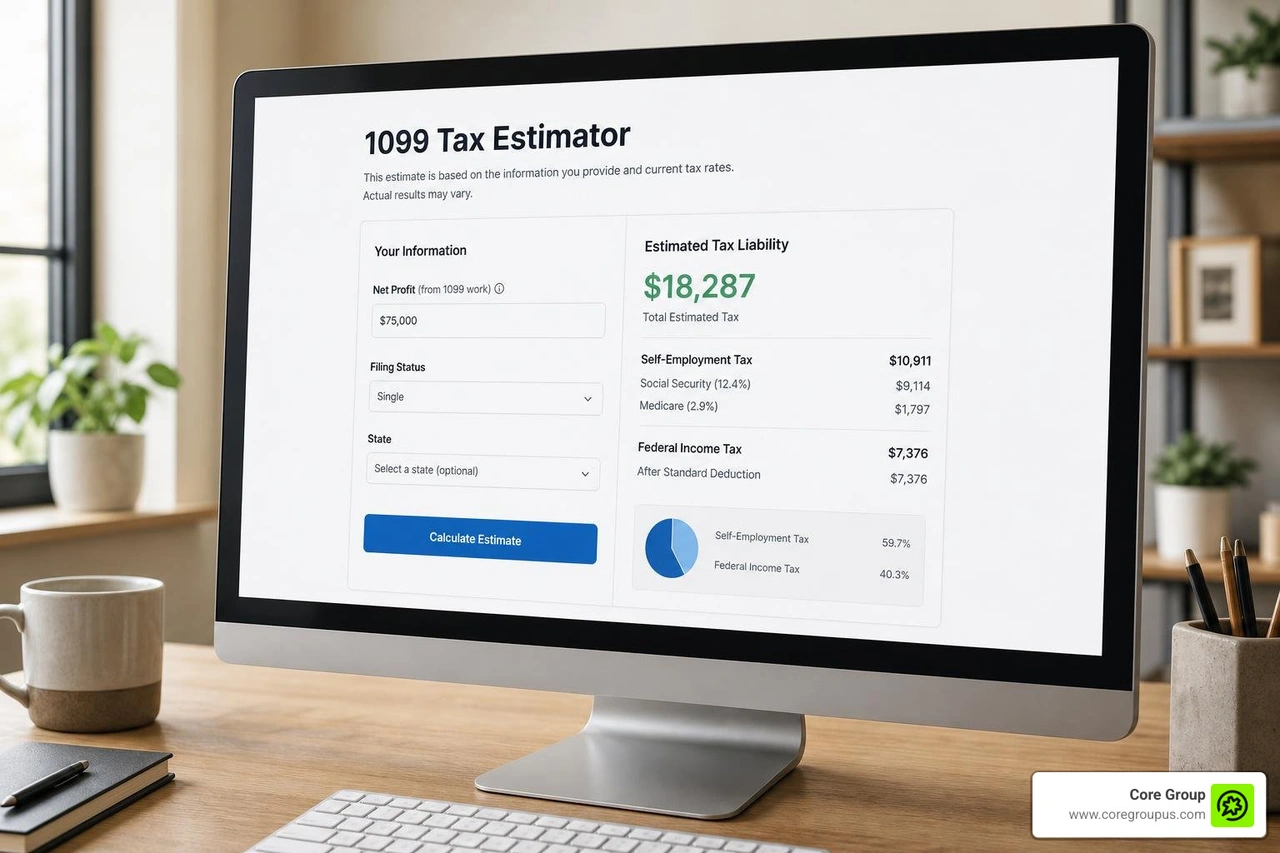
Using an online tool or calculator is the fastest way to get a handle on your upcoming tax bill. A quality llc get 1099 tax estimator will take your financial data and project exactly what you will owe in both self-employment and federal income taxes.
To use an estimator effectively, you must understand the difference between your gross income and your net profit. Your gross income is the total amount of money your clients paid you before any expenses are taken out. Your net profit is what is left over after you subtract all of your ordinary and necessary business expenses.
Once the estimator has your net profit, it will apply the self-employment tax rate and estimate your federal income tax based on the current tax brackets. Because the United States uses a progressive income tax bracket system, your tax rate increases as your income climbs. An estimator accounts for these brackets to give you an accurate, personalized effective tax rate.
To keep your profit numbers accurate throughout the year, you can follow our 1099 Contractor Profit Tracking Guide.
Key Inputs Required for an LLC Get 1099 Tax Estimator
To get the most accurate results from a tax estimator, you need to gather a few key pieces of information. If you put incorrect numbers in, you will get incorrect estimates out.
You should have the following inputs ready
- Gross 1099 receipts, which is the total of all payments you expect to receive from clients during the tax year.
- Estimated deductible business expenses, which includes everything from software subscriptions to advertising costs.
- Your filing status, such as single, married filing jointly, or head of household, because this determines your tax brackets and standard deduction.
- Your state of residence, because state income tax rates vary wildly and significantly impact your total tax burden.
Keeping close tabs on your business expenses throughout the year is the only way to ensure these inputs are correct. For strategies on staying organized, read our guide on 1099 Contractor Expense Tracking.
How the LLC Get 1099 Tax Estimator Accounts for Business Deductions
A great estimator does more than just subtract simple expenses. It also factors in advanced business deductions that can slash your taxable income.
The home office deduction is a prime example. If you use a portion of your home exclusively and regularly for your business, you can deduct a percentage of your rent, mortgage interest, utilities, and insurance. You can use either the simplified method, which is a flat $5 per square foot up to 300 square feet, or the actual expense method.
Vehicle mileage is another massive deduction. If you drive your personal vehicle for business purposes, you can track your miles and deduct them using the standard IRS mileage rate, which is $0.70 per mile.
Additionally, self-employed individuals can deduct 100 percent of their health insurance premiums for themselves, their spouses, and their dependents. This is an above-the-line deduction that does not require you to itemize.
Finally, retirement contributions made to self-employed retirement accounts, such as a SEP IRA or a Solo 401k, are fully deductible and can reduce your taxable income by tens of thousands of dollars. To ensure you are claiming every deduction you are legally entitled to, read our complete LLC Tax Deductions Guide 2026.
Frequently Asked Questions About LLC 1099 Taxes
What is the minimum 1099 income to file taxes as an LLC
Many people believe that if they make under a certain amount, they do not have to report their income. However, if you are operating an LLC or working as an independent contractor, you must file a tax return if your net earnings from self-employment are $400 or more.
This $400 threshold applies to your combined net earnings across all of your self-employment activities. If you cross this threshold, you must file Schedule C and Schedule SE to calculate and pay your self-employment tax.
Even if your net earnings are under $400, you may still be required to file an income tax return if you meet other filing requirements, such as having W-2 income or investment earnings. To learn more about these filing minimums, read our guide on the LLC Get 1099 Minimum.
What are the most common LLC 1099 tax mistakes
One of the most common mistakes LLC owners make is failing to save enough money for their quarterly estimated tax payments. It is incredibly easy to treat every dollar that enters your business bank account as personal spending money, only to face a massive, unexpected tax bill in April.
Another major error is mixing personal and business expenses. If you use your business credit card to pay for personal groceries or vacations, you are risking an IRS audit and weakening the liability protection of your LLC.
Finally, many business owners miss the quarterly tax deadlines entirely, which leads to avoidable underpayment penalties and interest. To protect your business from these traps, read our guide on LLC Get 1099 Mistakes.
How does an LLC report 1099 NEC income
If you provide services to another business and earn $600 or more, that business is required to send you a Form 1099-NEC, which stands for Nonemployee Compensation.
If your LLC is a single-member LLC, you do not file a separate tax return for the business. Instead, you report the income from all of your 1099-NEC forms on Schedule C of your personal Form 1040.
You do not need to attach the actual 1099-NEC forms to your tax return, but you must keep them in your records. The IRS receives copies of these forms directly from the businesses that paid you, and they will use automated systems to match that data to your reported income. For a clear explanation of how this form works, check out our guide where we have 1099 NEC Explained.
Conclusion
Managing your taxes as an LLC owner does not have to be a source of constant stress and anxiety. By using an llc get 1099 tax estimator, tracking your business expenses diligently, and making your quarterly estimated tax payments on time, you can stay in the good graces of the IRS while keeping more of your hard-earned money.
At Core Group, we offer financial management, bookkeeping, and tax services specifically tailored for creative entrepreneurs. We understand that your time is best spent on your craft, not on complicated tax calculations.
Our unique profit-first playbook is designed to give you total peace of mind and save you hours of administrative headache. We are so confident in our ability to streamline your business finances that we back our services with a MacBook Pro guarantee.
If you are ready to stop worrying about your taxes and start growing your business with confidence, read our guide on Single Member LLC 1099 Reporting and reach out to us today.