The Complete Introductory Guide to Filing S-Corporation Taxes
S Corporation Eligibility Requirements and Election Deadlines
Before enjoying pass-through tax benefits, a business must meet specific qualifications under Internal Revenue Code Subchapter S. Meeting these criteria is necessary to ensure the IRS accepts your S-corp tax filing status without issues.
An S corporation must be a domestic entity legally formed as a corporation or an LLC that chooses corporate taxation. In addition, the structure must satisfy strict ownership rules to maintain eligibility.
Shareholder Limits and Qualification Rules
The IRS limits an S corporation to no more than 100 shareholders. Family members can often be treated as a single shareholder for this limit, which provides flexibility for family-owned operations.
Shareholders must fit strict qualification rules. Allowable owners include individual US citizens and permanent residents, along with certain estates and qualifying trusts. Partnerships, corporations, and non-resident alien individuals cannot hold stock in an S corporation.
Furthermore, an S corporation can only issue a single class of stock. While voting rights can differ among shares, all shares must confer identical rights to distributions and liquidation proceeds. Failing to enforce equal economic rights risks revoking your status. Review our guide on S-Corp Eligibility Requirements for an in-depth breakdown of these rules.
Submitting Form 2553 for Early S-Corp Tax Help
To elect S corporation status, you must submit Form 2553, Election by a Small Business Corporation, to the IRS. Filing this form on time is critical for setting up your business correctly.
For a calendar-year entity, Form 2553 must be filed no later than 2 months and 15 days after the beginning of the tax year in which the election takes effect. For example, to secure S-corp status for 2026, you must submit Form 2553 by March 15, 2026. Every shareholder must sign the consent section of Form 2553.
If you miss this deadline, you may qualify for relief under Revenue Procedure 2013-30. This provision allows late election relief within 3 years and 75 days of the intended effective date, provided you show reasonable cause for the late submission. Following a structured S-Corp Setup Process helps keep your initial filings on track.
How Pass Through Taxation and Federal Filing Works
Pass-through taxation allows business profits and losses to pass directly through the corporate entity to individual shareholders. The S corporation acts as a conduit rather than a direct tax-paying entity for standard operating income. Profits flow to shareholder personal tax returns via Schedule E of Form 1040, preventing taxation at both the business and individual levels.
Comparing C Corporations and S Corporations
The main distinction between C corporations and S corporations centers on double taxation. C corporations pay federal income tax on net earnings at the entity level. When those earnings are distributed as dividends, shareholders pay income tax a second time on their individual returns.
S corporations avoid double taxation completely for standard operational profits. Corporate net income passes through to owners, who pay income tax based on their individual brackets.
| Tax Characteristic | C Corporation Structure | S Corporation Pass Through |
|---|---|---|
| Federal Income Tax Level | Entity level plus shareholder dividend level | Individual shareholder level only |
| Pass Through of Net Losses | Disallowed; net operating losses stay at corporate level | Allowed; passed through to shareholders subject to basis limits |
| Self Employment Tax Treatment | Dividends exempt, but double taxation applies to profit | Distributions exempt from FICA; salary subject to payroll tax |
| Max Shareholder Limit | Unlimited shareholders allowed | Capped at 100 qualifying shareholders |
| Stock Classes | Multiple classes permitted (Preferred, Common) | Single class of stock only |
Federal Tax Forms Deadlines and Schedule K-1 Breakdown
S corporations file Form 1120-S, U.S. Income Tax Return for an S Corporation, to report annual income, deductions, gains, losses, and credits. The standard filing deadline is March 15 for calendar-year businesses.
If you need more time to prepare your return, file Form 7004 to request an automatic 6-month extension. This moves the final filing deadline from March 15 to September 15. However, an extension to file is not an extension to pay any taxes owed.
Each shareholder receives a Schedule K-1 from the S corporation. This schedule details the owner's share of pass-through income, losses, and credits. Shareholders use their Schedule K-1 to fill out Schedule E on their personal Form 1040.
Starting in 2024 and continuing through 2026, S corporations filing 10 or more total returns across all form types per calendar year must e-file Form 1120-S. Tracking eligible deductions helps reduce total flow-through income on these filings; explore our list of S-Corp Business Deductions to learn more.
Essential Strategies for Professional S-Corp Tax Help

Operating an S corporation requires ongoing management beyond submitting annual tax forms. Keeping your tax strategy healthy involves setting up owner payroll correctly and keeping an eye on federal entity-level taxes.
Owner Payroll and Reasonable Compensation Requirements
An owner-operator who provides significant services to an S corporation must be classified as an employee and paid reasonable compensation via W-2 payroll. Paying yourself exclusively through profit distributions to avoid employment tax is illegal and triggers severe IRS audit penalties.
W-2 salaries are subject to FICA payroll taxes, which total 15.3% divided between employer and employee portions. This includes 12.4% for Social Security up to the wage base limit ($184,500 in 2026) and 2.9% for Medicare. Distributions taken after paying a reasonable compensation salary are exempt from self-employment taxes.
Determining reasonable compensation requires assessing industry standards, duties performed, geographic location, and time spent on the business. Setting salary levels defensibly is key to preserving pass-through tax savings. Read our guide to S-Corp Payroll Rules to structure your payroll correctly.
State Tax Variations and Pass Through Entity Tax Rules
State tax laws for S corporations do not always mirror federal rules. Some states impose corporate income taxes, minimum franchise fees, or require separate state-level election forms.
For example, California imposes a 1.5% net income tax on S corporations alongside an annual minimum franchise tax, managed through the Franchise Tax Board. Other states, such as Delaware, detail specific corporate income tax expectations on their official government platforms, including the Delaware Division of Revenue.
Many states offer Pass-Through Entity Tax (PTET) elections as a workaround for the federal $10,000 State and Local Tax (SALT) deduction cap. A PTET election allows the S corporation to pay income tax directly at the entity level, converting a personal state tax burden into a fully deductible business expense on federal Form 1120-S.
In contrast, certain local jurisdictions do not recognize pass-through status at all. New York City taxes S corporations at the entity level under its General Corporation Tax, removing state-level pass-through benefits for NYC-based businesses.
Avoiding Common S-Corp Tax Mistakes and Managing Basis

A frequent issue S corporation owners face is maintaining proper stock and debt basis tracking. Basis represents your financial investment in the entity and caps the amount of losses you can deduct on your individual tax return.
Shareholders must file Form 7203, S Corporation Shareholder Stock and Debt Basis Limitations, alongside their individual tax return to document basis calculations. Taking distributions that exceed your stock basis turns those payments into taxable capital gains.
We frequently see S-corp owners make several operational mistakes.
- Commingling business and personal funds by using business accounts for personal expenses
- Distributing profits unevenly among shareholders, violating the single class of stock rule
- Forgetting to submit state S-corp election forms, such as New York Form CT-6
- Failing to issue owner W-2s before taking non-dividend distributions
- Skipping annual basis updates on Form 7203, which blocks future loss deductions
Reviewing our full S-Corp Tax Planning Guide 2026 will help you avoid these mistakes and protect your entity's tax savings.
Frequently Asked Questions About S-Corporation Taxes
What happens if I miss the Form 2553 filing deadline?
If you miss the initial deadline to file Form 2553, you can apply for late election relief under Rev. Proc. 2013-30. You must submit Form 2553 within 3 years and 75 days of your intended effective date, attach a statement explaining your reasonable cause for missing the deadline, and confirm all shareholders reported income consistently.
Does an S corporation pay federal income tax directly?
Generally, an S corporation pays no direct federal corporate income tax. However, entity-level federal taxes apply in specific scenarios. Former C corporations converting to S-corps may owe Built-in Gains tax if converted assets are sold at a gain within 5 years, or Excess Net Passive Income tax if passive income exceeds 25% of gross receipts alongside accumulated C-corp earnings.
How does state taxation differ from federal S-corp tax help?
State rules vary widely. While federal pass-through status avoids corporate income taxes, states like California tax S-corp profits at 1.5%. Other areas, like New York City, treat S corporations as regular C corporations for municipal tax purposes. Many states also require separate state election forms beyond federal Form 2553.
Conclusion

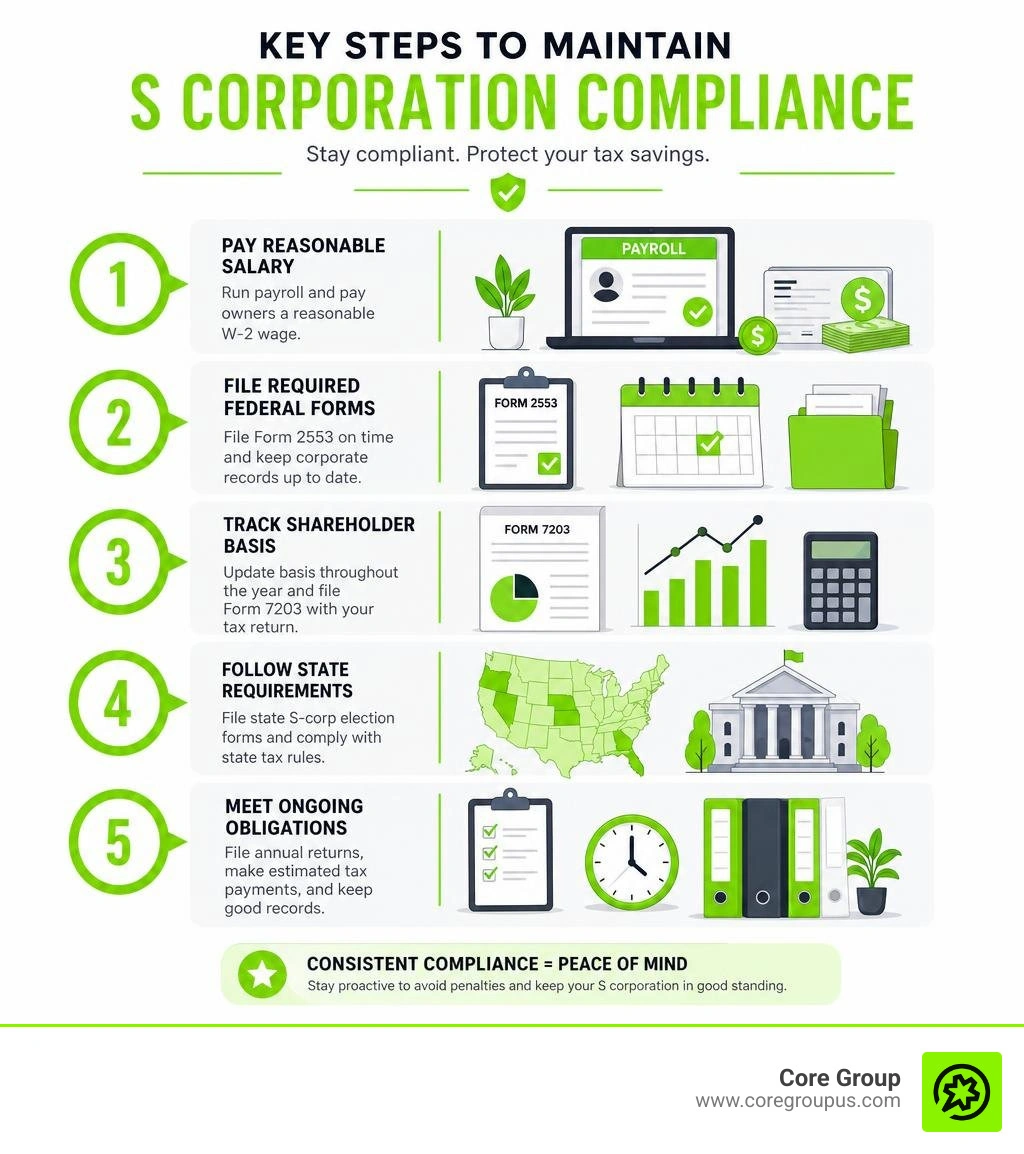
Navigating S corporation tax requirements requires staying top of deadlines, managing reasonable compensation payroll, tracking shareholder basis, and following state tax rules.
At Core Group, we offer financial management, bookkeeping, and tax services for creative entrepreneurs across the nation. Our no-fluff, profit-first playbook provides complete peace of mind, freeing you from financial management chores so you can focus on growing your creative business.
If you are ready to set up an S corporation or need ongoing compliance help, check out our guide on How to Form S-Corp to build a clear strategy for your business today.