A Practical Guide to Compare Tax Planning Strategies
The Main Types of Tax Planning to Compare
The main types of tax planning are short-term, long-term, permissive, purposive, and strategic planning. Each serves a different purpose.
- Short-term planning lowers taxes for the current year through valid deductions, credits, expense timing, and retirement contributions.
- Long-term planning uses multi-year decisions such as retirement saving, asset sales, and business growth to improve after-tax wealth.
- Permissive planning uses tax breaks the law clearly allows.
- Purposive planning connects tax choices to real goals, such as buying a home, funding education, or building a creative business.
- Strategic planning brings these methods together with entity structure, income timing, cash flow, and future tax rates.
For a film, media, or creative business owner, the right approach is rarely about chasing the biggest write-off. It is about keeping more of what you earn while protecting cash flow, staying compliant, and making decisions that support the work you want to create.
I am Christian Brim, and the sections ahead will help you compare these approaches and choose the mix that fits your business and personal goals.
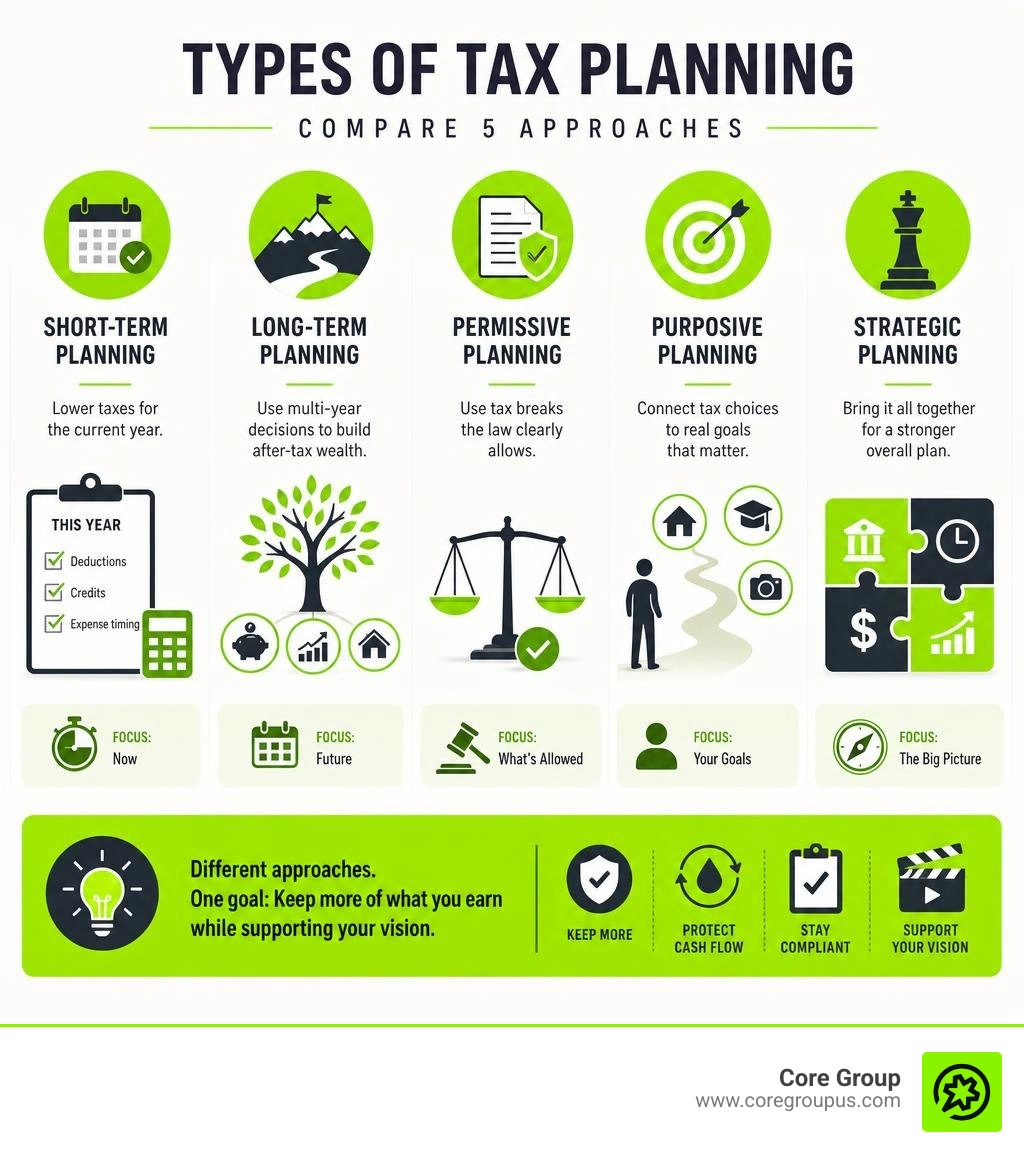
Types of tax planning word guide
Core Objectives and Benefits of Strategic Tax Planning
At Core Group, we believe tax strategy should never happen in isolation from your day-to-day operations. True tax optimization is about aligning legal tax code incentives with your operational cash flow so you can reinvest in your creative craft. When we structure your financial affairs, we pursue distinct objectives that protect your enterprise and build lasting wealth.
The primary objective is the direct reduction of overall tax liability. By capturing every legitimate deduction, credit, and statutory exemption, your enterprise retains more capital. That saved capital directly funds team expansion, studio upgrades, and new media projects.
Another critical objective is litigation minimization. Operating aggressively without clear legal grounds invites IRS audits, costly penalties, and unnecessary disputes. A compliant, well-documented tax strategy builds a transparent wall around your earnings.
Strategic tax planning also fosters systematic capital accumulation. Rather than sending excess cash to tax authorities, you redirect those funds into wealth-generating assets like retirement accounts, interest-bearing instruments, and business infrastructure. This creates economic stability for your business, smoothing out the natural income spikes and dry spells of the creative industry.
Maintaining a healthy cash flow allows you to meet operational expenses and handle estimated tax payments without stress. Understanding the essential intersection of Tax Planning and Tax Management ensures you do not just calculate what you owe, but manage when and how cash leaves your bank accounts. When you deploy comprehensive Tax Planning Strategies, your financial decisions become intentional growth drivers rather than reactive scrambles.
Proactive Financial Management vs Reactive Tax Preparation
Many creative entrepreneurs confuse tax preparation with tax planning. Tax preparation looks in the rearview mirror. It is historical reporting where an accountant takes what happened over the past twelve months, puts the numbers into tax software, and tells you what you owe. By the time you sit down to file your tax return in the spring, the window to alter your tax outcome has already closed.

Proactive financial management looks forward through the windshield. We project your revenue, track your expenses quarterly, and model out your marginal tax brackets before the tax year ends.
This forward forecasting lets us manage your bracket thresholds intentionally. For instance, if we see your creative agency is having a banner fourth quarter, we can implement equipment expensing or accelerate retirement contributions before December 31 to keep your income from pushing into a higher federal tax bracket.
This ongoing review creates cash flow predictability. Instead of experiencing the dread of an unexpected tax bill, you know your liabilities in advance, make accurate quarterly payments, and keep your business running smoothly.
Primary Types of Tax Planning Explained
Tax strategy operates across multiple dimensions. Understanding how these approaches differ based on timeframes and statutory intentions helps you select the best approach for your creative enterprise.
| Planning Type | Primary Objective | Time Horizon | Key Examples |
|---|---|---|---|
| Short-Term | Immediate tax reduction for the current fiscal year | Under 12 months | Year-end equipment expensing, harvesting capital losses, maxing annual IRA or 401(k) limits |
| Long-Term | Multi-year asset growth, tax deferral, and wealth preservation | 2 to 10+ years | Setting up defined benefit plans, Roth conversion ladders, long-term real estate holding |
| Permissive | Utilizing explicit statutory deductions and exemptions allowed by the tax code | Ongoing / Annual | Claiming standard or itemized deductions, home office write-offs, IRA deductions |
| Purposive | Aligning tax-advantaged choices with specific life or business milestones | Goal-dependent | 529 college savings plans, Health Savings Accounts (HSAs), capital equipment acquisitions |
| Strategic | Structuring the overall business model and entity classification for permanent tax efficiency | Multi-year structural | S corporation elections, partnership profit allocations, multi-tier corporate structuring |
For deeper technical definitions of these foundational mechanisms, review the comprehensive guide on Key Tax Planning Concepts and Issues.
Understanding Short Term and Long Term Types of Tax Planning
Short-term tax planning focuses on immediate, tactical maneuvers completed within a single tax year. This method targets rapid tax liability reduction before the year closes. For creative businesses, short-term planning often involves claiming Section 179 deductions on production gear, cameras, and editing suites purchased before December 31. It also includes taking advantage of clean energy incentives.
Under the Inflation Reduction Act, businesses and property owners can claim the Residential Clean Energy Credit, which offers a 30% credit for systems installed through 2032, before stepping down to 26% in 2033 and 22% in 2034. Individuals can also leverage the Clean Vehicle Credit, providing up to $7,500 for qualified electric vehicles, subject to adjusted gross income limits of $300,000 for married joint filers and $150,000 for single filers. To make sure you do not miss standard year-end windows, review our Year-End Tax Planning Tips 2026.
Long-term tax planning focuses on cumulative wealth preservation over several years or decades. This approach does not always seek to eliminate taxes in year one. Instead, it balances tax obligations across multiple years to minimize lifetime tax drag.
Long-term planning involves establishing multi-tier retirement plans like Solo 401(k)s or Defined Benefit plans, managing long-term capital gains brackets, and structuring staged equity transfers. By pacing income realization over multiple years, you prevent high-revenue spikes from triggering the top 37% federal income tax bracket or the 3.8% Net Investment Income Tax.
Comparing Permissive and Purposive Types of Tax Planning
Permissive tax planning works directly within the explicit provisions, exemptions, and deductions provided by statutory tax laws. When you claim the standard deduction ($16,100 for single filers and $32,200 for married couples filing jointly in 2026), deduct necessary business software subscriptions, or claim legitimate travel expenses for client shoots, you are engaging in permissive planning. You are simply exercising the rights granted to you by the tax code without needing complex restructuring.
Purposive tax planning goes a step further by using specific provisions of the tax code to achieve targeted financial and personal objectives. The tax code is designed with economic incentives to encourage specific behaviors like saving for retirement, building clean energy infrastructure, or funding higher education.
Purposive planning coordinates these incentives with your actual life goals. For example, contributing to a Health Savings Account (HSA) gives you a triple tax advantage (tax-deductible contributions, tax-free growth, and tax-free withdrawals for qualified medical expenses) while building a dedicated medical reserve fund for your family.
Similarly, establishing a 529 plan uses state-sanctioned tax-free growth to fund a child's future education. Academic frameworks detailed in TAXES AND BUSINESS STRATEGY show how aligning statutory provisions with contractual and investment goals maximizes after-tax returns.
Strategic and Structural Tax Planning for Business Entities
Strategic tax planning focuses on the legal and organizational architecture of your business. How your business is organized under state and federal law dictates how every dollar of revenue is taxed. Operating as a default sole proprietorship or single-member LLC subjects all net earnings to both ordinary income tax and the 15.3% self-employment tax (covering Social Security and Medicare).
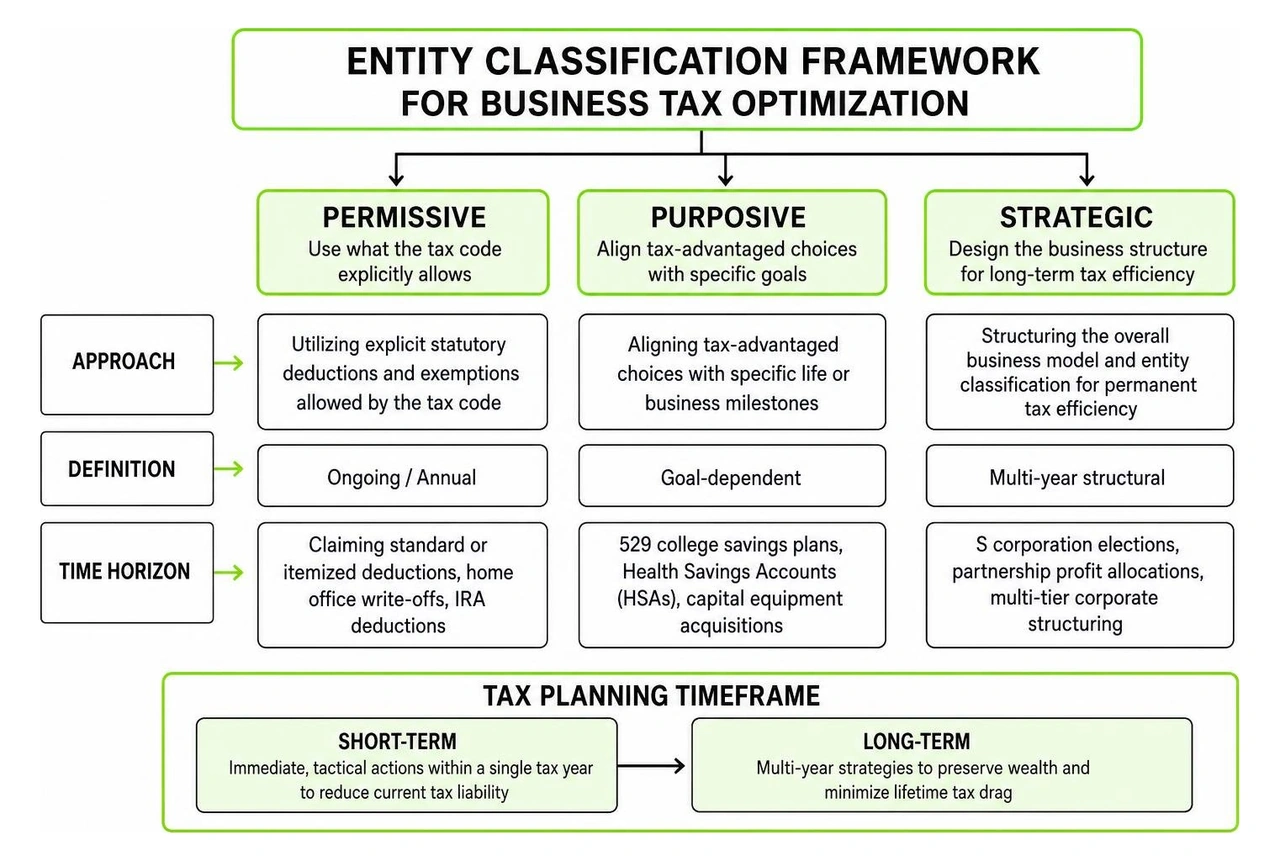
By implementing structural tax planning, an eligible creative agency can make an S corporation election. Under an S-Corp structure, net income splits into two streams, which are reasonable W-2 salary paid to the owner and shareholder distributions. While the W-2 salary is subject to payroll taxes, distributions pass through free from self-employment taxes.
For high-earning service businesses, this structural shift saves thousands of dollars annually. To explore this framework in detail, check out our S-Corp Tax Planning Guide 2026 and our breakdown of Corporate Tax Planning and Strategy.
Methodological Categories of Tax Planning
Beyond timeframes and entity types, tax strategy relies on three main financial methods: deferring income, converting income character, and shifting income across taxable entities.
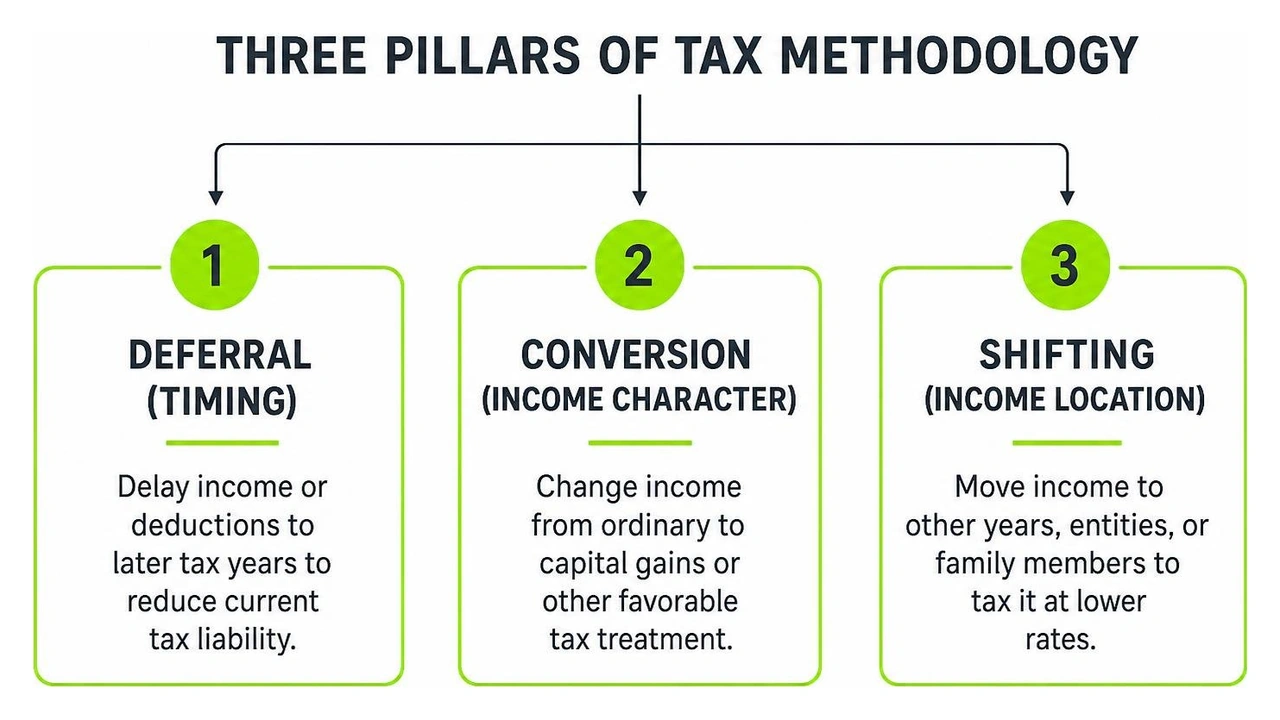
Deferral and Timing Methods
Deferral planning leverages the time value of money. A dollar of tax paid three years from now costs you significantly less in real purchasing power than a dollar paid today. Furthermore, money kept in your business today can be invested to generate additional profit before taxes come due.
Common deferral mechanisms include the following.
- Accelerating business deductions into the current tax year while deferring client billings into January of the subsequent tax year.
- Utilizing Section 179 expensing and bonus depreciation to write off qualifying equipment purchases immediately rather than spreading deductions over five to seven years.
- Establishing nonqualified deferred compensation (NQDC) plans or traditional workplace retirement accounts like 401(k) plans to delay income recognition until retirement, when your marginal tax rate may be lower.
- Structuring real estate and large asset sales via installment agreements to spread taxable gains over multiple years, keeping you in lower marginal brackets.
Implementing these timing strategies requires careful cash forecasting. For practical tactics, review our guide on Strategies to Minimize Taxes.
Income Conversion and Character Shifting
Not all income is taxed equally. In the United States, ordinary income generated from wages, freelancing, and active business operations faces progressive tax rates up to 37%. In contrast, long-term capital gains (assets held for over one year) enjoy lower rates of 0%, 15%, or 20%, depending on your overall taxable income.
Conversion planning changes the tax character of your income from highly taxed categories to lower-taxed or tax-exempt categories.
One powerful conversion strategy involves filing a Section 83(b) election within 30 days of receiving restricted equity in an early-stage venture. This locks in ordinary income value at grant (often negligible), converting all subsequent equity growth into long-term capital gains upon eventual sale.
Other conversion strategies include investing in qualified municipal bonds to generate federal tax-free interest, or investing in Qualified Small Business Stock (Section 1202), which can eliminate capital gains taxes entirely on qualifying business sales up to statutory limits.
Income Shifting Across Legal Entities and Family Members
Income shifting moves earnings from a taxpayer in a high marginal tax bracket to another taxpayer or entity in a lower marginal bracket.
Within family-owned enterprises, parents can employ their minor children to handle legitimate business tasks like media management, graphic design, or studio maintenance. The wages paid to the child are deductible business expenses for the company.
The child can then utilize their standard deduction ($16,100 in 2026) to pay zero federal income tax on those earnings, while funding a custodial Roth IRA that grows tax-free for decades.
For larger enterprises and high-net-worth creators, income shifting involves setting up Family Limited Partnerships (FLPs) or trusts to spread ownership of income-producing assets across family members.
When structuring partnerships and multi-member entities, establishing proper governance ensures you Avoid Double Taxation and stay compliant with IRS allocation rules.
Evaluating the Risks and Legal Boundaries in Tax Strategy
Every tax strategy exists on a spectrum from compliant planning to illegal evasion. Understanding these boundaries protects your business from expensive audits, civil penalties, and legal disputes.
Tax Planning vs Tax Avoidance and Tax Evasion
Tax planning is the lawful arrangement of your financial affairs to minimize tax liabilities using explicit statutory provisions and economic incentives.
Tax avoidance also operates within legal bounds, but it pushes into aggressive territory by finding unintended loopholes and gray areas in the statutory language. While not criminal, aggressive tax avoidance schemes often trigger IRS audits, transaction recharacterizations, and substantial accuracy-related penalties if disallowed.
Tax evasion is illegal. It involves deliberately concealing income, fabricating deductions, disguising transactions, or falsifying business records. Evasion carries severe criminal penalties, including heavy fines and imprisonment.
Maintaining meticulous accounting records, retaining receipts, and working with licensed tax advisors ensures your tax positions remain defensible under audit. For an objective overview of compliant tax practices, review the educational resources on Tax Planning Strategies and Benefits.
Judicial Doctrines and Statutory Limitations
The IRS and federal courts apply specific judicial doctrines to evaluate whether a tax strategy holds up under legal scrutiny. If a strategy lacks real-world substance, authorities can disregard the legal paperwork and tax the transaction according to its underlying reality.
Key judicial doctrines include the following.
- Economic Substance Doctrine. The transaction must change your economic position in a meaningful way, aside from any federal income tax benefits.
- Business Purpose Doctrine. The underlying transaction must serve a legitimate business goal. Setting up an entity purely to generate tax losses is disallowed.
- Substance Over Form Doctrine. Tax authorities look at the actual economic reality of a deal rather than the formal legal paperwork used to disguise it.
- Assignment of Income Doctrine. Income is taxed to the individual or entity that actually earns it; you cannot simply assign your paycheck to someone else to lower your tax bracket.
- Step Transaction Doctrine. A series of separate, formally distinct steps will be evaluated as a single integrated transaction if they were planned together to bypass tax rules.
Frequently Asked Questions About Tax Planning
What is the most effective approach among all tax planning methods?
No single tax planning method works best on its own. The most effective approach is a blended, strategic plan tailored to your cash flow, business model, and personal risk profile.
For creative entrepreneurs, this means pairing structural planning (such as an S-Corp election) with permissive year-round expense tracking, purposive savings via HSAs and Solo 401(k)s, and smart income-timing strategies at year-end. A good tax strategy should never create cash flow shortages or force you into risky investments just to save a dollar on taxes.
How do tax credits differ from deductions in short term planning?
Tax deductions and tax credits lower your tax bill in very different ways.
- Tax Deductions reduce your total taxable income. The actual dollar savings depend on your marginal tax bracket. For example, if you are in the 24% tax bracket, a $1,000 deduction saves you $240 in federal taxes.
- Tax Credits reduce your tax liability dollar-for-dollar. A $1,000 tax credit wipes out a full $1,000 of taxes owed, regardless of your marginal tax bracket.
When organizing your short-term plans, prioritize qualifying for tax credits (like clean energy and clean vehicle credits) before maximizing above-the-line and itemized deductions.
Can small business owners combine multiple tax planning methods in 2026?
Yes, combining multiple tax planning methods is the foundation of effective tax strategy.
A creative studio can operate as an S corporation (structural planning), claim the standard business deductions for travel, software, and marketing (permissive planning), set up a Solo 401(k) to build retirement wealth (purposive planning), and make smart year-end equipment purchases using Section 179 depreciation (deferral and timing planning). Combining these approaches ensures your business captures savings at the corporate, payroll, and personal income tax levels.
Conclusion
Tax planning is not a one-time chore you complete right before filing deadlines. It is an ongoing financial strategy that directly impacts your company's profitability, cash reserves, and long-term security.
By understanding the distinct types of tax planning (short-term, long-term, permissive, purposive, and strategic), you can move away from reactive tax scrambles and make intentional, forward-looking financial decisions.
At Core Group, we provide financial management, bookkeeping, and proactive tax strategy designed specifically for creative entrepreneurs.
We cut through the noise with our no-fluff, profit-first playbook that gives you complete peace of mind, saves you valuable time, and keeps you focused on your creative business, backed by our MacBook Pro guarantee.
Ready to stop guessing and start keeping more of your hard-earned revenue? Explore our customized tax planning resources and discover how simple, proactive tax management can transform your bottom line.