How to Master LLC Tax Reporting in 30 Days
How LLC Tax Classification Determines If Your LLC Gets a 1099 Payment
Whether your business receives a 1099 depends on how the IRS views your entity structure rather than your state registration. An LLC is a legal structure created under state law, but the IRS treats it as a tax chameleon. It can be taxed as a sole proprietorship, a partnership, an S Corporation, or a C Corporation.
Clients looking at an invoice cannot tell how your business files its taxes. That is why the Form W-9 you provide to clients dictates whether an llc get 1099 payment form at the end of the tax year.
To help navigate these nuances, you can check out this comprehensive resource on Do LLCs Get a 1099? Complete Answer by LLC Type (2026).
Single-Member LLC Rules for Receiving an LLC Get a 1099 Payment
By default, the IRS treats a single-member LLC as a disregarded entity. For income tax purposes, the IRS does not separate the owner from the business enterprise. Income and business expenses flow directly to the owner's personal tax return on Schedule C.
When filling out a Form W-9 for clients, a single-member LLC owner must place their personal name on Line 1 and the LLC business name on Line 2. You then check the box for Single-member LLC.
Because the IRS treats disregarded entities like sole proprietorships, clients who pay your single-member LLC for services must issue a Form 1099 when payments reach the reporting threshold. You can review detailed rules on single member llc 1099 reporting and learn how to navigate these requirements smoothly.
Multi-Member LLCs and Corporate Exceptions for an LLC Get a 1099 Payment
If your business has multiple owners, the IRS taxes your enterprise as a partnership by default. Multi-member LLCs taxed as partnerships are not exempt from 1099 reporting. Clients who pay a partnership for professional services must issue a 1099 form if total payments meet the annual threshold. Inside the business, partners do not get 1099 forms from the LLC itself. Profit distributions and guaranteed payments are reported on Schedule K-1 after the entity files Form 1065.
The rules change dramatically if your LLC elects to be taxed as an S Corporation or a C Corporation. The IRS generally exempts corporations from receiving 1099 information returns. Once your corporate election is active, clients who pay your company for standard services no longer need to send a 1099.
However, the corporate exemption has critical exceptions. The IRS mandates that two types of service payments trigger a 1099 regardless of corporate status.
- Medical and healthcare payments made in the course of business
- Payments made to attorneys for legal services or legal gross proceeds
If your LLC provides legal representation or medical care, clients must issue a 1099 even if your firm operates as an S Corp or C Corp. You can read more about these partnership nuances in Do LLC Partnerships Get 1099s? IRS Reporting Rules.
Form 1099-NEC versus Form 1099-MISC and Updated 2026 Thresholds
Understanding which form you receive or issue is vital for accurate tax filing. For years, nonemployee compensation was bundled on Form 1099-MISC. The IRS separated these reporting paths to streamline operations.
A major regulatory update takes effect for tax years beginning after 2025. For 2026 payments, the minimum threshold for reporting nonemployee compensation and miscellaneous payments increases from $600 to $2,000. This change significantly reduces administrative reporting loads for small businesses.
To review official agency guidelines, consult the Instructions for Forms 1099-MISC and 1099-NEC (12/2026) | Internal Revenue Service.
Nonemployee Compensation Rules for Form 1099-NEC
Form 1099-NEC is dedicated exclusively to nonemployee compensation. If a business pays an independent contractor, freelancer, or unincorporated LLC for services, those fees belong on Form 1099-NEC.
To trigger Form 1099-NEC reporting, payments must meet four criteria.
- The payment is made to someone who is not your employee
- The payment is made for services rendered in the course of your trade or business
- The payment is made to an individual, partnership, estate, or disregarded entity
- Total payments for the calendar year equal or exceed the reporting threshold
For 2026 payments, if your single-member LLC receives $2,000 or more in direct client payments via cash, check, or ACH for services, the payer must issue Form 1099-NEC by January 31. To dive deeper into form structures, review our breakdown on 1099 nec explained alongside our overview of the llc get 1099 minimum rules.
Rents Royalties and Attorney Payments on Form 1099-MISC
While Form 1099-NEC covers service fees, Form 1099-MISC handles miscellaneous business payments. For an llc get 1099 payment scenario involving non-service income, Form 1099-MISC is the correct document.
Common items reported on Form 1099-MISC include the following.
- Commercial rent paid to an LLC landlord ($2,000 threshold for 2026)
- Royalty payments ($10 threshold)
- Gross proceeds paid to an attorney in connection with legal settlements ($600 threshold)
- Prizes, awards, or medical and healthcare payments
For additional insights on tracking incoming revenue streams, explore our llc 1099 income guide 2026.
When Your Business Must Issue 1099 Forms to Contractors

As your enterprise grows, you will likely hire freelancers, graphic designers, or technical consultants. Managing an LLC means managing both sides of the 1099 equation. You must keep track of incoming client forms and remain compliant when issuing 1099 forms to vendors.
If your trade or business pays an unincorporated contractor $2,000 or more during 2026 for service work, you must issue them a Form 1099-NEC. For a thorough walkthrough on issuing forms, see Do I Need to Send a 1099 to an LLC? A Complete Guide | Salestaxcel.
Processing Form W-9 to Verify Payee Status
The primary tool for managing 1099 compliance is IRS Form W-9. You should make it a mandatory rule to collect a signed Form W-9 from every vendor before issuing your first payment.
Form W-9 collects essential vendor tax data.
- Business name and tax classification
- Exemptions from backup withholding
- Taxpayer Identification Number, such as an SSN or EIN
- Official signature and date
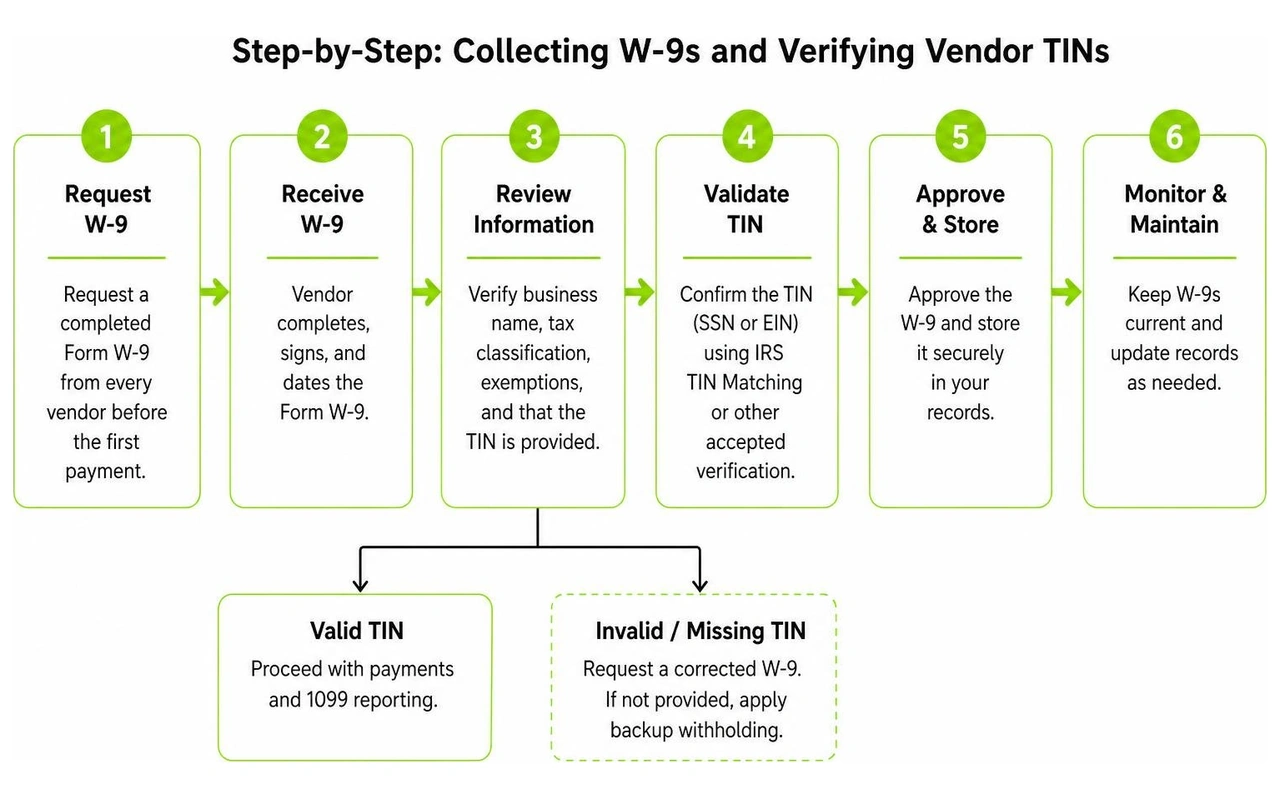
Collecting this form upfront prevents end-of-year stress. If a contractor refuses to provide a valid TIN, IRS rules require your business to begin backup withholding, deducting tax directly from vendor payments to remit to the IRS. You can streamline your document workflows by reviewing our guide on llc get 1099 documents.
Credit Card and Third-Party Payment Processor Exemptions
One of the most frequent accounting mistakes business owners make is double-reporting payments made through payment platforms.
If you pay a contractor using a credit card, PayPal, Stripe, or Venmo for Business, you do not issue a Form 1099-NEC. Third-party settlement organizations are governed by separate IRS rules under Section 6050W. Those entities issue Form 1099-K to report merchant transactions.
If you issue a Form 1099-NEC for payments settled through PayPal or credit cards, the IRS receives duplicate records of the contractor's income. This triggers unnecessary tax notices for your vendors. Only direct payments, such as cash, paper checks, wire transfers, and direct bank ACH transfers, should be included on your business Form 1099-NEC filings.
Common 1099 Mistakes and IRS Penalties to Avoid

Failing to meet IRS information return guidelines can lead to penalties that quickly eat into profit margins. Staying informed helps keep your hard-earned business revenue safe. For complete details on timelines, review our reference on when are 1099s due and explore how to avoid costly errors in our guide to llc get 1099 mistakes.
IRS Penalty Structure for Late or Incorrect Filing
The IRS imposes statutory penalties for failing to file correct information returns by the deadline. Penalties apply separately for failing to furnish a copy to the payee and failing to file Copy A with the IRS.
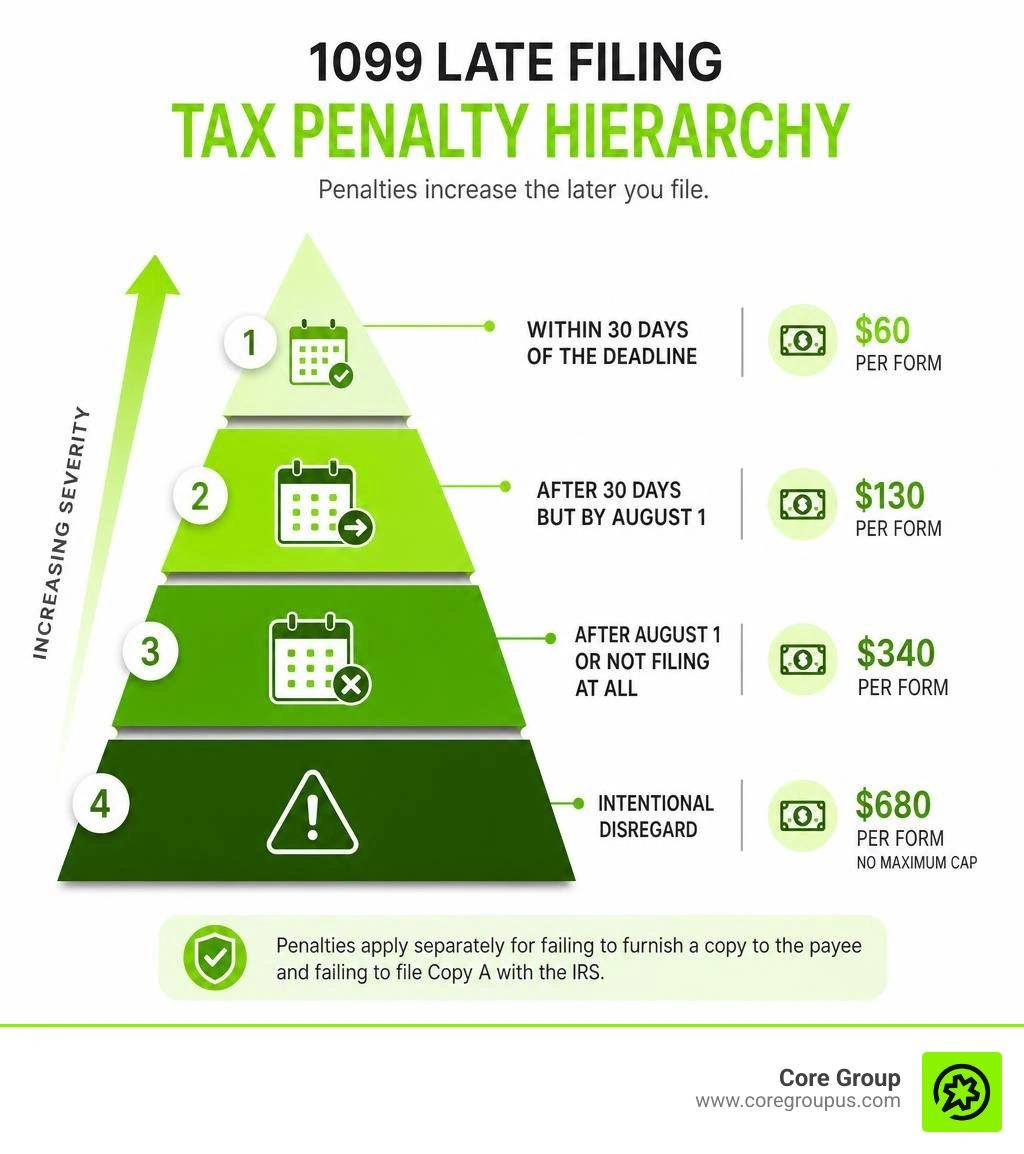
The tiered penalty structure for late filings reflects increasing severity.
- Filing within 30 days of the deadline: $60 per form
- Filing after 30 days but by August 1: $130 per form
- Filing after August 1 or not filing at all: $340 per form
- Intentional disregard: $680 per form with no maximum cap
In addition to individual form fines, businesses filing 10 or more aggregate information returns across all form types are required by law to file electronically. Trying to submit paper forms when you cross the 10-return threshold can result in rejected filings and late penalties. Using electronic tools like the IRS Information Returns Intake System (IRIS) ensures your forms arrive safely on time.
Frequently Asked Questions About 1099 Payments for LLCs
Does an LLC need to report income if no 1099 is received?
Yes, absolutely. An LLC must report all taxable business income on its federal and state tax returns regardless of whether a client issues a Form 1099. Form 1099 is simply an informational copy sent to the IRS.
If a client fails to send a form, misplaces your paperwork, or pays under the reporting threshold, your legal obligation to report the earnings remains unchanged. Omitting revenue because you did not receive a 1099 can trigger an IRS audit, back taxes, and accuracy penalties.
Can an LLC receive both a Form 1099-K and Form 1099-NEC?
Yes. An active enterprise frequently receives income through multiple channels. For example, if a client pays your creative agency $3,000 via ACH direct deposit and another client pays you $4,000 via credit card through your website checkout, you may receive both forms.
The first client will issue a Form 1099-NEC for the ACH payments, while your merchant processor will issue a Form 1099-K reflecting the card transactions. When filing your taxes, reconcile both forms against your general ledger to ensure gross revenue matches total receipts without double-counting processing fees.
Are payments to law firms exempt from 1099 reporting if incorporated?
No. Payments for legal services are strictly non-exempt under IRS regulations. Whether a law firm operates as a single-member LLC, partnership, S Corporation, or C Corporation, payments for attorney fees totaling $600 or more must be reported on Form 1099-NEC.
Additionally, settlement proceeds paid to an attorney are reportable in Box 10 of Form 1099-MISC. Always request a W-9 from legal counsel to ensure gross proceeds and fee payments are placed on the correct form.
Master Your LLC Taxes with Professional Guidance
Managing contractor forms, threshold updates, and IRS entity rules can feel overwhelming when you are focused on growing your business. At Core Group, we provide tailored financial management, bookkeeping, and tax services designed specifically for creative entrepreneurs.
We deliver a clear, no-fluff, profit-first playbook that guarantees total peace of mind and saves you precious time. Instead of spending your evenings tracking down vendor W-9s or calculating threshold limits, our expert team handles your financial ecosystem backed by our MacBook Pro guarantee.
Ready to remove the stress from your tax workflow? Master single-member LLC 1099 reporting with our dedicated team today and get back to doing the creative work you love.