How to Get 1099 Tax Documents for Your LLC
What It Means for an LLC to Get 1099 Documents
Understanding how an LLC get 1099 documents is one of the most common tax questions for small business owners and freelancers. The short answer is that it depends entirely on how your LLC is classified for tax purposes.
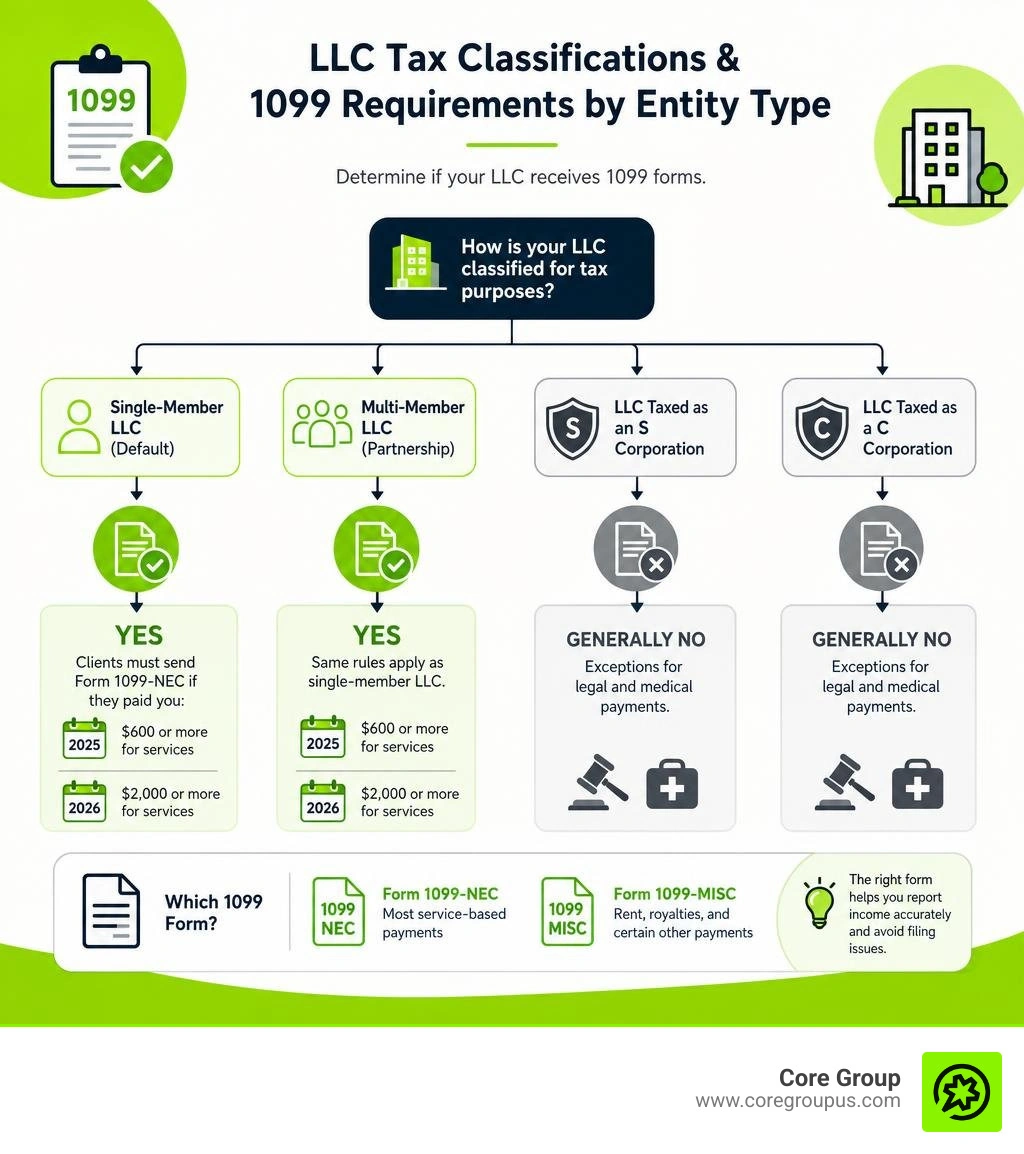
Quick Answer on Whether Your LLC Receives a 1099
- Single-member LLC (default) - Yes, clients must send you a Form 1099-NEC if they paid you $600 or more for services in 2025 (or $2,000 or more for payments made in 2026)
- Multi-member LLC taxed as a partnership - Yes, same rules apply as above
- LLC taxed as an S corporation - Generally no, with exceptions for legal and medical payments
- LLC taxed as a C corporation - Generally no, with the same legal and medical exceptions
The type of 1099 also matters. Most service-based LLCs receive Form 1099-NEC. Rent, royalties, and certain other payments come through on Form 1099-MISC instead.
Getting this wrong causes real problems. Clients may skip sending you a form you need, or send the wrong one. Either way, your income reporting gets messy and your tax filing gets complicated.
I'm Christian Brim, and in this guide I'll walk you through exactly how to make sure your LLC gets the right 1099 documents, on time and without errors.
Essential llc get 1099 documents terms
How LLC Entity Structure Impacts 1099 Eligibility
When business owners ask whether their company should expect an information return, the Internal Revenue Service looks directly at entity structure rather than legal state registration. A limited liability company is a legal structure created under state law, but federal tax law treats it based on election choices.
For income tax purposes, the federal government does not recognize an LLC as its own distinct category. Instead, an LLC defaults to being a disregarded entity or a partnership unless the owners explicitly elect corporate tax status. This structural reality determines whether your business will receive annual information tax forms from commercial clients.
If your entity operates under default rules, your clients are federally required to track payments and issue information returns. However, if you have elected corporate tax treatment, corporate exemption rules apply. You can review our detailed Single Member LLC 1099 Guide 2026 for comprehensive breakdown examples.
Single Member LLCs and Partnerships
A single-member limited liability company that has not made a corporate election is treated as a disregarded entity for federal tax purposes. The IRS views the business entity and its single owner as the exact same tax entity. Income earned by the business flows directly onto Schedule C of the individual owner tax return.
Because a single-member business operates as a sole proprietorship for tax administration, commercial clients must issue Form 1099-NEC when annual payments meet reporting thresholds. You can learn more about these specifics in our guide covering an Individual Sole Proprietor or Single Member LLC Get 1099.
Multi-member limited liability companies naturally default to partnership tax status. Partnerships are pass-through entities where profits and losses flow to individual partners via Schedule K-1 forms. However, third-party clients who pay partnership entities for nonemployee services are still legally required to issue Form 1099-NEC. Both single-member entities and partnership entities share this obligation under federal tax code provisions.
S Corporation and C Corporation Status
An LLC has the option to file Form 2553 to elect taxation as an S corporation or Form 8832 to elect C corporation treatment. Once the Internal Revenue Service approves this corporate election, corporate exemption rules apply immediately to vendor reporting.
Businesses that pay incorporated entities for general products or services are exempt from sending Form 1099-NEC or Form 1099-MISC. The tax code presumes that corporate entities maintain strict institutional accounting standards, reducing the need for information return matching. For a full breakdown of these rules, check out the resource on Do LLCs Get a 1099? Complete Answer by LLC Type (2026).
Important statutory exceptions exist to this corporate exemption rule. Regardless of whether an LLC is taxed as an S corporation or a C corporation, clients must issue a 1099 form if payments are made for legal services or medical and healthcare payments.
Legal service fees paid to an incorporated law firm or legal consulting LLC must be reported on Form 1099-NEC. Meanwhile, gross settlement proceeds paid to an attorney are reported on Form 1099-MISC. Medical and healthcare payments made to corporate healthcare providers or medical supply LLCs must also be reported on Form 1099-MISC.
Rules for How an LLC Get 1099 Documents from Clients

Ensuring that your company receives accurate 1099 tax forms begins long before year-end preparation. The primary administrative tool bridging your business and your client accounting team is Form W-9.
When your business onboard with a new client, providing an accurate, fully completed Form W-9 establishes your legal entity name, Taxpayer Identification Number, and federal tax classification. Without this official document on file, client accounting departments cannot determine whether your business qualifies for a corporate exemption or requires annual information returns.
Steps to Ensure Your Single Member LLC Get 1099 Documents
To ensure smooth reporting and eliminate tax season confusion, follow systematic setup procedures whenever you begin working with a commercial client.
First, register for an Employer Identification Number through the IRS website. While single-member entities can legally use the owner personal Social Security Number on tax forms, using a dedicated business EIN protects personal identity information on documents shared with clients.
Second, complete Form W-9 thoroughly. Ensure that Box 1 contains your legal personal name if operating as a disregarded entity, while Box 2 contains your official business name. Select the appropriate federal tax classification checkbox and write your EIN in Part I.
Third, send your completed W-9 to client accounts payable teams prior to issuing your first invoice. Keep track of all incoming payments using dedicated accounting software. You can cross-reference your tracking methods with our comprehensive LLC 1099 Income Guide 2026 to maintain perfect records throughout the year.
Form W9 Guidelines so Your LLC Get 1099 Documents Correctly
Mistakes on Form W-9 are the leading cause of incorrect 1099 filings and IRS tax matching discrepancies. Filling out this form properly guarantees that client accounts payable software classifies your firm accurately.
Line 1 requires the official name matching the tax return filed with the government. For a single-member entity, this is the legal name of the individual owner. Line 2 represents the Business Name or Disregarded Entity Name, where you enter your registered business name.
In Checkbox 3, select Individual, sole proprietor, or single-member LLC if you have not made a corporate election. If your business is an LLC taxed as an S corporation, C corporation, or partnership, select the Limited liability company box and enter the corresponding letter C, S, or P in the space provided.
In Part I, supply your Taxpayer Identification Number. For disregarded entities, providing your business EIN is standard business practice. Sign and date Part II to certify under penalty of perjury that your tax number and classification are correct. This prevents clients from legally applying backup withholding rules against your incoming payments. For technical details, refer to the Publication 1099 (2026), General Instructions for Certain Information Returns | Internal Revenue Service.
Deadlines Thresholds and Filing Requirements for LLCs
Understanding the official thresholds and timelines set by federal tax authorities is vital for keeping your accounting records synchronized with client filings. Information reporting guidelines dictate both payment minimums and strict delivery deadlines.
Beginning after tax year 2025, federal rules updated minimum reporting thresholds for various information return categories. Staying informed on these changing dollar thresholds prevents unexpected compliance discrepancies when reviewing year-end income records.
Payment Thresholds and Form Types
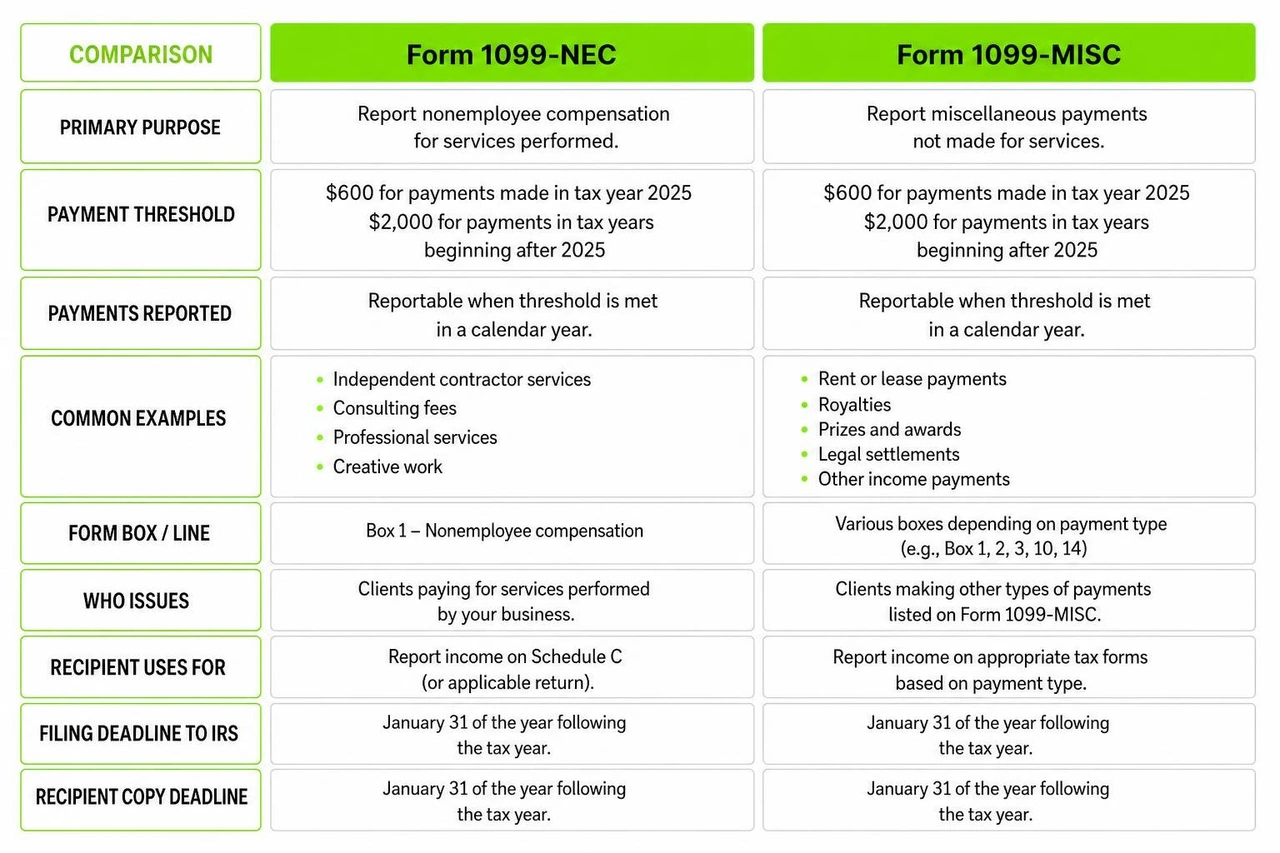
Clients determine which form to send based on the exact nature of the payments made to your business during the calendar year. For independent contractor services, consulting fees, and creative work, clients issue Form 1099-NEC. For rents, royalties, or legal settlement proceeds, clients issue Form 1099-MISC.
For payments made through tax year 2025, the threshold requiring a client to issue Form 1099-NEC was $600 in cumulative payments during the calendar year. For tax years beginning after 2025, updated tax rules increased minimum reporting thresholds for select information return categories to $2,000, with annual inflation adjustments scheduled to begin in 2027.
| Form Type | Primary Purpose | Payment Threshold | Client Reporting Categories |
|---|---|---|---|
| Form 1099-NEC | Nonemployee Compensation | $600 or $2,000 depending on tax year | Professional fees, contract work, legal service fees |
| Form 1099-MISC | Miscellaneous Income | $10 for royalties, $600 or $2,000 for rent | Commercial rent, royalties, legal gross proceeds |
| Form 1099-K | Third-Party Network Transactions | $20,000 and 200 transactions | Credit card processors, online payment platforms |
To read an in-depth analysis of payment minimums across entity types, explore our guide on the LLC Get 1099 Minimum.
IRS Filing Deadlines and Electronic Mandates
Federal tax law mandates strict deadlines for sending information returns to payees and submitting reports to the government. Payers who fail to meet these deadlines face monetary penalties per return.
Form 1099-NEC carries an aligned deadline for both recipient delivery and IRS submission. Payers must issue Copy B to contractors and submit Copy A to the IRS by January 31 following the tax year.
Form 1099-MISC requires payers to provide Copy B to recipients by January 31. However, the IRS filing deadline for paper Form 1099-MISC returns is February 28, while electronic filing forms are due by March 31. Details on these timeline variations can be found in our overview explaining When Are 1099s Due.
Under Treasury Department regulations, any business filing 10 or more information returns in aggregate across forms like W-2, 1099-NEC, and 1099-MISC must file electronically. The IRS Information Returns Intake System portal processes these filings. Payers submitting forms after statutory deadlines incur IRS penalties ranging from $60 to over $310 per late return, depending on how late the filing occurs. Check official instructions via the Instructions for Forms 1099-MISC and 1099-NEC (12/2026) | Internal Revenue Service.
Handling Missing or Incorrect LLC 1099 Forms

Despite clear tax guidelines, mistakes happen frequently during tax season. Clients might miscalculate payment totals, issue forms under incorrect social security numbers, or omit your business paperwork entirely.
Knowing how to handle these operational issues keeps your tax filings accurate and protects your business from IRS computer matching audits.
Resolving Errors on Issued Forms
If your business receives a Form 1099 containing incorrect dollar amounts, an outdated business address, or wrong Taxpayer Identification Numbers, contact the client accounting department immediately. Do not ignore the discrepancy, because the IRS receives Copy A of the same incorrect form.
Ask the client to issue a corrected Form 1099. If the original form was already filed with the IRS, the client must submit a new form checking the Corrected box at the top. This cancels out the original filing and updates federal records.
If the client filled out an unnecessary 1099 because your LLC is taxed as an S corporation, request that they void or correct the form on their end. Supply them with an updated Form W-9 showing your active S corporation election to prevent future errors. For additional insights on avoiding common accounting mistakes, read our article on LLC Get 1099 Mistakes.
What to Do If a Client Fails to Send a 1099
A common misconception among business owners is that if a client fails to issue a Form 1099, the income received does not need to be reported on federal tax returns. This is completely false.
The Internal Revenue Code requires businesses to report all earned gross revenue, regardless of whether a client sends a 1099 document or meets the reporting threshold. Tax liability is based on total business revenue, not total 1099 forms collected.
If a client fails to send an expected 1099-NEC by early February, verify your gross payment records against your bank statements and invoicing software. Enter the total revenue earned directly onto your tax return.
Do not file a Form 4852 or contact the IRS to demand an missing 1099-NEC, as those procedures apply primarily to missing Form W-2 employee wage statements. Simply ensure your bookkeeping records are precise. Explore our 1099 Contractor Profit Tracking Guide for effective recordkeeping strategies.
Frequently Asked Questions About LLC Tax Reporting
Do S Corporation LLCs ever receive 1099 forms?
Yes, S corporation LLCs receive 1099 forms under specific statutory exceptions. While corporate status generally exempts an LLC from standard nonemployee compensation reporting, payments made for legal services must be reported on Form 1099-NEC regardless of corporate status. Additionally, payments made for medical and healthcare services or legal settlement gross proceeds must be reported on Form 1099-MISC.
What happens if an LLC does not receive a expected 1099 document?
If your LLC does not receive an expected 1099 form, you must still report all revenue earned on your tax return. You do not need to request a replacement form from the client or notify the IRS. As long as your internal bookkeeping records accurately reflect all incoming payments, you simply include the total gross revenue on your Schedule C, Form 1065, Form 1120-S, or Form 1120.
How does third party payment processing impact 1099-NEC forms?
When clients pay your LLC through third-party payment networks such as credit card processors, payment gateways, or online platforms, the client is not required to issue a Form 1099-NEC. Instead, the payment processing network handles the information reporting on Form 1099-K. This rule prevents duplicate income reporting where both the client and the payment platform report the exact same funds to the IRS.
Conclusion
Understanding how an llc get 1099 documents requires navigating entity tax classifications, filing thresholds, and IRS reporting mandates. Whether your business operates as a single-member disregarded entity, a partnership, or an S corporation, managing your incoming tax documents properly keeps your business fully compliant.
Maintaining organized accounting records, collecting and delivering accurate Form W-9s, and verifying incoming tax forms against actual bank deposits ensures smooth year-end filing. For more details on compliance strategies, review our resource on Single Member LLC 1099 Reporting.
At Core Group, we offer comprehensive financial management, bookkeeping, and tax services designed specifically for creative entrepreneurs. Our team delivers a no-fluff, profit-first playbook that guarantees peace of mind and saves you valuable time, so you can focus on growing your business. Reach out to us today to streamline your accounting and build a profitable business.