A Comprehensive Guide to No Tax on Overtime Policy Implications
What No Tax on Overtime Really Means
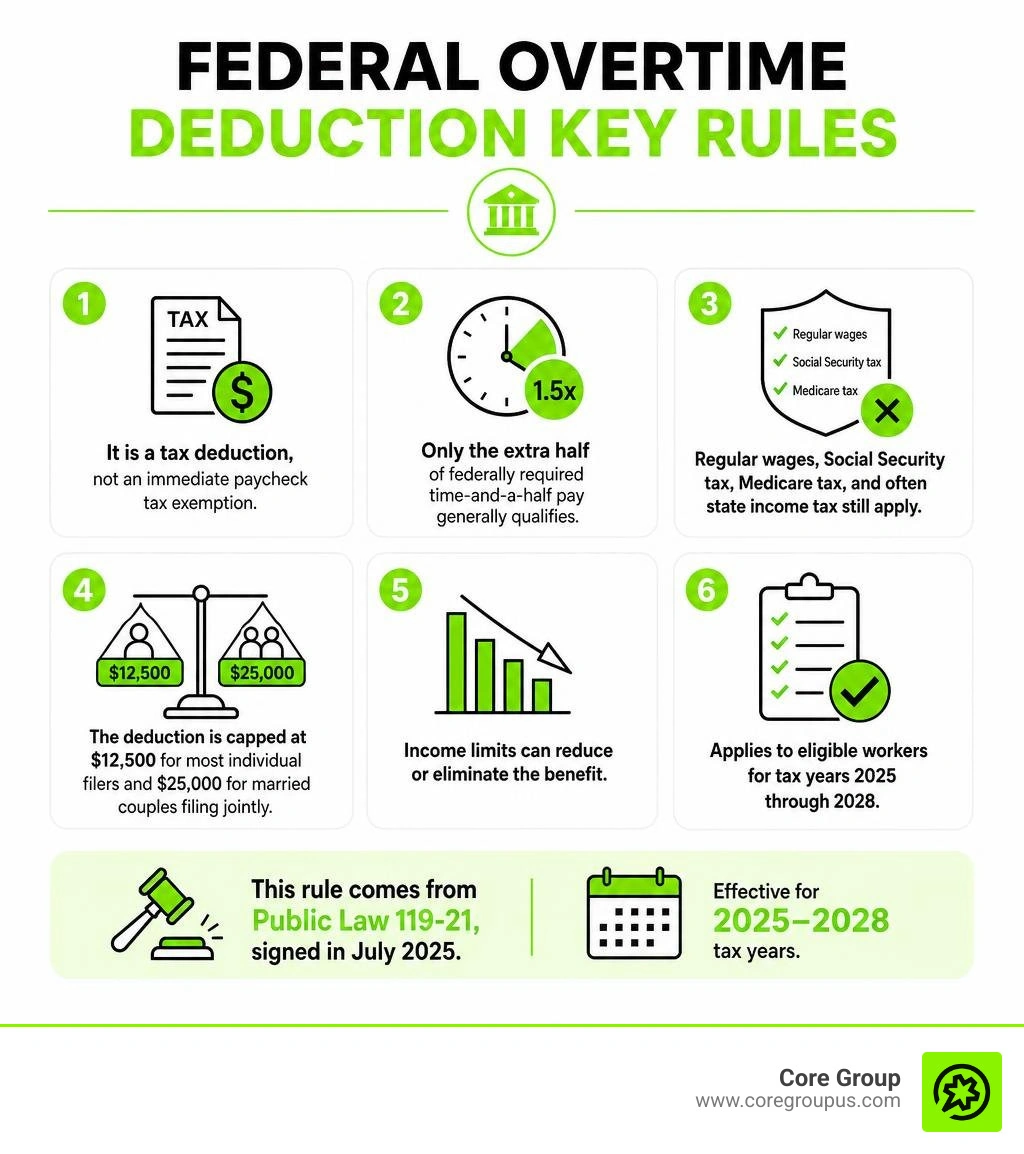
No tax on overtime explained in one sentence means eligible workers can deduct part of their qualifying overtime pay from federal income tax for tax years 2025 through 2028.
- It is a tax deduction, not an immediate paycheck tax exemption.
- Only the extra half of federally required time-and-a-half pay generally qualifies.
- Regular wages, Social Security tax, Medicare tax, and often state income tax still apply.
- The deduction is capped at $12,500 for most individual filers and $25,000 for married couples filing jointly.
- Income limits can reduce or eliminate the benefit.
The rule came from Public Law 119-21, signed in July 2025. Its name can be misleading because it does not make every overtime dollar tax-free. For creative entrepreneurs who also work overtime-eligible jobs, understanding the difference can help avoid missed deductions and costly filing mistakes.
I am Christian Brim, and next we will break down how this deduction works in plain English.
Key no tax on overtime explained vocabulary
How No Tax on Overtime Explained Mechanics Work
When news outlets proclaimed that overtime would no longer be taxed, many hard working employees assumed their overtime paychecks would suddenly arrive without federal tax withholdings. The reality of how this statutory policy operates is quite different. The federal rule established by Public Law 119-21 creates a targeted tax deduction that you claim on your annual tax return rather than a total tax exemption at the payroll level.
Under Section 7 of the Fair Labor Standards Act, non exempt employees must receive overtime pay for hours worked beyond 40 in a workweek. That pay rate is standardly set at one and a half times the regular hourly wage. The new tax law targets only a specific segment of those earnings.
To clarify how No Tax On Overtime Explained functions, we must distinguish between standard earnings and qualified overtime compensation. The deduction operates below the line for taxable income calculations, meaning it reduces federal taxable income whether you claim the standard deduction or itemize write offs. If you wonder When Does the No Tax on Overtime Start, it applies retroactively to January 1 2025 and runs through calendar year 2028.
Understanding the 0.5 Premium Rule for Qualified Wages
The single biggest misconception about this policy is that the full time and a half paycheck amount escapes taxation. It does not. The tax code restricts the deduction strictly to the overtime premium, which is the extra half portion of your time and a half rate.
Consider an employee who earns a regular base hourly wage of $30 per hour. When working overtime, this worker earns $45 per hour. That $45 rate breaks down into two distinct parts
- $30 base hourly wage, which represents straight time pay
- $15 overtime premium wage, which represents the extra 0.5 portion
Under federal guidelines, only the $15 premium portion counts as qualified overtime compensation. The baseline $30 per hour remains fully subject to standard federal income tax.
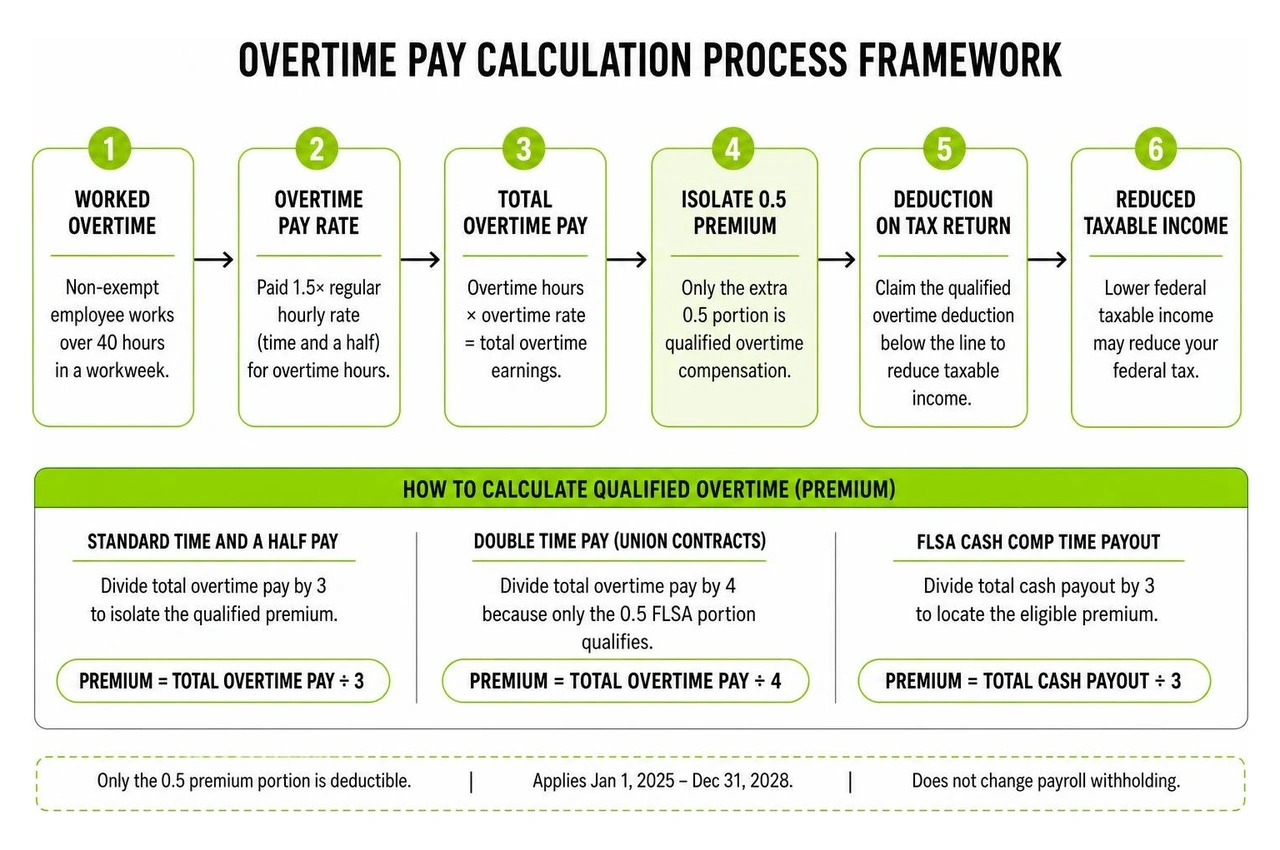
To figure out your eligible premium pay, learning How to Calculate Qualified Overtime relies on simple paystub division formulas
- For standard time and a half pay, divide your total overtime pay by 3 to isolate the qualified premium.
- For double time pay under union contracts, divide your total overtime pay by 4, because only the 0.5 FLSA portion qualifies under statutory limits.
- For FLSA cash compensatory time payouts, divide the total cash payout by 3 to locate the eligible premium.
No Tax on Overtime Explained Paycheck Withholding Myth
Many workers feel confused when they look at their weekly paychecks and discover federal income tax is still deducted from overtime hours. Employers remain legally required to collect income tax, Social Security, and Medicare withholdings on full overtime wages during the year.
The tax legislation did not alter employer payroll obligations or standard Form W-4 withholding protocols. If employers stopped withholding taxes on overtime, workers would face unexpected tax bills at year end.
Instead, you continue paying standard withholdings on your paycheck. You then claim the deduction on your annual tax return, which lowers your total tax obligation and frequently results in a larger tax refund or lower final tax balance. To learn more about standard tax handling on overtime earnings, review our detailed guide on Tax on Overtime Pay.
Payroll taxes under the Federal Insurance Contributions Act, which fund Social Security at 6.2 percent and Medicare at 1.45 percent, are entirely excluded from this law. Every dollar of overtime earned remains subject to the full 7.65 percent FICA payroll tax.
Eligibility Rules and Exclusions for Overtime Tax Relief
Not everyone who works long hours can claim this deduction. Federal guidelines restrict tax relief to specific categories of workers based on wage classification standards.
According to White House statistics, over 60 percent of Americans work in occupations eligible for overtime pay, with approximately 20 million workers regularly receiving overtime hours. Furthermore, about 4.8 million military veterans work in overtime eligible positions, with roughly 1.4 million regularly working extra hours.
To qualify for the deduction, you must meet three fundamental criteria
- You must be a non exempt employee receiving qualified overtime pay under Section 7 of the Fair Labor Standards Act.
- Your earnings must be officially reported on a formal statement like Form W-2.
- Your Modified Adjusted Gross Income must fall under federal phase out thresholds.
Understanding these criteria is essential when reviewing official guidance like the No Tax on Overtime Deduction documentation.
Several working groups are explicitly excluded from taking this deduction
- Exempt salaried employees who receive fixed executive, administrative, or professional salaries without FLSA overtime pay.
- Independent contractors and 1099 workers, because statutory overtime laws apply only to non exempt W-2 employees.
- Off the books cash workers whose earnings are not reported on official tax statements.
- Married individuals who file using the Married Filing Separately tax status.
Income Phase Out Limits and Annual Deduction Caps
To ensure tax relief focuses on middle income households, Congress introduced strict annual deduction caps and income phase outs.
The maximum qualified overtime deduction you can claim per tax year is capped as follows
- $12,500 maximum annual deduction for single filers, head of household filers, and qualifying surviving spouses
- $25,000 maximum annual deduction for married couples filing joint returns
The deduction begins phasing out when your Modified Adjusted Gross Income exceeds specific income limits. Single filers face phase outs starting at $150,000 of MAGI, with complete elimination of the deduction at $275,000. Joint filers face phase outs starting at $300,000 of MAGI, with complete elimination at $550,000.
The deduction shrinks by $100 for every $1,000 of MAGI earned above the starting threshold. For instance, a single worker with $175,000 in MAGI sits $25,000 over the threshold. Their maximum allowed deduction cap decreases by $2,500, limiting their final deduction ceiling to $10,000.
For an in depth breakdown of marginal brackets, read our article explaining What is the Federal Tax Rate on Overtime.
Specific Provisions for Public Safety and Union Schedules
Public safety workers like police officers, emergency medical technicians, and firefighters often work non traditional shifts governed by FLSA Section 207k. These special schedules calculate overtime over work periods ranging from 7 to 28 days rather than standard 7 day workweeks.
IRS guidance confirms that law enforcement and firefighter personnel working under Section 207k qualify for the overtime deduction. As long as the work schedule strictly complies with federal FLSA thresholds, the premium portion of those hours qualifies.
However, voluntary overtime or call out premiums paid under local employer policies that exceed federal FLSA minimums do not qualify. Only hours worked above the official federal FLSA statutory limits generate eligible premium deductions.
For unionized employees receiving double time pay, IRS rules limit the deductible portion strictly to the FLSA overtime premium. Even if contract terms pay twice the base rate, you generally divide the total double time earnings by 4 to determine your qualified deduction amount.
When public sector employees receive cash payouts for accrued FLSA compensatory time, the premium portion of that cash payout qualifies for the deduction in the calendar year the payment occurs. Compensatory time taken as paid time off does not qualify.
Calculating Tax Savings and Filing Requirements
More than 15.5 million returns out of the first 63.5 million filed in early 2026 claimed the overtime tax deduction, making it one of the most widely used tax relief measures in recent years. The White House projects average working households will gain up to $1,400 in annual tax savings.
For tax year 2025, employers are not required to separate qualified overtime premium amounts on W-2 forms. Instead, workers can check Box 14 on their 2025 W-2 for voluntary notation codes like FLSA OT Prem or manually compute qualified amounts using year end paystubs. Beginning in tax year 2026, employers will report qualified overtime compensation directly in W-2 Box 12 using Code TT.
For additional filing guidance, check out our No Tax Overtime Guide 2026.
The table below outlines real world federal tax savings across different income brackets and filing choices for tax year 2025.
| Taxpayer Filing Status | Base Taxable Wage Income | Qualified Overtime Premium Earned | Federal Income Tax Bracket | Estimated Federal Tax Savings |
|---|---|---|---|---|
| Single Filer | $45,000 | $3,000 | 12% | $360 |
| Single Filer | $75,000 | $6,000 | 22% | $1,320 |
| Single Filer | $120,000 | $12,500 (Max Cap) | 24% | $3,000 |
| Married Filing Jointly | $85,000 | $8,000 | 12% | $960 |
| Married Filing Jointly | $160,000 | $15,000 | 22% | $3,300 |
| Married Filing Jointly | $280,000 | $25,000 (Max Cap) | 24% | $6,000 |
No Tax on Overtime Explained Step by Step Claim Process
Claiming your overtime tax savings involves completing IRS Schedule 1-A alongside Form 1040. You do not need to itemize deductions to receive this tax break.
Follow this simple step by step filing method
- Gather your final end of year paystub and W-2 form to verify your total overtime earnings.
- Calculate your qualified overtime premium using IRS division rules if your W-2 does not list it separately.
- Complete Schedule 1-A Part III, entering your qualified overtime premium on Line 21.
- Apply statutory caps of $12,500 for single filers or $25,000 for joint filers.
- Compute your Modified Adjusted Gross Income to confirm if phase out reductions apply.
- Transfer the allowable deduction from Schedule 1-A to Form 1040 Line 13b.
- Attach Schedule 1-A to your completed federal tax return.
Because this deduction sits below the line, you can claim the full standard deduction on Form 1040 while simultaneously deducting your qualified overtime premium. To review common standard deduction questions, see Can You Claim No Tax on Overtime with the Standard Deduction? + FAQs.
State Tax Conformity and Common Mistakes to Avoid
A frequent pitfall involves assuming state income taxes automatically mirror federal deductions. State tax treatment depends entirely on individual state conformity statutes.
States with rolling conformity automatically adopt federal tax law changes, granting state level overtime deductions. States with static conformity or non conforming codes require taxpayers to add federal overtime deductions back into state taxable income. States with no wage income tax, like Florida or Texas, remain unaffected.
If you work in California, state tax laws do not conform to this federal provision. To understand California specific overtime calculations, read Is Overtime Taxed at a Higher Rate in California.
To protect your refund, avoid these four common filing mistakes
- Deducting your total time and a half earnings instead of isolating the 0.5 premium portion.
- Claiming the deduction while using the Married Filing Separately status.
- Attempting to claim the deduction as an independent contractor or 1099 freelancer.
- Discarding year end paystubs that contain essential documentation needed for calculation auditing.
Frequently Asked Questions About Overtime Tax Deduction
Does the Overtime Deduction Apply to State Income Taxes
The federal overtime tax deduction applies exclusively to federal income tax liability. Whether it reduces your state income tax depends entirely on your state laws.
Some states adopt federal changes automatically, granting equivalent state level deductions. Other states require you to add the federal deduction back onto your state tax return, keeping state overtime taxes fully intact.
Why Was Money Still Withheld From My Paycheck for Overtime
Employers must comply with standard payroll tax regulations, which require continued withholding for federal income tax, Social Security, and Medicare on overtime pay.
The law created an annual tax return deduction rather than an immediate payroll exemption. You realize your actual tax savings when filing Form 1040, which often leads to a higher tax refund.
Can I Claim the Overtime Deduction if I Take the Standard Deduction
Yes, you can claim both deductions together. The overtime deduction is entered on Schedule 1-A and reported on Form 1040 Line 13b.
Because it functions independently from itemized deductions, you can take the full standard deduction and still deduct your qualified overtime premium.
Conclusion
Understanding the no tax on overtime explained rules ensures you maximize tax savings while remaining fully compliant with IRS standards. By separating the 0.5 premium portion, maintaining clear paystub records, and completing Schedule 1-A correctly, hardworking employees can keep more of their money.
At Core Group, we provide financial management, bookkeeping, and tax services tailored specifically for creative entrepreneurs and small business owners. Our no fluff, profit first playbook guarantees peace of mind and saves you valuable time, allowing you to focus on growing your business while we handle the numbers.
If you need professional guidance navigating complex tax rules or managing your business finances, explore our comprehensive planning insights on the overtime tax rate or reach out to our expert team today.