401k Contribution Limits for 2026: Official IRS Breakdown
What the IRS Set as the 401k 2021 Contribution Limit
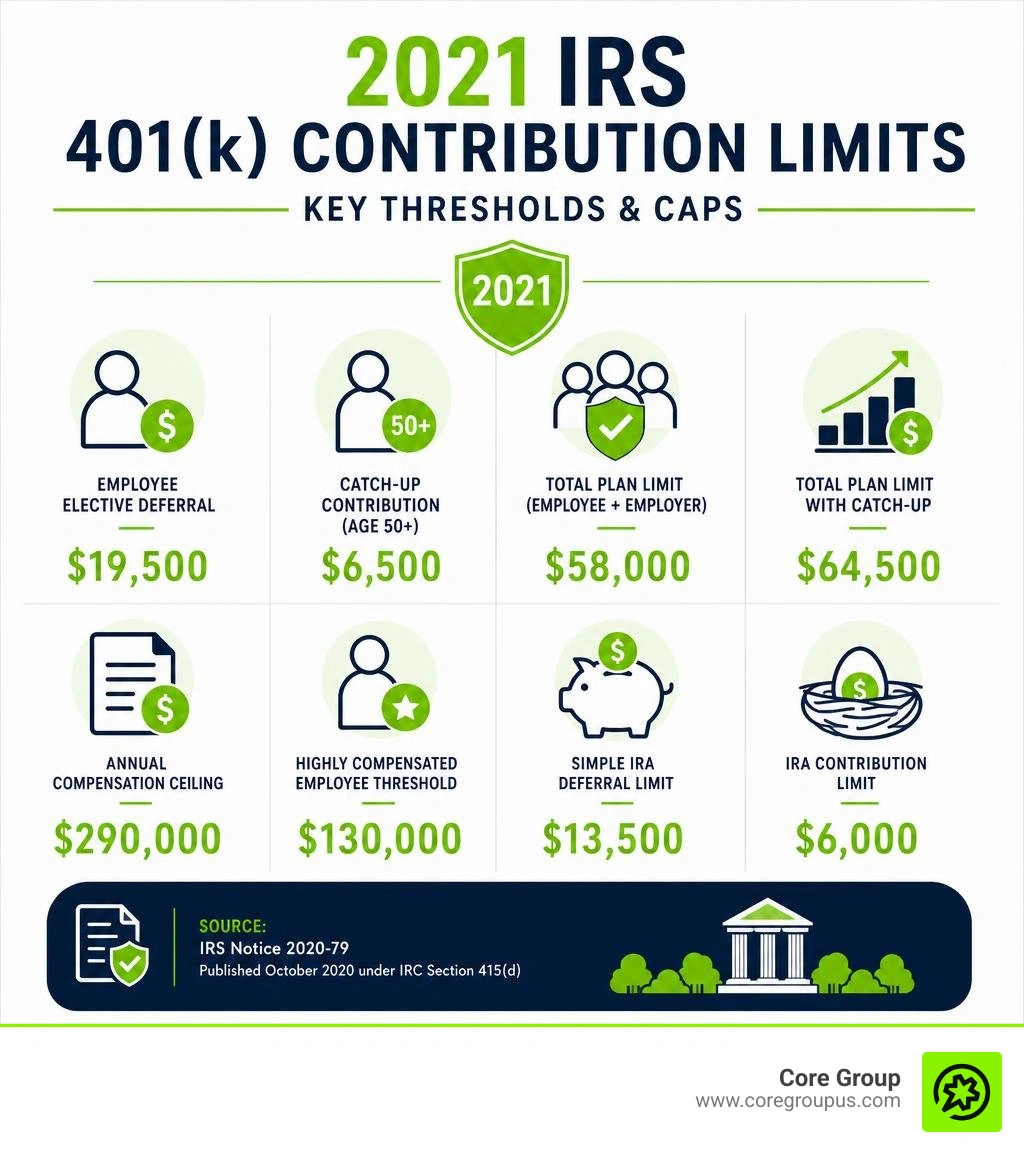
The 401k 2021 contribution limit IRS rules kept the employee elective deferral flat while nudging the total plan ceiling higher. Here is a quick snapshot of every key figure for 2021.
| Limit Type | 2021 Amount |
|---|---|
| Employee elective deferral | $19,500 |
| Catch-up contribution (age 50+) | $6,500 |
| Total plan limit (employee + employer) | $58,000 |
| Total with catch-up | $64,500 |
| Annual compensation ceiling | $290,000 |
| Highly compensated employee threshold | $130,000 |
| SIMPLE IRA deferral limit | $13,500 |
| IRA contribution limit | $6,000 |
These numbers come directly from IRS Notice 2020-79, published in October 2020 under IRC Section 415(d).
Why did the employee deferral stay flat? Inflation in 2020 was suppressed by the COVID-19 pandemic. Because the IRS adjusts limits in $500 increments based on cost-of-living data, there simply was not enough inflation to trigger a bump in the individual deferral amount. The total plan limit, however, adjusts in $1,000 increments and cleared the threshold, rising from $57,000 to $58,000.
For creative entrepreneurs and freelancers juggling irregular income, knowing these exact numbers matters. A missed dollar of tax-deferred savings is a dollar taxed today instead of later.
I'm Christian Brim, and in this guide I'll walk you through every 2021 limit, how it compared to neighboring tax years, and what it means for your retirement strategy.
401k 2021 contribution limit irs vocab explained
Complete Breakdown of the 401k 2021 Contribution Limit IRS Rules
Understanding how retirement plan caps work requires looking at how the IRS divides contributions into separate categories. When the Treasury Department published IRS Notice 2020 79, it defined specific guardrails for what workers could set aside from their paychecks and what business owners could add on top.
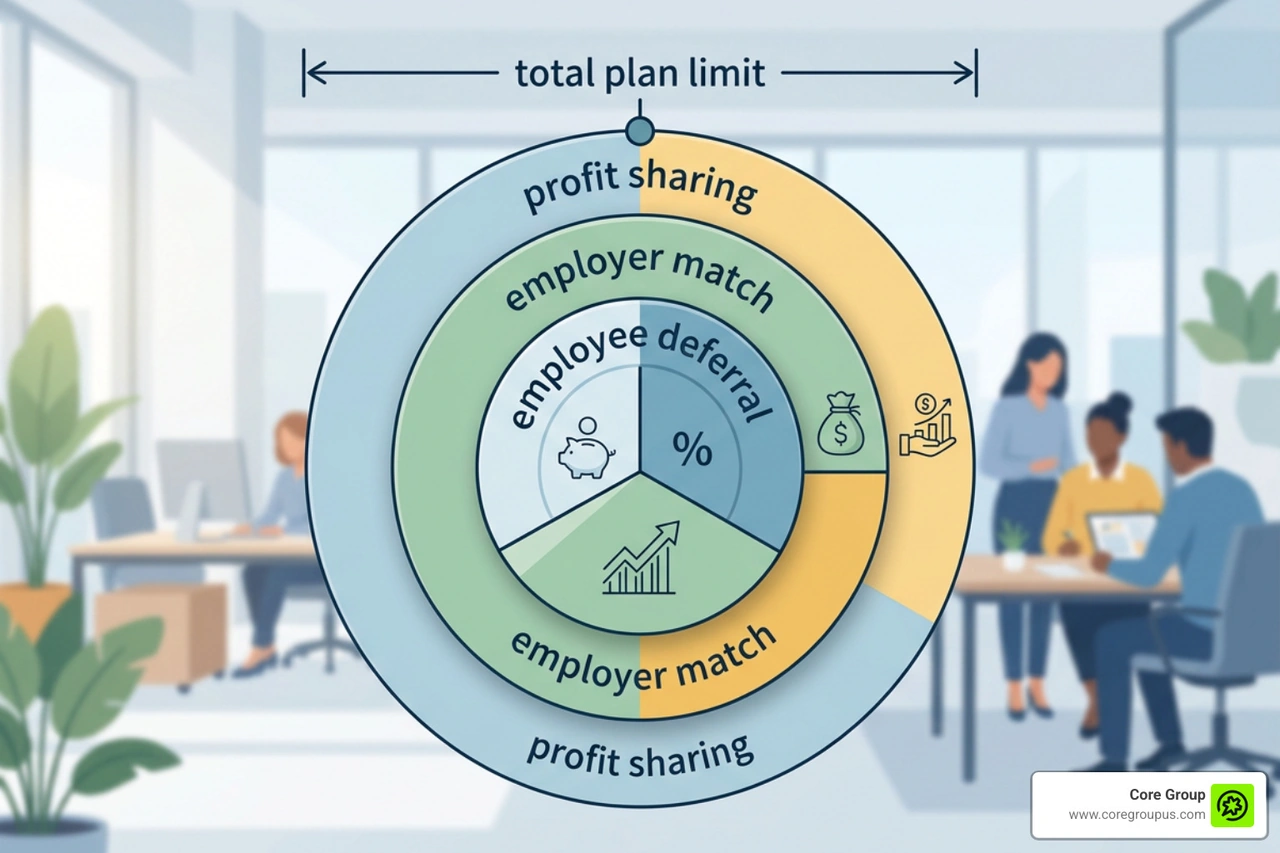
Many plan participants assume that the individual salary deferral cap is the only ceiling that exists. In reality, your account receives dollars from multiple sources. You can fund your account via pre-tax deferrals, Roth deferrals, and in certain advanced plans, voluntary non-Roth contributions using a 401k After Tax Contribution strategy. On top of that, your employer can contribute matching funds or profit sharing allocations.
To keep tax-advantaged accounts fair, the IRS enforces three main pillars.
- The individual elective deferral limit under Section 402(g)
- The catch-up contribution cap under Section 414(v) for workers who are 50 or older
- The overall defined contribution cap under Section 415(c) covering all combined deposits
Let's explore each component to see how the numbers operated during the 2021 tax year.
Understanding the Employee 401k 2021 Contribution Limit IRS Deferral Rules
For the 2021 tax year, the baseline salary deferral maximum was $19,500. This limitation applies to all regular employee elective deferrals made through payroll withholding. Whether you chose traditional pre-tax contributions to lower your immediate taxable income or Roth 401k contributions using after-tax dollars, the aggregate total of your salary deferrals could not exceed $19,500.
This rule is enforced on a per-person basis rather than a per-plan basis. If you changed jobs mid-year or worked two separate jobs concurrently, your combined elective deferrals across all employers still topped off at $19,500. Payroll systems are designed to stop deferrals automatically once you reach the threshold at a single company. However, if you switched employers mid-stream, your new employer's payroll software had no way of knowing what you deferred at your previous job. Monitoring this total was entirely your responsibility.
For detailed official guidance on employee deferrals across multiple accounts, you can review the official 401k plan limits guide provided by the federal government.
Catch Up Savings Under the 401k 2021 Contribution Limit IRS Guidelines
If you celebrated your 50th birthday at any point during 2021, the tax code granted you access to catch-up contributions under IRC Section 414(v). For 2021, the catch-up contribution limit was $6,500.
Adding this catch-up allowance to the standard salary deferral brought the total allowable employee deferral to $26,000. You did not need to wait until your actual birthdate to start making these extra deferrals. As long as you turned 50 by December 31, 2021, you were legally eligible to utilize the full $6,500 catch-up option starting on January 1 of that year.
This extra room allowed experienced professionals and business owners to accelerate their nest egg building during their peak earning years. Over time, these catch-up thresholds have expanded significantly, as seen in recent adjustments like the 2026 Maximum 401k Contribution Over 50 guidelines.
Total Combined Plan Additions and Employer Compensation Limits
While individual salary deferrals stayed flat in 2021, the overall contribution ceiling under Section 415(c) enjoyed a $1,000 bump. The total limit on annual additions increased from $57,000 in 2020 to $58,000 in 2021. If you qualified for age 50 catch-up contributions, your grand total account capacity reached $64,500.
What counts toward this $58,000 cap?
- Your $19,500 employee elective deferrals
- Any employer matching contributions
- Any employer profit-sharing or non-elective contributions
- Any voluntary after-tax employee contributions
For self-employed creative agency owners operating a Solo 401k, this total cap was a game changer. Even though you could only defer $19,500 as an employee, your business could make profit-sharing contributions to help you bridge the gap toward the $58,000 maximum.
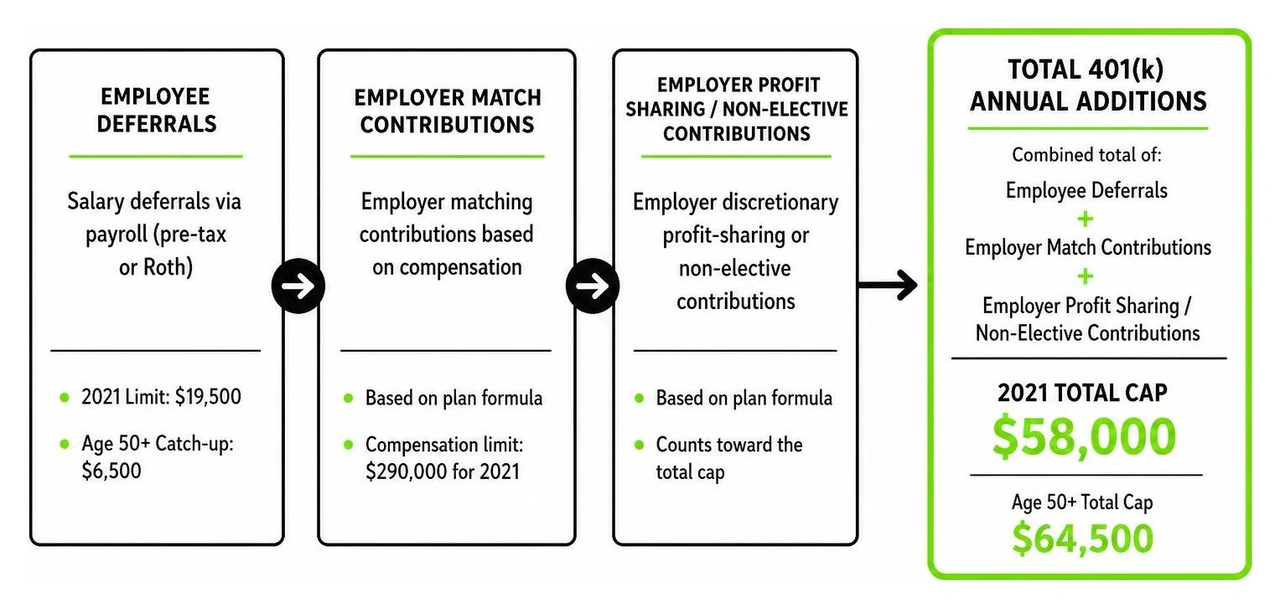
At the same time, the IRS limits the amount of compensation that can be used to calculate retirement contributions. Under IRC Section 401(a)(17), the annual compensation ceiling for 2021 rose to $290,000, up from $285,000 in 2020. This means employer matching formulas could not consider any income earned beyond $290,000. If your plan offered a 5 percent match, the absolute maximum match you could receive was 5 percent of $290,000, which equaled $14,500. You can learn more about how company matching caps function by reviewing our guide on the 401k Company Match Limit rules.
As reported in the initial IRS retirement contribution release, these cost-of-living adjustments ensure that retirement savings mechanisms keep pace with broader economic expansion over time.
Comparing 2021 Retirement Limits to Previous and Subsequent Tax Years
Looking at retirement limits in isolation only tells part of the story. Examining multi-year trends highlights how cost-of-living adjustments fluctuate based on macroeconomic conditions. The Consumer Price Index for Urban Wage Earners and Clerical Workers, known as CPI-W, directly dictates whether the IRS raises retirement thresholds each autumn.
In 2020, the economic slowdown caused by the early months of the pandemic suppressed price inflation. As a result, employee deferral limits remained completely stagnant between 2020 and 2021. However, as inflation accelerated in late 2021 and 2022, statutory limits took substantial leaps forward in subsequent years.
| Tax Year | Employee Deferral Limit | Catch-Up Limit (Age 50+) | Total Addition Limit (Section 415c) | Compensation Limit |
|---|---|---|---|---|
| 2020 | $19,500 | $6,500 | $57,000 | $285,000 |
| 2021 | $19,500 | $6,500 | $58,000 | $290,000 |
| 2022 | $20,500 | $6,500 | $61,000 | $305,000 |
| 2023 | $22,500 | $7,500 | $66,000 | $330,000 |
| 2024 | $23,000 | $7,500 | $69,000 | $345,000 |
| 2025 | $23,500 | $7,500 | $70,000 | $350,000 |
Comparing these historical figures reveals how quickly savings parameters expand during inflationary periods. To see how these historic numbers stack up against today's figures, check out our analysis on the 401k Maximum Contribution 2026 ceiling and the latest legislative updates in our overview of 401k Changes 2026.
Highly Compensated Employee and Key Employee Thresholds
To prevent retirement plans from unfairly favoring executives and business owners over lower-wage workers, the IRS enforces non-discrimination testing. These tests evaluate contribution levels based on compensation classifications.
For 2021, the threshold for a Highly Compensated Employee, or HCE, remained unchanged at $130,000. An employee was defined as an HCE for 2021 if they met either of these conditions.
- Owned more than 5 percent of the business at any time during 2020 or 2021
- Earned more than $130,000 in compensation from the business during the preceding 2020 plan year
Meanwhile, the key employee threshold for top-heavy testing remained flat at $185,000 for 2021.
If a plan fails Actual Deferral Percentage, or ADP, testing, high earners may be forced to take corrective distributions, turning pre-tax retirement savings back into taxable income. To bypass these complex testing hurdles entirely, many creative firms choose to adopt a safe harbor plan design. You can explore how these options eliminate non-discrimination testing by reading our Safe Harbor 401k Complete Guide.
Other Qualified Retirement Plans and Tax Credits for 2021
401k accounts were not the only retirement vehicles affected by IRS Notice 2020-79. The IRS updated parameters across the entire spectrum of tax-advantaged accounts, including Individual Retirement Accounts, SIMPLE IRAs, SEP IRAs, defined benefit pensions, and low-income tax credits.

Understanding how these accounts interact gives business owners and freelancers maximum flexibility when designing their tax reduction strategies. For an expert HR overview of these rules, you can reference the 2021 employer plan limits summary published by SHRM.
IRA Limits and Phase Out Ranges
For 2021, the maximum contribution limit for both Traditional and Roth IRAs remained unchanged at $6,000. The catch-up contribution limit for individuals age 50 and older stayed fixed at $1,000, bringing the maximum IRA deposit to $7,000.
While anyone with earned income can contribute to a Traditional IRA, deducting those contributions on your tax return depends on your Modified Adjusted Gross Income, or MAGI, if you or your spouse are covered by a workplace retirement plan.
For 2021, the Traditional IRA income phase-out ranges were set as follows.
- Single taxpayers covered by a workplace plan with MAGI between $66,000 and $76,000
- Married couples filing jointly where the contributing spouse is covered by a plan with MAGI between $105,000 and $125,000
- Married filing jointly where the contributing spouse is not covered, but their partner is with MAGI between $198,000 and $208,000
Roth IRA eligibility was similarly restricted by income phase-outs.
- Single filers and heads of household with MAGI between $125,000 and $140,000
- Married couples filing jointly with MAGI between $198,000 and $208,000
If your income sits right near these thresholds, workplace deferrals can prove extremely useful. To understand how salary reductions lower your overall tax picture, read our detailed article on Do 401k Contributions Reduce Magi.
Small Business Plans and Saver Credit Thresholds
Small business owners and self-employed creatives often utilize alternative plan structures like SIMPLE IRAs, SEP IRAs, or Defined Benefit plans to optimize overhead costs and administrative requirements.
Here is how those alternative plan limits looked in 2021.
- SIMPLE IRA salary deferral limit of $13,500 (unchanged from 2020)
- SIMPLE IRA catch-up limit (age 50+) of $3,000
- SEP IRA minimum compensation threshold of $650 (up from $600 in 2020)
- SEP IRA maximum contribution cap of $58,000 (up from $57,000)
- Defined Benefit Plan annual benefit cap of $230,000 (unchanged)
To assist low-to-moderate-income workers, the IRS also offers the Retirement Savings Contributions Credit, commonly known as the Saver's Credit. In 2021, the Adjusted Gross Income limits to qualify for this credit were.
- Married couples filing jointly at $66,000 (up from $65,000)
- Heads of household at $49,500 (up from $48,750)
- Single filers and married individuals filing separately at $33,000 (up from $32,500)
Choosing the right plan structure depends on your agency's cash flow, employee headcount, and long-term profit goals. To weigh your options, check out our guide covering Safe 401k Options for business owners.
Frequently Asked Questions About 2021 IRS Limits
What happens if an employee exceeds the 2021 elective deferral cap
Exceeding the $19,500 elective deferral cap creates an excess deferral. This most frequently occurs when a creative professional changes employers mid-year and maxes out contributions at both jobs.
When this happens, you must notify your plan administrator immediately and request a corrective distribution of the excess deferral plus any attributable earnings before April 15 of the following tax year. The plan administrator will process the refund and issue IRS Form 1099-R.
If you fail to remove the excess deferral by April 15, you will suffer double taxation. The excess amount gets taxed in the year contributed and then gets taxed a second time when distributed from the account in the future. For a deeper look into handling over-contributions, read the 2021 401k contribution analysis breakdown.
Can someone contribute to both a 401k and a 457 plan in 2021
Yes, you can contribute the maximum allowable amount to both plans independently. IRC Section 457(b) plans, which are offered by state and local governments as well as certain non-profit organizations, maintain a completely separate statutory contribution limit from Section 401(k) and 403(b) plans.
In 2021, an eligible employee participating in both a 401(k) and a 457(b) plan could defer $19,500 into their 401(k) account and an additional $19,500 into their 457(b) account, for a staggering total deferral of $39,000. If they were age 50 or older, catch-up contributions applied to both accounts, raising their potential total deferral ceiling to $52,000.
How were overall contribution limits historical trends set
The framework governing annual adjustments was established by Congress under Internal Revenue Code Section 415. Congress mandated that retirement account limits be adjusted annually to reflect changes in the cost of living using CPI-W figures.
Statutory adjustments follow strict rounding conventions.
- Individual 401(k) deferral limits adjust in $500 increments
- Total defined contribution caps under Section 415(c) adjust in $1,000 increments
- IRA limits adjust in $500 increments
Historical shifts reflect major legislative milestones, including the Revenue Act of 1978, the Economic Growth and Tax Relief Reconciliation Act of 2001, and the SECURE 2.0 Act of 2022. You can explore the full timeline of limits from 1978 through today by visiting the Historical 401k Limit database.
Conclusion
At Core Group, we provide financial management, bookkeeping, and tax services specifically tailored for creative entrepreneurs across the nation. Whether you operate an agency in California, Colorado, New York, Texas, or anywhere in between, navigating IRS rules requires a plan that cuts through the noise.
Our team operates on a no-fluff, profit-first playbook designed to guarantee peace of mind, save you valuable time, and keep your business financially healthy. We are so committed to delivering modern, efficient financial guidance that we back our services with a MacBook Pro guarantee.
Understanding historical benchmarks like the 2021 limits helps you construct a smarter, more resilient financial plan today. By optimizing your business cash flow and matching contributions, you build real wealth while reducing your tax bill.
Ready to take control of your agency's numbers and master your retirement strategy? Explore our complete breakdown on 401k and MAGI guidelines to see how Core Group can transform your financial future.