Tax Deductions for Self-Employed: How Your LLC Can Save Big
What Your LLC Can Actually Deduct from 1099 Income
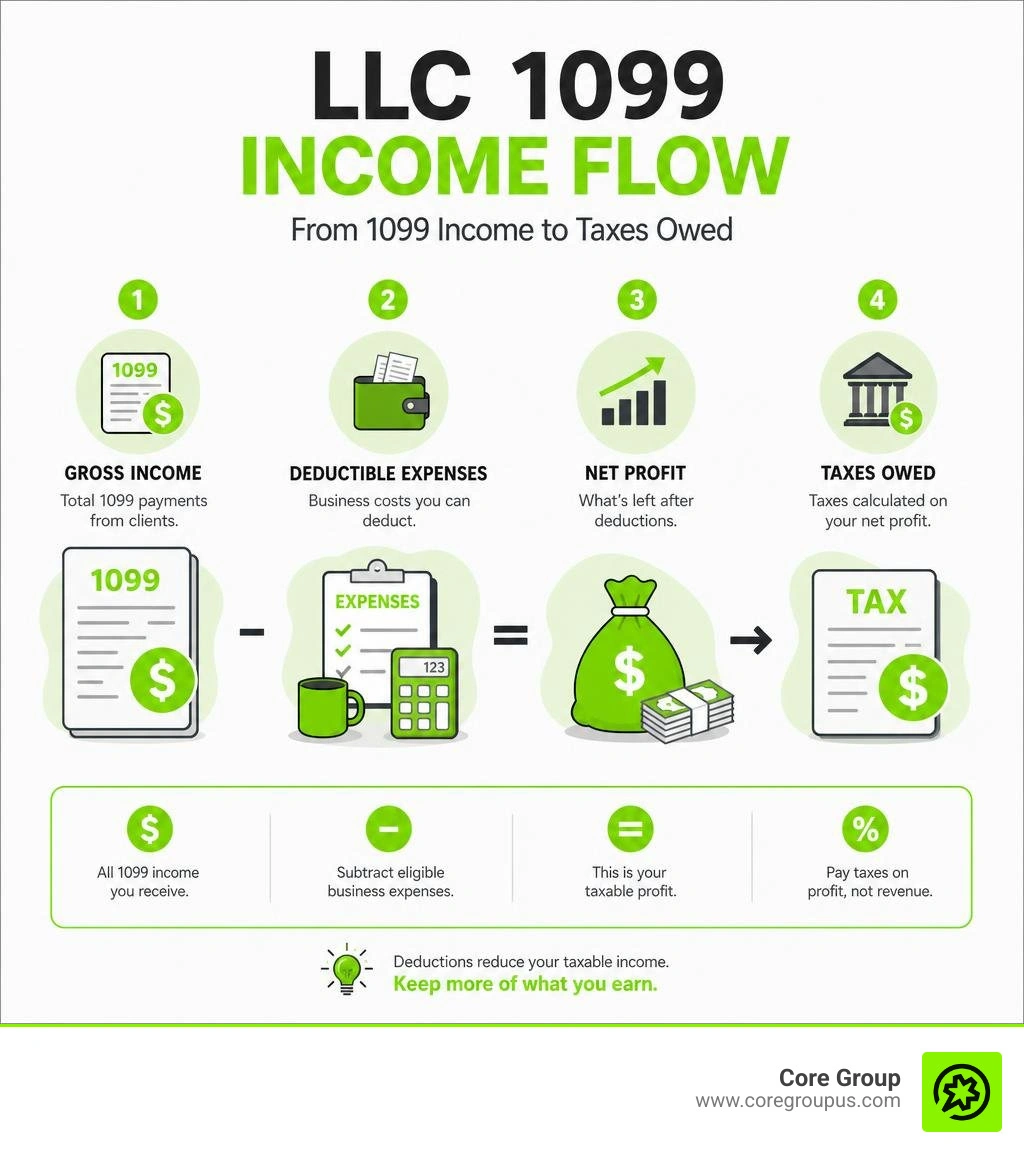
When you run an LLC and get 1099 expenses rolling in from clients, the IRS lets you subtract a wide range of business costs from that income before calculating what you owe. That means you only pay tax on your profit, not your total revenue.
Here are the most common deductible expenses for an LLC receiving 1099 income
- Home office costs (rent, utilities, internet)
- Vehicle and mileage expenses (72.5 cents per mile for the first half of 2026)
- Business software, equipment, and supplies
- Health insurance premiums
- Retirement plan contributions (SEP IRA, Solo 401k, SIMPLE IRA)
- Phone and internet bills (business-use portion)
- Professional fees paid to contractors, accountants, or lawyers
- Business meals (50% deductible)
- Education and training directly related to your work
- Half of your self-employment tax
- Up to 20% of net business income via the Qualified Business Income (QBI) deduction
You report these deductions on Schedule C of your personal tax return, subtracting them from your gross 1099 income to arrive at your net profit. That net profit is what gets taxed.
If you are a freelancer, independent contractor, or creative professional running a single-member LLC, this matters a lot. The IRS taxes self-employment income at a base rate of 15.3% before income tax even applies. Smart deductions can cut that number down significantly.
And here is the thing most people miss. If your net earnings from self-employment are under $400, you may not owe self-employment tax at all. But if you are earning more than that (and most creative entrepreneurs are), every deductible expense you skip is money left on the table.
Llc get 1099 expenses vocabulary
How to Track and Claim Your LLC Get 1099 Expenses
To successfully write off your business costs, we must understand what the IRS considers a valid business deduction. The golden rule is that the expense must be both ordinary and necessary to run your business. An ordinary expense is one that is common and accepted in your industry. A necessary expense is one that is helpful and appropriate for your trade. For creative entrepreneurs, this might include high-end design software, camera equipment, or digital marketing tools.
When you operate a single-member LLC, the IRS treats you as a disregarded entity by default. This means your business does not file its own corporate tax return. Instead, you report all your business income and claim your business expenses on Schedule C of your personal Form 1040. The net profit calculated on Schedule C flows directly to your personal tax return, where it is taxed at your individual income tax rate.
If you provide services to other businesses, those clients will track their payments to you. If they pay you nonemployee compensation, they will report those payments on Form 1099-NEC. You must ensure that the total revenue you report on Schedule C matches or exceeds the amounts listed on all the Form 1099-NEC documents you receive. Failing to report this income can quickly trigger an automated IRS flag.
To maximize your write-offs without raising red flags, we recommend keeping a highly detailed list of your operating costs. If you want a complete breakdown of what you can write off this year, check out our comprehensive LLC Tax Deductions Guide 2026. Additionally, if you are unsure whether your business structure requires clients to send you these forms, you can read more about how different entities are treated in our guide on Do LLCs Get a 1099.
Maximizing Your Home Office and Vehicle Deductions
For most self-employed creatives, our biggest operational write-offs come from the spaces we work in and the vehicles we drive. These travel deductions and business expenses can dramatically reduce your taxable income when calculated correctly.
How to Calculate Your Home Office Deduction
If you run your business from a spare bedroom, a converted garage, or even a dedicated desk in your apartment, you may qualify for the home office deduction. To claim this write-off, your workspace must meet two strict IRS requirements. First, it must be used regularly and exclusively for your business. This means your office cannot double as a guest bedroom or a kids play area. Second, it must be your principal place of business, meaning you perform your primary administrative or operational tasks there.

When calculating this deduction, you have two options. The first is the simplified method, which allows you to claim five dollars per square foot of your office space up to a maximum of 300 square feet. This gives you an easy write-off of up to 1,500 dollars without needing to track individual utility bills.
The second option is the actual expense method. With this approach, you track all your actual home expenses, including rent, mortgage interest, property taxes, utilities, home insurance, and internet. You then deduct a percentage of these costs based on the square footage of your office relative to the total square footage of your home. For creatives who pay high rent in major metropolitan areas, the actual expense method often yields a much larger deduction. You can learn more about unique workspace deductions in our guide on Creative Business Expenses.
Tracking Vehicle and Mileage Expenses for Your LLC
If you drive your personal vehicle to meet clients, pick up supplies, or travel to project sites, you can deduct these auto expenses. However, you cannot deduct your daily commute from your home to a regular office space, as the IRS views commuting as a personal expense.
To write off vehicle costs, you must choose between the standard mileage rate and the actual expenses method. For the 2026 tax year, the standard mileage rate is set at 72.5 cents per mile for the first half of the year and increases to 76 cents per mile for the second half of the year. This rate is designed to cover gas, oil changes, insurance, maintenance, and depreciation.
Alternatively, the actual expenses method allows you to track and deduct the exact business percentage of your vehicle expenses, including fuel, repairs, tires, insurance, registration fees, and lease payments. If you choose the actual expenses method in the first year you use your vehicle for business, you are locked into that method for the lifetime of the vehicle. If you start with the standard mileage rate, you can switch between methods in later years.
| Expense Category | Standard Mileage Rate Method | Actual Expenses Method |
|---|---|---|
| Recordkeeping | Must track business miles driven | Must track all receipts for gas, repairs, and insurance |
| Depreciation | Calculated automatically within the rate | Calculated manually based on vehicle value |
| Flexibility | Can switch to actual expenses in later years | Locked into actual expenses for that vehicle |
| Best For | High-mileage drivers with fuel-efficient cars | Low-mileage drivers with heavy or expensive vehicles |
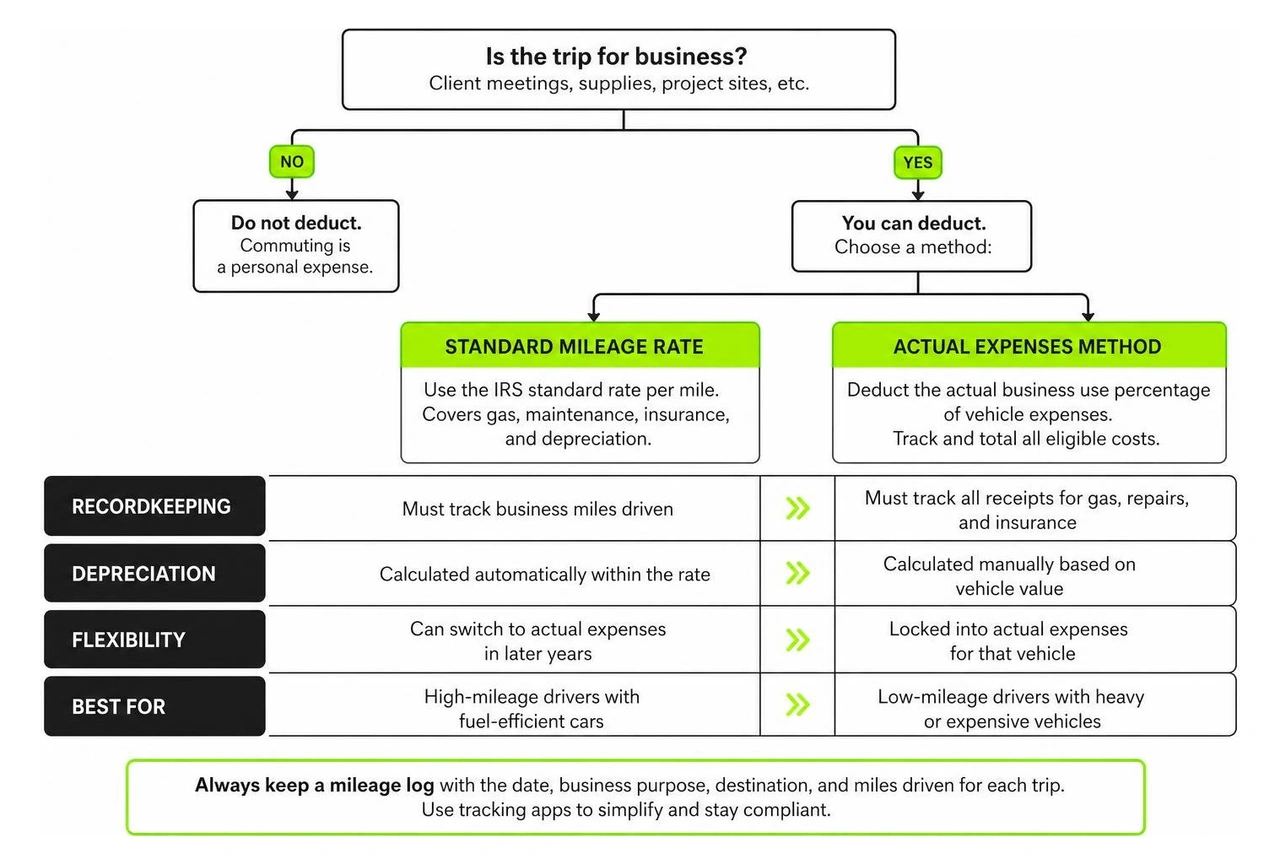
Regardless of the method you choose, keeping a meticulous mileage log is non-negotiable. Your log must record the date of each trip, the business purpose, the destination, and the exact miles driven. To simplify this process, we recommend using mobile tracking apps that log your drives automatically. You can read our advice on maintaining clean travel records in our article on 1099 Contractor Expense Tracking.
Health Insurance and Retirement Plan Deductions
Taking care of your health and planning for your future are essential parts of running a sustainable business. Fortunately, the tax code provides excellent incentives that allow self-employed individuals to secure long term savings and employee benefits with tax-deferred growth.
Deducting Health Insurance Premiums as a Self Employed LLC
If you run an LLC and have net self-employment income, you can generally deduct 100% of the health insurance premiums you pay for yourself, your spouse, and your dependents. This is an above-the-line deduction, meaning it directly reduces your adjusted gross income on your tax return, even if you do not itemize your deductions.
To qualify for this deduction, you must meet two conditions. First, your LLC must show a net profit, as you cannot deduct more in premiums than your business earns. Second, you must not be eligible to participate in an employer-sponsored health plan through your own W-2 job or your spouse's employer. If you pay for long-term care insurance, you can also deduct those premiums up to specific limits based on your age. These medical deductions are reported using Form 7206. For more details on managing your medical write-offs, explore our LLC 1099 Income Guide 2026.
Retirement Plan Contributions to Lower Your Taxable Income
Contributing to a tax-advantaged retirement plan is one of the smartest ways to lower your current tax bill while building wealth. As an LLC owner, you have access to several excellent plans that offer much higher contribution limits than standard employee accounts.
The most popular options include a SEP IRA, a Solo 401k, and a SIMPLE IRA. A SEP IRA allows you to contribute up to 25% of your net self-employment earnings, making it incredibly flexible for years when your income fluctuates. A Solo 401k is even more powerful because it allows you to contribute both as an employee and as an employer, significantly maximizing your tax-deferred savings. By routing your business profits into these accounts, you keep more money in your pocket today and secure your financial future. To learn how to balance your retirement savings with your monthly cash flow, refer to our 1099 Contractor Profit Tracking Guide.
Self Employment Tax QBI and Recordkeeping Rules
Remaining compliant with IRS guidelines requires a solid understanding of how self-employment taxes are calculated, how special deductions apply, and what documentation you must keep to protect your business.
How to Deduct Half of Your Self Employment Tax
When you work as a W-2 employee, your employer pays half of your FICA taxes, which fund Social Security and Medicare, while you pay the other half through payroll deductions. When you are self-employed, you must pay the full 15.3% self-employment tax yourself. This tax consists of 12.4% for Social Security and 2.9% for Medicare, and it is calculated on Schedule SE.
To help ease this burden, the IRS allows you to deduct 50% of your self-employment tax directly from your adjusted gross income on Schedule 1 of Form 1040. This deduction is designed to treat you similarly to an employer who can deduct payroll taxes as a business expense. To understand how this tax impacts your overall filing, read our guide on Single Member LLC Taxes.
Applying the Qualified Business Income Deduction to Your LLC
The Qualified Business Income deduction, commonly known as the QBI deduction or Section 199A, allows eligible self-employed individuals and pass-through entities to deduct up to 20% of their qualified business income. This is a massive tax break that was permanently extended by the One Big Beautiful Bill Act.
For the 2026 tax year, you qualify for the full 20% deduction if your taxable income as a single filer is below $203,000, or below $406,000 if you are married filing jointly. If your income exceeds these thresholds, the deduction may be limited based on the type of business you run and the W-2 wages your business pays. To see how to maximize this deduction for your specific business setup, review our LLC Get 1099 Tax Maximum Guide 2026.
Essential Documentation to Substantiate Your LLC Get 1099 Expenses
If you ever face an IRS audit, your deductions are only as good as your documentation. The IRS has the power to disallow any business deduction that is not backed by proper records, which can lead to back taxes, interest, and penalties.
To achieve complete audit protection, we strongly recommend keeping personal and business finances completely separate. You should open a dedicated business checking account and credit card exclusively for your LLC. This creates a clean paper trail and prevents the commingling of funds, which can jeopardize your personal liability protection.

You must keep digital or physical receipts for every business purchase, noting the business purpose of the transaction. For business meals, always write down who was present and what business matters were discussed. For a deeper look at how to manage contractor payments and documentation, read our breakdown of 1099 NEC Explained. Additionally, if you hire other freelancers to help with your projects, you can learn when you are required to issue forms to them by reading our guide on Do I Need to Send a 1099 to an LLC.
What You Cannot Deduct When Your LLC Get 1099 Expenses Filed
While the list of legitimate write-offs is long, there are several common expenses that the IRS strictly prohibits you from deducting. Attempting to claim these personal costs can trigger an audit and damage your business credibility.
First, you cannot deduct personal, living, or family expenses. This includes standard clothing, unless it is a branded uniform or protective gear required for your job. Second, commuting costs between your home and your regular workplace are strictly non-deductible. Third, entertainment expenses, such as taking clients to sporting events or concerts, are no longer deductible under current tax laws. Finally, you cannot deduct political contributions, fines, or penalties paid to government agencies. To make sure you do not accidentally claim these restricted items, consult our guide on Single Member LLC 1099 Reporting.
Frequently Asked Questions about LLC 1099 Expenses
Navigating business taxes can be overwhelming, so we have gathered quick answers to the most common questions self-employed LLC owners ask.
What is the 1099 reporting threshold for the 2026 tax year
Starting in the 2026 tax year, the reporting threshold for Form 1099-NEC has been officially raised to $2,000 under the One Big Beautiful Bill Act. This is a significant increase from the historical $600 limit. This means businesses are only required to issue you a Form 1099-NEC if they pay your LLC $2,000 or more for services during the calendar year. However, you must still report all of your business income on Schedule C, even if you do not receive a physical 1099 form because your earnings from a client fell below this threshold.
Do single member LLCs get 1099 forms
Yes, single-member LLCs typically receive Form 1099-NEC from their business clients. Because the IRS treats single-member LLCs as disregarded entities, you are taxed similarly to a sole proprietorship. When a client requests your tax information, you should fill out Form W-9 using your LLC name and check the individual or single-member LLC box. This ensures your clients know to issue you a 1099 for your services.
Can I deduct startup costs before my LLC is officially formed
Yes, the IRS allows you to deduct up to $5,000 of qualifying startup expenses in your first year of business. These expenses can include market research, legal fees, advertising, and business launch costs incurred before your LLC was officially registered. If your startup costs exceed $50,000, the immediate $5,000 deduction begins to phase out dollar-for-dollar. Any remaining startup costs must be amortized and written off over a period of 15 years.
Conclusion
Managing your llc get 1099 expenses does not have to be a source of stress. By staying organized, separating your business finances, and claiming all the legitimate deductions you are entitled to, you can keep more of your hard-earned profit in your business.
At Core Group, we specialize in helping creative entrepreneurs navigate the complexities of bookkeeping, tax planning, and financial management. Our "no-fluff, profit-first playbook" is designed to give you ultimate peace of mind and save you valuable time, allowing you to focus entirely on your craft. We stand behind our work with our unique MacBook Pro guarantee, ensuring you receive the highest level of professional service. If you are ready to simplify your business finances and stop worrying about tax season, explore our resources on Single Member LLC 1099 Reporting and let us help you build a more profitable business.