The Ultimate Guide to Understanding LLC vs Corporation
Is an LLC a Corporation and Why Does It Matter
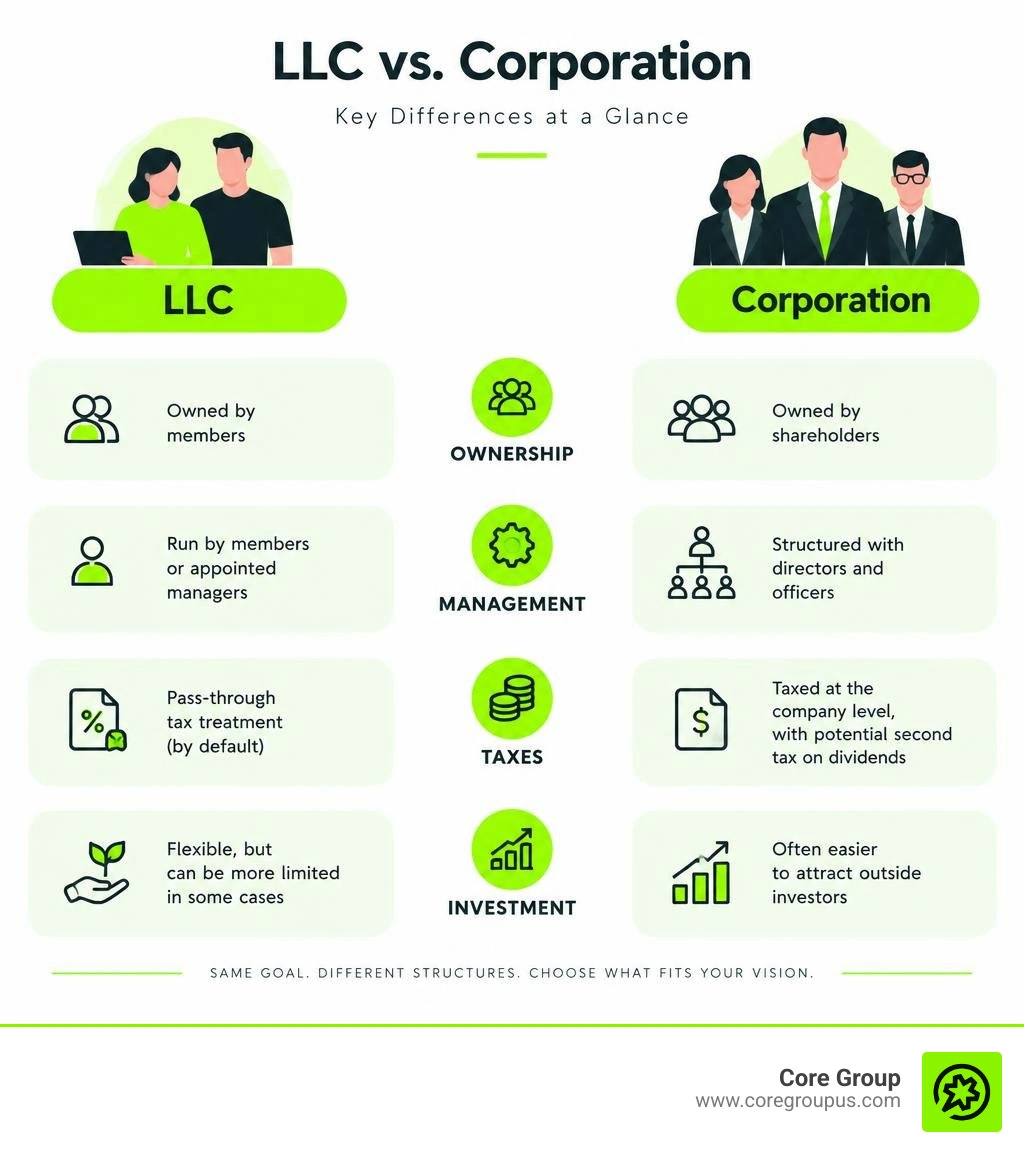
No. An LLC is not the same legal entity as a corporation. Both can protect an owner's personal assets, but they differ in ownership, management, paperwork, and taxes.
An LLC is owned by members and can be run directly by them or by appointed managers. A corporation is owned by shareholders and follows a more formal structure with directors and officers. LLCs usually receive pass-through tax treatment by default, while C corporations pay tax at the company level and may face a second tax when they distribute dividends.
The important nuance is that an LLC can elect corporate tax treatment without becoming a corporation under state law. That choice can affect your tax return, payroll strategy, cash flow, and plans to bring in investors.
If you are building a creative business, the right structure should reduce financial friction while supporting where you want the business to go next. I'm Christian Brim, and this guide will help you compare the options with clarity.
Is an llc a corporation terms made easy
Is an LLC a Corporation? Fundamental Legal Differences

When business owners ask whether an LLC is simply another type of corporation, the short answer is no. A Limited Liability Company, commonly known as an LLC, is a distinct legal entity designed under state law to blend the liability shield of a traditional corporate entity with the administrative simplicity and tax flexibility of a partnership or sole proprietorship.
Both entities provide limited liability protection, creating a legal barrier between the personal assets of the owners and the debts or liabilities of the company. However, the legal mechanics behind each structure are entirely separate. When distinguishing if an LLC is a sole proprietorship or corporation, you quickly find that an LLC represents a hybrid entity rather than a corporate clone. Corporations have existed in American jurisprudence for centuries, while LLCs first emerged in the late 1970s as a modern alternative for entrepreneurs who wanted asset protection without corporate bureaucracy.
To create an LLC, you submit Articles of Organization or a Certificate of Formation to your state government. In contrast, incorporating a business requires filing Articles of Incorporation or a Certificate of Incorporation. Each state maintains distinct legal requirements, which you can see in the foundational guidelines published by agencies such as the Division of Corporations - State of Delaware, as well as corporate divisions in states like California, Texas, New York, Florida, and across all fifty states.
Is an LLC a Corporation Under State Law?
Under state statutes, an LLC is never a corporation. When you form an LLC, the individuals or entities that hold an equity stake are called members, and their ownership stakes are designated as membership interests or units. Corporations, on the other hand, are owned by shareholders who hold physical or digital share certificates representing stock.
The foundational governing document for an LLC is the operating agreement. This internal document dictates how profits and losses get distributed, how major voting decisions occur, and how members can enter or exit the business. Corporations rely on formal corporate bylaws, which outline statutory voting procedures, officer responsibilities, and shareholder rights. While corporate bylaws must conform strictly to state corporate codes, LLC operating agreements offer immense freedom of contract, allowing members to craft custom management rules that suit their unique enterprise.
Management Structures and Ongoing Compliance Formalities
The internal operation of each structure reveals massive differences in daily governance and compliance.
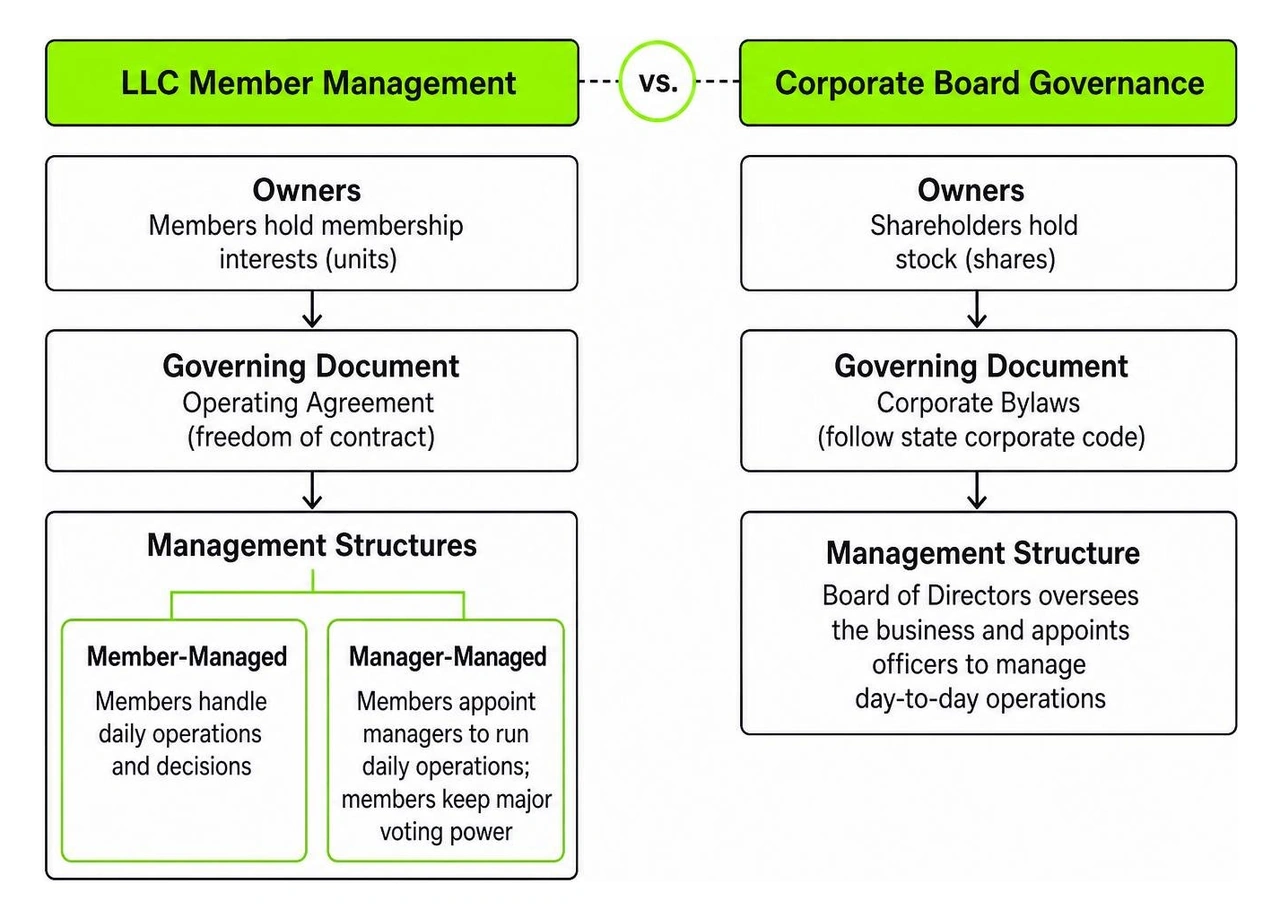
LLCs provide two primary governance setups
- Member-managed. The owners directly handle daily operations, enter into contracts, and manage business assets without needing a separate governing council.
- Manager-managed. The members appoint specific managers, who may or may not be owners, to run day-to-day operations, while passive members retain major voting power over significant business decisions.
Corporations require a mandatory, three-tiered governance hierarchy. Shareholders own the company, but they do not manage daily operations. Instead, shareholders elect a board of directors responsible for high-level oversight and strategic policy. The board of directors then appoints corporate officers, such as the Chief Executive Officer, President, Treasurer, and Secretary, who manage daily business activities.
With this corporate hierarchy comes a demanding calendar of corporate formalities. Corporations must hold regular board meetings, host an annual shareholder meeting, give formal notice of meetings, and record detailed meeting minutes. LLCs are generally free from these statutory meeting requirements, freeing creative founders from unnecessary administrative red tape.
Tax Classifications. How LLCs and Corporations Pay Federal Income Tax
Tax treatment represents the most significant area of confusion when evaluating these structures. The legal entity you form at the state level does not automatically lock you into a single, permanent tax category at the federal level.
Understanding your federal income tax obligations for LLC entities begins with how the Internal Revenue Service views business structures. The IRS does not have a separate tax return category specifically called an LLC. Instead, the IRS fits domestic LLCs into established tax buckets based on owner count, as explained in the official Limited liability company (LLC) | Internal Revenue Service guidelines.
| Feature | Single-Member LLC (Default) | Multi-Member LLC (Default) | C Corporation | S Corporation (Tax Election) |
|---|---|---|---|---|
| Default Tax Status | Disregarded Entity | Partnership | Corporation | Requires Form 2553 Election |
| Tax Return Form | Schedule C (Form 1040) | Form 1065 & Schedule K-1 | Form 1120 | Form 1120-S & Schedule K-1 |
| Double Taxation? | No | No | Yes (Corporate + Dividend) | No |
| Federal Corporate Tax Rate | N/A (Personal Rates) | N/A (Personal Rates) | Flat 21% (as of 2026) | N/A (Pass-Through) |
| Self-Employment Tax | Applies to 100% of net profit | Applies to active member profits | None on dividends | Only applies to W-2 salary |
Under default rules, LLCs enjoy pass-through taxation. This means the entity pays no federal income tax directly. Instead, company revenue, deductions, gains, and losses flow straight to the owners' individual tax returns. In a multi-member LLC, the business files an informational Form 1065 return, generating a Schedule K-1 for each partner to report their proportional earnings.
When Is an LLC a Corporation for Tax Purposes?
An LLC becomes a corporation for tax purposes only when its members deliberately choose that classification by filing an election with the IRS.
By default, the IRS classifies a single-owner LLC as a disregarded entity. If you are handling single-member LLC tax reporting, you report your business activities directly on Schedule C of your personal Form 1040. However, the IRS allows an LLC to change its tax personality by submitting Form 8832, known as the Entity Classification Election.
According to IRS rules on LLC corporate elections, an LLC can file Form 8832 to elect C corporation tax status. Once approved, the LLC remains a limited liability company under state law, but it files federal taxes on Form 1120 like any standard corporation.
Why would an owner make this move? A C corporation pays a flat federal corporate tax rate of 21%. If a growing company plans to reinvest substantial profits back into operations or build working capital reserves, paying the corporate rate can sometimes prove more favorable than subjecting those retained earnings to higher individual income tax brackets.
S Corporation Status and Avoiding Double Taxation
While C corporations offer the ability to retain capital at a predictable rate, they come with double taxation. The business pays tax on its net income at the corporate rate, and when remaining profits get distributed to shareholders as dividends, those shareholders pay taxes a second time on their personal returns.
Fortunately, businesses can utilize strategies to avoid double taxation on business earnings by electing S corporation status. By submitting Form 2553 to the IRS, an eligible LLC or corporation can maintain pass-through tax status while introducing a powerful payroll strategy.
Under an S corp setup, owner-employees must pay themselves a reasonable W-2 salary for the services they perform. That salary is subject to standard payroll taxes, including Social Security and Medicare. However, any additional net profits can be distributed as shareholder dividends, which are exempt from self-employment taxes.
To qualify for an S corporation, the business must satisfy strict eligibility criteria
- It cannot have more than 100 shareholders
- All shareholders must be individual U.S. citizens or permanent residents
- It can issue only one class of stock, meaning all distributions must be strictly proportionate to ownership percentages
For many established entrepreneurs, moving to an S corp classification delivers significant tax savings while preserving the organizational simplicity of an LLC.
Ownership, Investment, and Raising Capital. LLC vs Corporation
When planning how to fund your venture, the distinction between membership interests and corporate stock becomes critical.

Corporations have a massive advantage when seeking institutional venture capital or angel investment. Professional investors overwhelmingly prefer Delaware C corporations for several straightforward reasons
- Standardized Equity Instruments. Corporations can issue common stock to founders and preferred stock to investors. Preferred stock can include specialized rights, such as liquidation preferences, anti-dilution clauses, and board appointment guarantees.
- Seamless Stock Option Pools. Corporate structures easily accommodate equity compensation plans, stock options, and vesting schedules to recruit top-tier talent.
- Simple Transferability. Transferring ownership in a corporation requires issuing or reassigning share certificates. In an LLC, introducing new members or transferring units generally requires amending the operating agreement and obtaining formal consent from other members.
- Investor Tax Cleanliness. Institutional funds often dislike receiving Schedule K-1 forms from pass-through LLCs, as unrelated business taxable income can complicate their tax reporting.
While standard businesses can find plenty of ways to maximize growth using our navigating tax deductions for growing business entities resource, high-growth tech startups that require multiple venture funding rounds almost always choose the C corporation path from day one.
Pros and Cons. Choosing Between an LLC and a Corporation
Choosing the right structure requires weighing operational ease against long-term growth ambitions.
Limited Liability Company Advantages
- Operational Flexibility. You can establish customized management rules and divide profits in ways that differ from ownership percentages.
- Minimal Compliance Burden. No mandatory shareholder meetings, board elections, or formal corporate minutes are required by law.
- Pass-Through Tax Defaults. Avoid double taxation right out of the gate without filing special initial tax elections.
- Flexible Tax Options. An LLC can elect to be taxed as a disregarded entity, partnership, C corporation, or S corporation as business needs change.
Limited Liability Company Disadvantages
- Self-Employment Taxes. Default LLC profits are generally subject to the full 15.3% self-employment tax for active members.
- Difficult Investor Fundraising. Institutional investors often avoid purchasing LLC membership units.
- State Franchise Fees. Some states impose ongoing franchise taxes or gross receipt fees on LLCs regardless of profitability.
Corporation Advantages
- Venture Capital Magnet. The gold standard for outside investment, equity crowdfunding, and issuing multiple stock classes.
- Transferable Ownership. Shares can be traded, sold, or transferred with minimal internal restructuring.
- Retained Earnings Strategy. The ability to keep profits in the company taxed at the 21% flat corporate rate.
- Perpetual Existence. Corporations naturally survive changes in ownership or the death of founders without requiring operational restructuring.
Corporation Disadvantages
- Double Taxation. Standard C corporations pay tax at both the entity and shareholder levels.
- Rigid Formalities. Strict statutory requirements to adopt bylaws, hold regular meetings, and maintain formal corporate records.
- Restrictive S Corp Rules. If electing pass-through S corp treatment, ownership is limited to 100 U.S. resident shareholders and a single class of equity.
Frequently Asked Questions About Business Entity Selection
Can an LLC Convert into a Corporation Later?
Yes. If your business begins as an LLC and later requires venture capital or plans an initial public offering, you can convert the entity into a corporation.
Most states offer a straightforward statutory conversion process. You submit a conversion filing and new Articles of Incorporation to the secretary of state, which automatically transfers your assets, contracts, liabilities, and operational history into the new corporate structure without disrupting active commercial relationships. In states without statutory conversion, businesses accomplish the same result through a statutory merger or asset transfer.
Do LLCs and Corporations Both Protect Personal Assets?
Both structures offer strong limited liability protection, but neither is invincible. Courts can pierce the corporate veil if you fail to maintain a strict legal separation between your personal affairs and the business.
To maintain strong asset protection across either entity type, always follow these rules
- Never commingle personal and business funds. Maintain separate business checking accounts and credit cards.
- Adequately capitalize the business to handle predictable commercial risks and expenses.
- Sign all contracts, invoices, and legal agreements formally in the company's name rather than your own.
- Observe all mandatory state compliance rules, annual filings, and governing documents.
Which Entity Is Better for Creative Entrepreneurs and Freelancers?
For solo creative founders, agency owners, and freelancers, an LLC is usually the superior starting choice. It offers robust asset protection without burying you in administrative paperwork.
As a creative entrepreneur, spending your weekends drafting board minutes or organizing shareholder meetings distracts from producing great work. An LLC lets you maintain agility, handle managing 1099 contractor payments and income smoothly, and scale operations on your own terms. Once your net earnings reach a level where self-employment tax becomes a heavy financial burden, you can easily elect S corporation status to optimize your tax bill without abandoning your LLC foundation.
Conclusion
Building a successful creative enterprise requires smart foundational decisions. An LLC is not a corporation, but it provides the flexibility to operate as a simple pass-through entity today while retaining the power to adopt corporate tax advantages whenever your growth demands it.
At Core Group, we help creative entrepreneurs cut through financial noise with our no-fluff, profit-first playbook. Our mission is to handle your ongoing financial management, tax planning, and bookkeeping so you can regain peace of mind and focus entirely on creating your best work, backed by our MacBook Pro guarantee.
When your business is generating consistent profits and you want to reduce your self-employment tax burden, review our step-by-step guidance on how to form an S corp to see if making an S corporate tax election is the right next move for your financial future.