How to Manage Overtime Taxes in Colorado and Beyond for Creative Studios
Why Managing Overtime Taxes Matters for Small Creative Businesses Right Now
Managing overtime taxes in a small creative business just got a lot more complicated, and a lot more important.
Here is a quick snapshot of what you need to know in 2026.
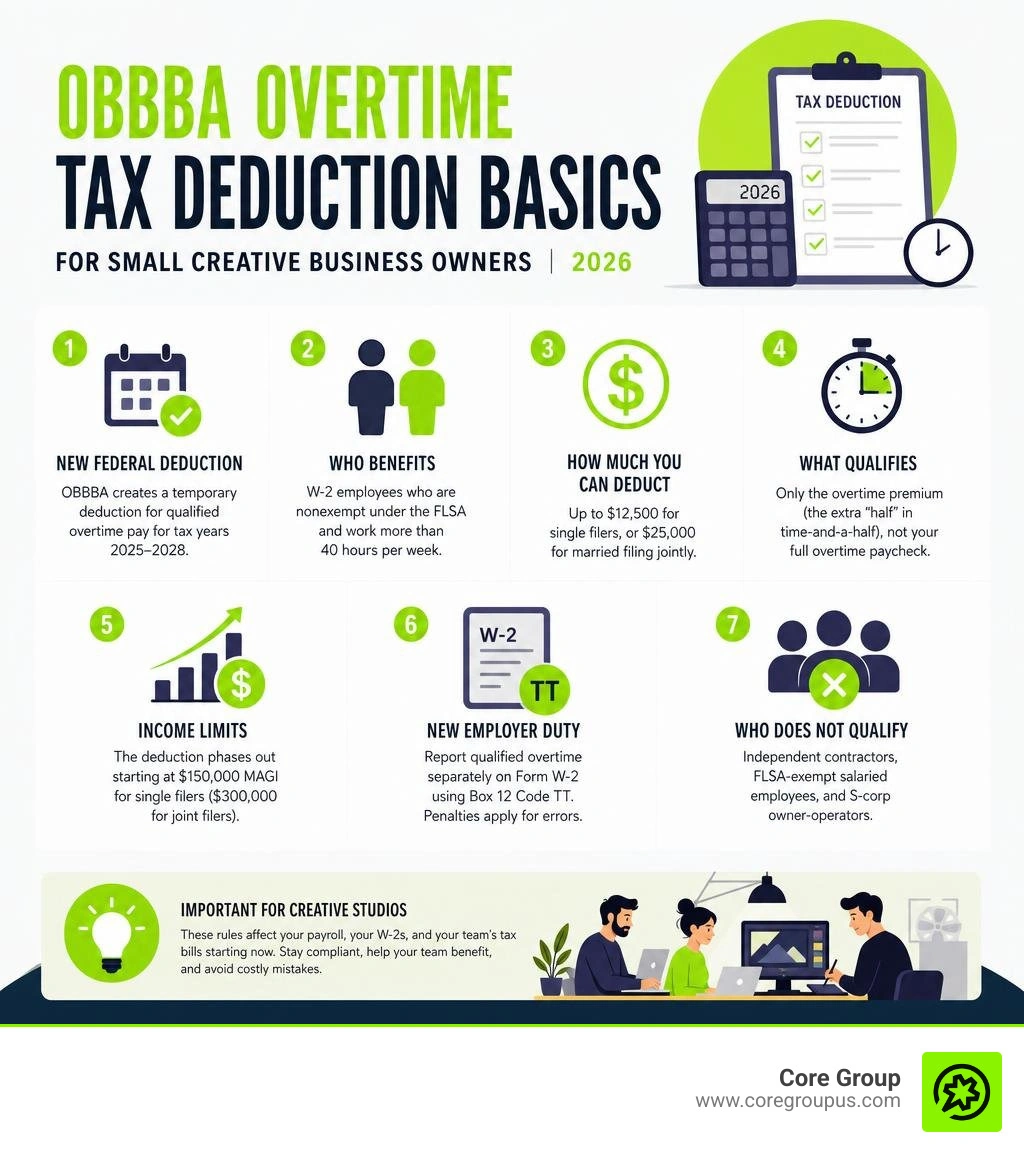
- New federal deduction - The One Big Beautiful Bill Act (OBBBA), signed into law on July 4, 2025, created a temporary deduction for qualified overtime pay covering tax years 2025 through 2028
- Who benefits - W-2 employees who are nonexempt under the Fair Labor Standards Act (FLSA) and work more than 40 hours per week
- How much you can deduct - Up to $12,500 for single filers, or $25,000 for married filing jointly
- What actually qualifies - Only the overtime premium (the extra "half" in time-and-a-half), not your full overtime paycheck
- Income limits - The deduction phases out starting at $150,000 MAGI for single filers ($300,000 for joint filers)
- New employer duty - You must now report qualified overtime separately on Form W-2 using Box 12 Code TT, with real penalties for getting it wrong
- Who does not qualify - Independent contractors, FLSA-exempt salaried employees, and S-corp owner-operators
If you run a film studio, design agency, or any other creative operation with hourly crew or staff, these rules affect your payroll, your W-2s, and your team's tax bills starting now.
Running a creative business means your focus is on the work, not the tax code. But with the average employee claiming the overtime deduction saving roughly $1,440 in federal taxes, and with new mandatory W-2 reporting requirements that carry per-form penalties ranging from $60 to $660, ignoring this is no longer an option.
This guide walks through exactly what Colorado and nationwide creative studio owners need to do to stay compliant, help their teams benefit, and avoid costly mistakes.
Managing overtime taxes small creative business definitions include
Understanding the One Big Beautiful Bill Act Overtime Rules
The passage of the One Big Beautiful Bill Act introduced some of the most significant changes to the tax code in recent memory. By establishing a federal tax deduction for overtime pay, the federal government aimed to reduce the tax burden on hourly workers. However, this historic legislation also handed small business owners a brand new set of payroll and reporting obligations that require careful attention.
To help your creative studio navigate these changes, you first need to understand how the deduction is structured and what actually qualifies. For a general overview of how overtime is treated on a federal level, you can read our detailed guide on the Tax on Overtime Pay. You can also learn more about the broader legislative intent and employee perspectives from the analysis on the New Tax Deduction for Overtime Pay.

What is the OBBBA Overtime Tax Deduction
The OBBBA overtime tax deduction is a federal income tax deduction that eligible employees can claim on their individual year-end tax returns. It is designed to reduce the amount of income subject to federal income tax, but it does not make overtime pay completely tax free.
For the 2026 tax year, the deduction is capped at $12,500 for single filers and $25,000 for married couples filing jointly. This deduction is available below the line, meaning employees can stack it on top of their standard deduction using Schedule 1-A when they file their Form 1040.
However, high earners should note that this tax benefit phases out. The phase-out range begins at a modified adjusted gross income of $150,000 for single filers and $300,000 for married couples filing jointly. The deduction completely disappears once a single filer reaches $275,000 in modified adjusted gross income, or $550,000 for joint filers.
Qualified Overtime versus State Mandated Hours
One of the biggest areas of confusion for creative studio owners is determining what counts as qualified overtime. Under the OBBBA, qualified overtime is strictly defined by reference to the Fair Labor Standards Act. This means the deduction only applies to overtime required under federal law, which is generally hours worked over 40 in a single workweek by nonexempt employees.
Additionally, only the premium portion of the overtime pay qualifies for the deduction. The premium portion is the extra half in the time and a half calculation. For example, if a video editor has a regular hourly rate of $30 and works 10 hours of overtime at $45 per hour, the regular portion of that pay is $30 per hour and the premium portion is $15 per hour. In this scenario, only the $15 per hour premium portion, totaling $150, is eligible for the deduction.
This federal restriction creates compliance challenges in states with their own daily overtime laws. For instance, California requires overtime pay for any hours worked beyond 8 in a single day. To understand how these local rules differ from federal guidelines, you can read about whether Is Overtime Taxed at a Higher Rate in California.
Similarly, states like Alaska and Colorado have specific daily overtime and rest period requirements that do not align perfectly with the federal 40-hour workweek standard. For detailed state-specific compliance, you can review the Alaska overtime laws | Employer compliance guide | QuickBooks Blog or check out the Delaware overtime laws | Employer compliance guide - QuickBooks. Overtime paid solely due to state daily limits, union contracts, or voluntary company policies does not qualify for the federal OBBBA deduction if the employee did not actually exceed 40 hours of work in that federal workweek.
Employer Compliance and W2 Reporting Requirements
While the tax deduction is claimed by employees on their individual returns, the burden of tracking and reporting the qualified amounts falls squarely on the employer. If you run a small creative studio, you must update your internal processes to ensure you are meeting these new federal requirements. For a broader look at small business compliance, read our guide on Payroll Tax Compliance. You can also find valuable insights on employer duties in the legal blog post on What Employers Need to Know About No Tax on Tips and No Tax.
Mandatory Reporting with Box 12 Code TT
During the 2025 transition year, the IRS provided penalty relief and allowed employers to report estimated overtime amounts using Box 14 or separate statements. However, for the 2026 tax year, reporting is fully mandatory.
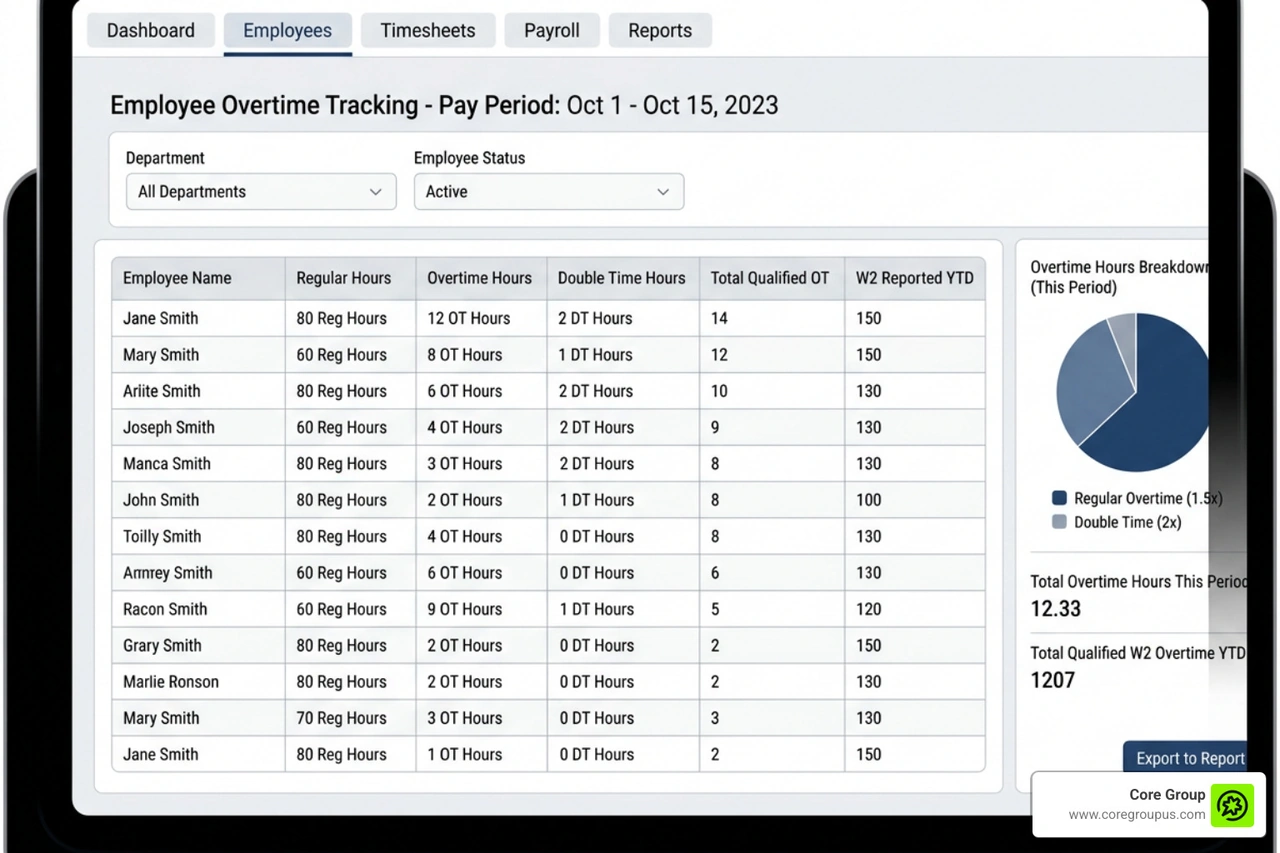
Employers must now separately identify and report the total qualified overtime premium compensation paid to each employee. This must be reported on Form W-2 in Box 12 using the new designated Code TT.
To accomplish this, you must set up separate earnings codes in your payroll system. Your system must be able to isolate the 50 percent premium portion of FLSA-qualified overtime from regular wages and non-qualifying overtime. Relying on manual year-end calculations is incredibly risky and can lead to major reporting errors.
Penalties for Noncompliance with Overtime Reporting
Failing to comply with the new W-2 reporting rules can be incredibly expensive for a small business. Under Internal Revenue Code Section 6721 and Section 6722, the IRS imposes strict penalties for failing to file correct information returns and failing to furnish correct payee statements.
The penalty for each incorrect W-2 form ranges from $60 to $660 depending on how quickly the error is corrected. If the IRS determines that a small business owner showed intentional disregard for the reporting rules, the penalty increases to a minimum of $660 per form with no maximum cap. For a studio with dozens of crew members and freelancers, these fines can quickly wipe out your creative margins.
Best Practices for Managing Overtime Taxes Small Creative Business Owners Must Know
Successfully managing overtime taxes in a small creative business requires a mix of robust bookkeeping, updated payroll settings, and clear policies. Because creative projects often involve irregular hours, last-minute edits, and late-night shoots, having a structured approach to time tracking is essential.
The Role of Bookkeeping in Managing Overtime Taxes Small Creative Business Operations Require
Clean financial records are the foundation of any tax strategy. For a complete overview of financial organization, you can read our Bookkeeping for Creatives Complete Guide.
To manage overtime taxes effectively, you must separate your business and personal finances. This means routing all payroll expenses through dedicated business bank accounts.
When you pay your crew, you should also carefully track any platform fees or processing costs associated with your payroll provider. These fees are fully deductible business expenses that should be categorized correctly in your monthly books to keep your taxable income as low as possible.
Strategic Payroll Adjustments for Managing Overtime Taxes Small Creative Business Teams Face
To keep your payroll running smoothly and avoid year-end surprises, you should make proactive adjustments to your systems. For practical advice on setting up your systems, read our resources on Payroll for SMB and HR and Payroll for Small Business.
First, work with your payroll provider to ensure your software is fully updated to support Box 12 Code TT. Second, communicate with your employees about the new deduction.
Because the overtime deduction is claimed on their year-end tax returns, some employees might want to adjust their withholdings to reflect their lower expected tax liability. They can do this by using the updated Form W-4 Deductions Worksheet to prevent too much federal tax from being withheld from their paychecks throughout the year.
Tax Planning Strategies for Creative Studios and S Corporations
As a creative entrepreneur, you should always look for ways to optimize your entity structure and minimize your overall tax drag. Implementing proactive strategies can help you and your employees save money while remaining fully compliant with the OBBBA guidelines. To explore more advanced options, check out our insights on Tax Planning Strategies and Strategies to Minimize Taxes.
Entity Structure and S Corporation Limitations
Many successful creative studio owners choose to operate as S Corporations to reduce their self-employment tax liability. While this structure has many benefits, S Corp owners must understand the limitations when it comes to the new overtime deduction. You can read our analysis on whether Should Creative Entrepreneurs Become an S-Corp for more context.
Under S Corporation rules, owner-employees must pay themselves a reasonable salary. However, S Corp owners are classified as executives, which means they are exempt from FLSA overtime protections.
Because they do not qualify for FLSA-mandated overtime, S Corp owners cannot pay themselves overtime or claim the $12,500 personal overtime deduction. The deduction is strictly reserved for nonexempt W-2 employees.
Reducing Modified Adjusted Gross Income to Preserve Deductions
If you have key creative employees whose earnings put them close to the $150,000 modified adjusted gross income phase-out threshold, you can help them preserve their overtime deduction through smart benefits planning.
Encouraging employees to make pre-tax contributions to a traditional 401k or a SEP IRA reduces their modified adjusted gross income. By lowering their taxable income below the phase-out limits, your employees can stay eligible for the maximum federal overtime deduction while building their long-term retirement savings.
Frequently Asked Questions about Overtime Taxes
When does the federal overtime tax deduction expire
The OBBBA overtime tax deduction is a temporary measure. Under the current legislation, the deduction is scheduled to sunset after December 31, 2028. Unless Congress votes to extend the law or make it permanent, overtime compensation will return to being fully taxable at standard federal rates starting in the 2029 tax year.
Does the overtime deduction apply to state and local taxes
No, the OBBBA overtime deduction is strictly a federal income tax deduction. Overtime pay remains subject to state and local income taxes in states that do not conform to the federal tax changes. Additionally, overtime earnings are still fully subject to FICA payroll taxes, meaning both employers and employees must continue to pay their respective shares of Social Security and Medicare taxes on all overtime wages.
Can independent contractors claim the overtime tax deduction
No, independent contractors and freelancers who receive 1099 forms do not qualify for the overtime tax deduction. The deduction is strictly limited to W-2 employees who are covered under the FLSA. If you are a freelancer looking for alternative ways to manage your tax burden, you can read our guide on As a Freelancer How Do I Plan for Taxes or check out our tips on Tax Planning for Freelancers.
Conclusion
Managing overtime taxes does not have to be a source of stress for your creative studio. By setting up clean tracking systems, updating your payroll software for 2026, and understanding the differences between federal and state rules, you can protect your business from penalties while helping your hardworking crew keep more of their earnings.
At Core Group, we help creative entrepreneurs handle their bookkeeping, payroll, and tax planning through our simple, profit-first playbook. We take the financial stress off your plate, giving you complete peace of mind and more time to focus on your art, all backed by our MacBook Pro guarantee.
If you want to make sure your studio is fully compliant and optimized for the 2026 tax year, let us help you build a clear financial plan. To get started, you can learn more about how federal guidelines impact your bottom line by reading our resources on the Overtime Tax Rate.