The Single-Member LLC Guide to Hiring 1099 Contractors Without IRS Drama
What Every Single-Member LLC Owner Needs to Know About Hiring 1099 Contractors
Yes, can a single-member LLC have 1099 employees is one of the most searched questions by solo business owners looking to grow, and the short answer is yes, but with an important catch on the terminology.
Quick Answer
- A single-member LLC can hire independent contractors (commonly called "1099 workers")
- There is no such thing as a "1099 employee" in the legal sense. A worker is either an independent contractor (1099) or an employee (W-2), never both
- As the hiring LLC, you must correctly classify each worker or face serious IRS penalties
- You do not need to run payroll for contractors, but you do have specific tax reporting duties
The term "1099 employee" is a popular shorthand, but it is actually a legal contradiction. Using it loosely in contracts or conversations can create real problems with the IRS. What people usually mean is an independent contractor, a self-employed professional you pay on a project or contract basis.
For creative entrepreneurs running a single-member LLC, the ability to bring in contractors is a powerful way to scale without the full cost and complexity of hiring W-2 staff. But the rules around classification, tax forms, and compliance are not optional, and getting them wrong can be expensive.
I'm Christian Brim, and in this guide I'll walk you through everything your single-member LLC needs to know to hire contractors the right way.
Here are some important terms to learn about single-member LLC taxes and contractors
- single member llc taxes
- 1099 contractor expense tracking
- is an llc a sole proprietorship or corporation
Can a single-member LLC have 1099 employees and contractors

When you run a solo business, you wear every hat in the company. Eventually, you reach a point where you cannot do it all alone. You need help, but you might not be ready to deal with the administrative headache of full-time payroll. This is where independent contractors enter the picture.
By default, the IRS treats a single-member LLC as a disregarded entity. This means that for income tax purposes, the federal government essentially pretends your LLC does not exist as a separate entity. Instead, all of your business profits and expenses flow directly onto your personal tax return, specifically on Schedule C of your Form 1040. You can learn more about this structure on the IRS Single Member Limited Liability Companies Guide page.
Even though your income taxes flow through to your personal return, your LLC is still a legitimate, separate legal entity under state law. This legal separation gives your business the authority to sign contracts, open bank accounts, and hire outside help. Whether you want to hire a virtual assistant, a graphic designer, or a web developer, your single-member LLC has the full legal right to contract with other self-employed individuals.
The legal reality of whether a single-member LLC can have 1099 employees
To keep your business safe from audits, we must address the legal elephant in the room. The phrase "1099 employee" does not exist in any tax code or labor law. In fact, using this term in your written agreements or daily communications is a major red flag for auditors.
Under federal law, a worker can only be one of two things. They are either a W-2 employee or a 1099 independent contractor.
An employee works under your direct supervision, and you control how, when, and where they perform their duties. You are responsible for withholding federal income taxes, paying the employer share of FICA taxes, and providing unemployment insurance.
An independent contractor is a separate business owner who provides a specific service to your LLC. They control their own hours, use their own tools, and pay their own self-employment taxes. When you hire an independent contractor, you do not pay them through payroll, and you do not withhold any taxes. Instead, you pay their invoices in full and report those payments at the end of the year.
How state laws impact whether a single-member LLC can have 1099 employees
While federal IRS guidelines are highly important, you must also pay close attention to the rules in your specific state. Many states have implemented incredibly strict tests to determine if a worker is truly an independent contractor.
For example, if you operate your LLC in California, you must comply with the California AB5 law, which utilizes the strict ABC test. Under this three-pronged test, a worker is automatically assumed to be an employee unless the hiring business can prove three specific points. First, the worker must be free from the control and direction of the hiring entity. Second, the worker must perform work that is outside the usual course of the hiring entity's business. Third, the worker must be customarily engaged in an independently established trade or occupation.
This means if you run a graphic design LLC in California and you hire a freelance graphic designer to help with client projects, you may fail the second prong of the ABC test because the contractor is performing the exact same type of work your business offers. States like Connecticut, Massachusetts, and New Jersey also enforce variations of this strict ABC test. We always recommend checking your local labor department rules to ensure you do not run afoul of state-level classification laws.
The critical differences between W2 employees and 1099 independent contractors
Correctly classifying your team members is the foundation of a healthy business. The IRS does not take worker classification lightly, and they do not care if you and your worker signed an agreement agreeing to a 1099 relationship. What matters to the IRS is the actual, real-world nature of your day-to-day working relationship.
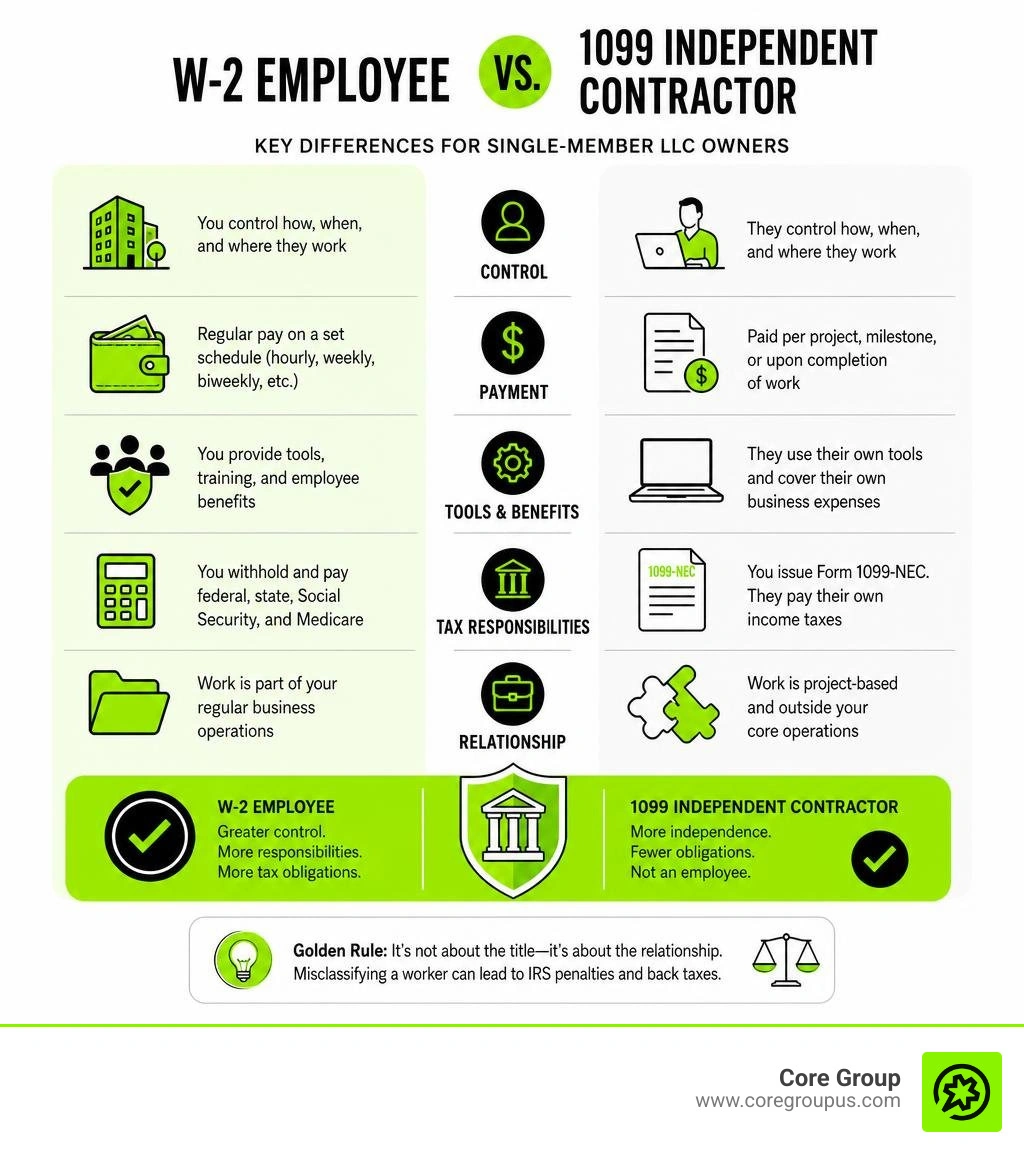
To help you visualize these differences, we have put together a comparison table outlining the key operational distinctions.
| Operational Factor | W-2 Employee | 1099 Independent Contractor |
|---|---|---|
| Work Schedule | Set by the LLC owner | Set by the contractor |
| Tools and Equipment | Provided by the business | Provided by the contractor |
| Payment Method | Hourly wage or salary on regular payroll | Flat project fee or hourly invoice |
| Tax Withholding | LLC withholds income, Social Security, and Medicare taxes | No tax withholding, contractor pays self-employment tax |
| Core Business Tasks | Performs core, ongoing operations of the business | Performs specialized, project-based tasks |
| Business Expenses | Reimbursed by the LLC | Paid by the contractor as a business expense |
To determine where a worker falls, the IRS looks at three specific categories of common-law rules, behavioral control, financial control, and the type of relationship.
Behavioral control and how it defines the relationship
Behavioral control focuses on whether your LLC has the right to direct and control how the worker performs the task for which they were hired.
If you provide detailed instructions on when, where, and how to work, you are exercising behavioral control. This includes dictating the exact hours they must be online, specifying the exact software tools they must use, or requiring them to follow a highly detailed, step-by-step process that you created. If you train the worker on how to perform the job, this is also a strong indicator of an employer-employee relationship.
With an independent contractor, you should only control the final result of the work, not the method used to achieve it. For example, if you hire a contractor to build a website, you can specify what pages you want and when the project is due. However, you cannot dictate which hours of the day they write the code or what brand of computer they use to get the job done.
Financial control and the type of relationship
Financial control looks at whether your LLC has the right to control the business aspects of the worker’s job.
An independent contractor typically has a significant financial investment in their own business. They buy their own laptops, pay for their own software subscriptions, rent their own office space, and market their services to other clients. They also have the opportunity to realize a profit or incur a financial loss on a project. If they miscalculate a project bid, they lose money, which is a classic indicator of being a separate business entity.
Additionally, we must look at how the worker is paid. Employees are guaranteed a regular wage or salary, whereas contractors submit invoices and are usually paid per project or through a flat retainer. If your contractor is a single-member LLC or a sole proprietor, they will need to provide you with their business details so you can properly track payments. You can read more about how this works in our guide on Individual Sole Proprietor Or Single Member Llc Get 1099.
The type of relationship is defined by written contracts, employee benefits, and the permanence of the work. If you provide benefits like health insurance, paid time off, or retirement matching, the IRS will view that worker as an employee. Furthermore, if you hire someone with the expectation that the relationship will continue indefinitely rather than ending when a specific project is completed, this points toward a W-2 relationship.
Tax obligations and required forms for hiring 1099 contractors

One of the main reasons creative entrepreneurs love hiring independent contractors is that it dramatically simplifies their ongoing tax obligations. When you pay a contractor, you do not have to worry about federal unemployment taxes, state unemployment taxes, or matching the 7.65 percent FICA portion for Social Security and Medicare.
However, you cannot just hand over cash or send a digital payment and call it a day. You must maintain an immaculate paper trail to protect your business. You can read our detailed breakdown of these rules in our guide on single-member llc taxes and keep your business on track with our Llc 1099 Income Guide 2026.
Collecting Form W9 and verifying taxpayer identification numbers
The very first step in hiring any independent contractor is collecting a completed Form W-9. This form is the contractor's official certification of their tax details, including their legal business name, their entity structure, and their Taxpayer Identification Number, which can be either a Social Security Number or an Employer Identification Number.
We highly recommend making it a strict business policy to collect a completed W-9 before you send a single dollar to a contractor. If you wait until tax season in January to ask for a W-9, you will inevitably find yourself chasing down unresponsive contractors, which can lead to filing delays. To avoid these costly administrative headaches, review our resource on Llc Get 1099 Mistakes.
Filing Form 1099 NEC for nonemployee compensation
If your single-member LLC pays an independent contractor 600 dollars or more for services during the calendar year, you are legally required to file Form 1099-NEC with the IRS and provide a copy to the contractor. This form is specifically used to report nonemployee compensation, which is any payment made to someone who is not your employee for services rendered to your business.
To stay organized, here is the list of required tax forms you must manage when working with contractors.
- Form W-9, collected from the contractor before work begins to verify their tax details
- Form 1099-NEC, filed annually with the IRS and sent to the contractor by January 31 for any contractor paid 600 dollars or more
- Form 1096, the physical transmittal form used if you choose to mail paper copies of your 1099s to the IRS, though electronic filing is highly recommended
That you generally do not need to issue a 1099-NEC to contractors that are taxed as C-Corporations or S-Corporations. However, you must always issue a 1099-NEC to sole proprietors, single-member LLCs, partnerships, and any attorney you hired for business legal services, regardless of their corporate structure.
To ensure you are calculating these limits correctly, consult our deep dives on 1099 Nec Explained, Nonemployee Compensation, and the Llc Get 1099 Minimum rules.
The risks of worker misclassification and how to protect your business
Worker misclassification is one of the most common and expensive mistakes a small business owner can make. The IRS, state labor departments, and workers' compensation boards are constantly scanning for businesses that try to bypass payroll taxes and labor laws by treating actual employees as independent contractors.
If you are audited and the IRS determines you misclassified your workers without a reasonable basis, you can be held personally liable for substantial back taxes and interest. Fortunately, some businesses may qualify for Relief Provisions under Section 530 of the Revenue Act of 1978. To qualify for this safe harbor, you must have a reasonable basis for your classification, you must have treated all similar workers consistently, and you must have filed all required federal tax returns, including Form 1099-NEC, on time. For a full breakdown of these maximum tax risks, check out our Llc Get 1099 Tax Maximum Guide 2026.
Financial penalties and back taxes under IRS audits
If your single-member LLC is audited and found guilty of misclassifying employees, the financial fallout can be devastating. The IRS can demand that you pay back taxes for unpaid Federal Insurance Contributions Act taxes, which include Social Security and Medicare, as well as Federal Unemployment Tax Act taxes.
Additionally, misclassified workers who believe they should have been treated as employees can proactively report their status to the IRS by filing Form 8919. This form allows them to report their share of uncollected Social Security and Medicare taxes.
If you are ever unsure about a worker's status, you can submit Form SS-8 to the IRS. This form asks the IRS to officially determine the worker's status for you. However, you must plan ahead because the IRS can take at least six months or longer to issue a formal determination.
How hiring contractors affects your limited liability protection
The primary reason you formed a single-member LLC was likely to secure limited liability protection, which creates a legal barrier between your personal assets and your business liabilities. This barrier is commonly referred to as the corporate veil.
However, if you do not manage your independent contractors professionally, you can put this liability shield at risk. If you pay contractors out of your personal bank account, or if you sign contractor agreements in your personal name instead of your LLC's legal name, a court could rule that you are commingling funds and treating the business as an extension of yourself. This could allow creditors or disgruntled contractors to pierce the corporate veil and go after your personal savings, home, or vehicle.
Always ensure that every contractor agreement is signed as the owner of your LLC, and make all payments directly from your dedicated business checking account.
Frequently Asked Questions about single member LLC hiring rules
Navigating the rules of business growth can feel overwhelming. Here are some of the most common questions we hear from creative entrepreneurs trying to keep their single-member LLCs compliant.
Does a single member LLC need an EIN to hire 1099 contractors
Technically, if your single-member LLC is a disregarded entity with no employees, the IRS does not legally require you to have an Employer Identification Number for federal income tax purposes. You are allowed to use your personal Social Security Number on your business documents.
However, from a practical and security standpoint, obtaining a free EIN from the IRS is one of the smartest moves you can make. When you hire independent contractors, you will need to provide them with a W-9 if you ever partner on projects, and having an EIN prevents you from having to share your personal SSN with outside parties. Furthermore, almost every major bank will require an EIN to open a dedicated business checking account. To learn more about this process, read the IRS Employer ID Numbers Guide.
Can the owner of a single member LLC be a 1099 contractor for their own business
No, you cannot be an independent contractor for your own single-member LLC. Because a default single-member LLC is a disregarded entity, you and your business are considered the same tax entity by the IRS. You cannot write yourself a 1099-NEC or pay yourself as a contractor.
Instead, you pay yourself through an owner's draw. This is a simple transfer of funds from your business bank account to your personal bank account. You do not run payroll for this draw, and no taxes are withheld. You simply pay self-employment taxes on the net profit of the business at the end of the year.
However, if your business grows and you elect S-Corporation tax treatment, your tax relationship changes. As an S-Corp owner, you must pay yourself a reasonable salary through a regular payroll system, withholding W-2 taxes just like any other employer. For a breakdown of how to structure your personal compensation, read the guide on How To Pay Yourself as a Single-Member LLC? | Gusto.
When should a single member LLC hire a W2 employee instead of a contractor
Hiring contractors is fantastic for short-term projects, specialized tasks, or seasonal rushes. However, as your business matures, there comes a point where relying solely on 1099 talent can hold you back.
You should consider transitioning to W-2 employees when the work becomes core to your daily business operations, when you need consistent, ongoing help week after week, and when you want to build a unified company culture. If you want to specify exactly when someone works, how they perform their tasks, and ensure they only work for your business, you must hire them as a W-2 employee.
To explore this transition further, we recommend reviewing the insights on Can a Single-Member LLC Have Employees? Rules and Taxes - LegalClarity, the Single-Member LLC Complete 2026 Guide on OnlineLLCGuide.com, and the legal compliance tips found in Labor Law Essentials For Single-Member Llcs and What You Need To Know from LawShun.
Conclusion
Building a team is one of the most exciting milestones for any creative entrepreneur, but it comes with a serious responsibility to stay compliant with federal and state tax laws. Understanding the difference between a W-2 employee and an independent contractor is not just about avoiding IRS penalties, it is about building a strong financial foundation that allows your business to scale with confidence.
At Core Group, we specialize in offering financial management, bookkeeping, and tax services specifically tailored for creative entrepreneurs. We understand that you want to spend your time creating, not drowning in spreadsheets, tax forms, and compliance rules.
Our no-fluff, profit-first playbook is designed to guarantee you peace of mind and save you valuable time, allowing you to focus entirely on your business. We are so confident in our ability to streamline your financial operations that we back our services with our signature MacBook Pro guarantee.
If you are ready to stop worrying about contractor compliance and start maximizing your profitability, let us handle the numbers for you. For more detailed insights on managing your business taxes and reporting, check out our guide on Single Member Llc 1099 Reporting and reach out to us today to build your custom financial playbook.