A Practical Guide to Content Creator Tax Deduction Rules
How to Plan Taxes When Creator Work Runs Long
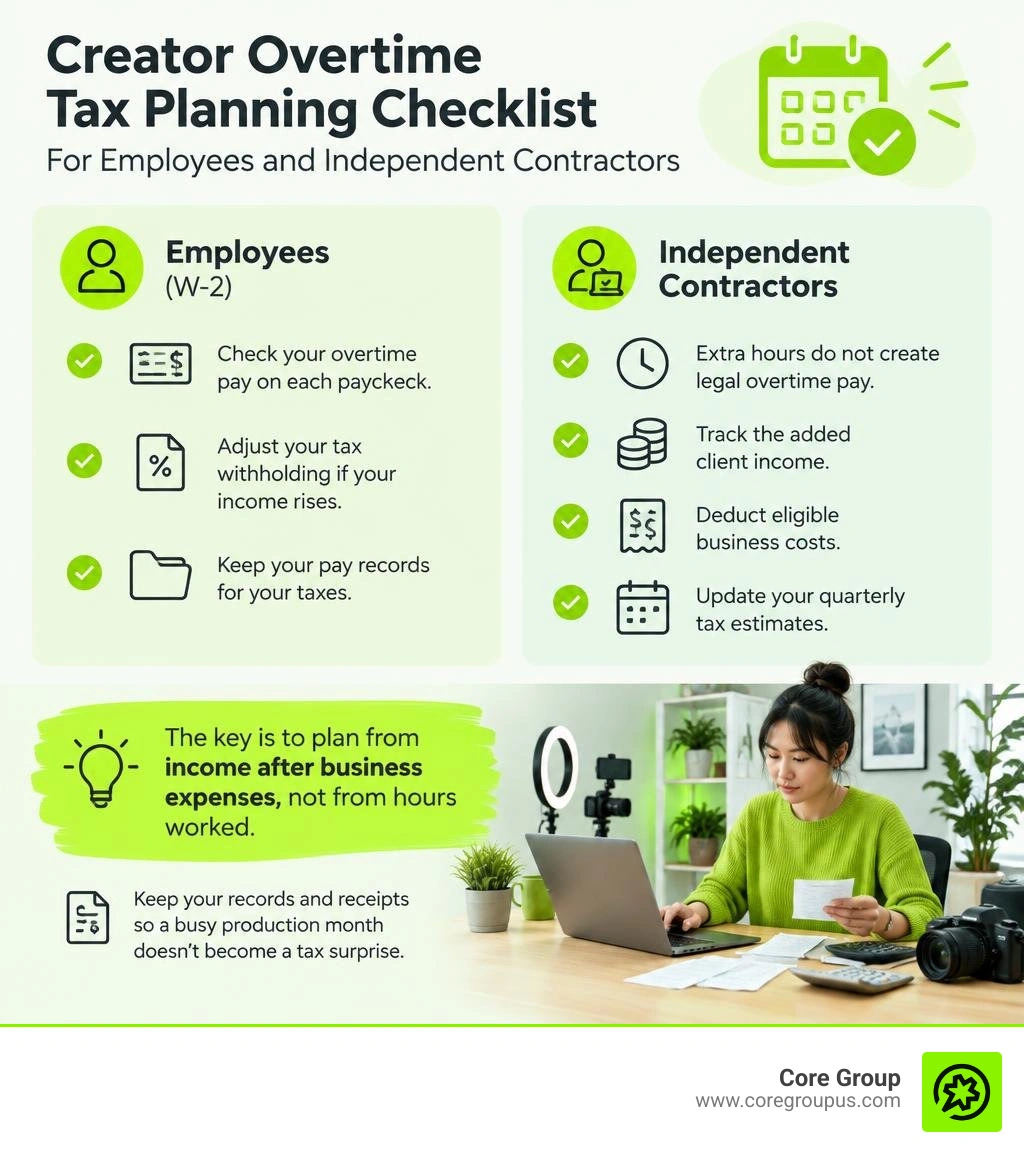
Start with how you're paid. If you're a W-2 employee, check your overtime pay on each paycheck and adjust your tax withholding if your income rises. If you're an independent contractor, extra hours do not create legal overtime pay. Track the added client income, deduct eligible business costs, and update your quarterly tax estimates instead.
The key is to plan from income after business expenses, not from hours worked. Keep pay records and receipts as you go, so a busy production month does not become a tax surprise.
I'm Christian Brim, and I'll walk you through a practical way to plan for that extra income.
Discover more about content creator overtime tax planning.
- overtime tax savings for artists
- managing overtime taxes small creative business
- overtime tax audit protection artists
Classification and Wage Rules How Overtime Works for Creators
Understanding how extra work hours affect your wallet starts with worker classification. The Fair Labor Standards Act establishes standards for minimum wage, overtime pay, recordkeeping, and youth employment across the United States. Under federal law, a standard workweek consists of a fixed, regularly recurring period of 168 hours, which equals seven consecutive 24-hour days.
When creators work over 40 hours in that fixed window, compensation rules depend entirely on whether you are classified as an exempt employee, a non-exempt employee, or an independent contractor. For state-specific payroll mechanics, systems like state payroll overtime reporting demonstrate how public and corporate accounting teams calculate and log overtime hours.
| Worker Classification | Overtime Pay Eligibility | Primary Tax Form | Self-Employment Tax | Withholding Type |
|---|---|---|---|---|
| W-2 Non-Exempt Employee | Mandatory 1.5x pay after 40 hours | Form W-2 | No, employer pays 7.65% share | Automatic employer tax withholding |
| W-2 Exempt Employee | Not eligible for overtime premiums | Form W-2 | No, employer pays 7.65% share | Automatic employer tax withholding |
| 1099 Independent Contractor | No statutory overtime premium | Form 1099-NEC or 1099-K | Yes, full 15.3% on net profit | Self-funded quarterly estimated taxes |
W-2 Non-Exempt vs. 1099 Independent Contractors
For a non-exempt W-2 employee, such as an in-house video editor at a media agency, working beyond 40 hours in a workweek triggers mandatory overtime pay at no less than one and a half times your regular hourly rate. Your regular rate includes all earnings, including hourly pay and nondiscretionary bonuses, divided by total hours worked. Discretionary bonuses, gifts, and expense reimbursements are excluded from this calculation.
If you operate as a freelance creator, you receive gross payments without overtime rate mandates. When a brand deal requires extended filming or late-night editing, you do not receive a legal overtime premium unless your private contract specifies rush fees. All your gross creator revenue flows directly onto Schedule C of Form 1040, where you must handle standard taxes for influencers.
Fair Labor Standards Act and Comp Time Rules
Compensatory time off, often called comp time, allows workers to take paid time off instead of receiving cash overtime pay. Under the Fair Labor Standards Act, comp time in lieu of overtime pay is strictly limited to public sector employees, such as government multimedia specialists.
Private employers cannot legally offer comp time to non-exempt creators in place of cash overtime wages. In the private sector, every non-exempt hour worked past 40 must be compensated with payroll funds. Freelancers, meanwhile, control their own production calendars and can choose to take rest days between heavy project delivery cycles.
Content Creator Overtime Tax Planning Federal, State, and Self-Employment Liabilities
Surge income from extensive production schedules creates distinct federal, state, and self-employment liabilities. When creators experience high-earning months from marathon streaming, product launches, or tight commercial deadlines, your total tax liability rises with your adjusted gross income. Effective tax rates for top-tier creators often land between 30% and 40% when combining federal income tax, self-employment tax, and state assessments.
Implementing smart strategies for managing overtime taxes in small creative businesses ensures that revenue spikes do not wipe out your operational cash reserves. Creators must also remain current on statutory updates, such as the implementation of recent tax acts, which shape state and federal payroll compliance.
| Annual Net Creator Profit | Estimated Self-Employment Tax | Estimated Federal Income Tax | Total Federal Tax Burden | Effective Federal Rate |
|---|---|---|---|---|
| $35,000 | $4,945 | $1,850 | $6,795 | 19.4% |
| $62,000 | $8,754 | $4,417 | $13,171 | 21.2% |
| $120,000 | $16,955 | $14,620 | $31,575 | 26.3% |
| $250,000 | $26,050 | $45,830 | $71,880 | 28.8% |
Calculating the 15.3% Self-Employment Tax on Surge Earnings
Self-employed creators pay self-employment tax under Schedule SE. This tax consists of 12.4% for Social Security and 2.9% for Medicare, totaling 15.3%. The tax is calculated on 92.35% of your net business profit rather than your gross revenue.
For 2026, the Social Security wage base caps at $184,500 of net earnings. Any net profit above this limit is exempt from the 12.4% Social Security portion, though the 2.9% Medicare tax applies to all net profit without a cap. High-earning creators whose income exceeds $200,000 for single filers or $250,000 for married couples filing jointly also face a 0.9% Additional Medicare Tax. Comprehensive tax planning for freelancers helps structure write-offs to reduce this self-employment tax base legally.
Quarterly Estimated Taxes and Underpayment Safe Harbors
Because independent creators do not have employers withholding income taxes from brand payments, the IRS requires quarterly estimated tax payments using Form 1040-ES. Missing these dates leads to underpayment penalties calculated as interest on the shortfall, generally running between 5% and 8%.

The four annual quarterly deadlines include the following dates.
- First Quarter on April 15
- Second Quarter on June 15
- Third Quarter on September 15
- Fourth Quarter on January 15 of the following tax year
To avoid underpayment penalties during high-revenue production surges, creators rely on safe harbor rules. You will avoid penalties if your total payments equal at least 90% of your current year tax liability, or 100% of the total tax shown on your previous year return. If your prior year adjusted gross income exceeded $150,000, your safe harbor target rises to 110% of that prior year tax. Applying targeted underpayment penalty prevention strategies provides budget certainty regardless of how high your overtime earnings climb.
Maximizing Deductions and Credits on Overtime and Extended Production
When working marathon editing sessions and extended video shoots, you incur substantial business costs. The IRS allows self-employed digital creators to deduct all ordinary and necessary expenses incurred to operate their creative trade. Lowering your net earnings through legitimate deductions decreases both your income tax and your 15.3% self-employment tax burden.
To build a reliable tax shield, review our complete breakdown of tax deductible expenses for influencers.
Common deductible costs during extended creator productions include the following items.
- Studio gear, tripods, lenses, and lighting equipment
- Microphones, audio interfaces, soundproofing materials, and headphones
- Editing computer hardware, memory upgrades, and high-speed external storage drives
- Digital editing software subscriptions, cloud storage, and licensing fees
- Dedicated home studio square footage and related utility allocations
- Business travel costs, lodging, and vehicle mileage logs for remote filming
- Business meals during production, deductible at 50% with proper receipts
- Props, costumes, and physical production assets purchased exclusively for content
- Professional services, bookkeeping, legal guidance, and business coaching
Content Creator Overtime Tax Planning for Studio Gear and Section 179
Purchasing professional equipment to handle demanding production deadlines offers immediate tax relief. Under Section 179 of the Internal Revenue Code, creators can deduct up to the full purchase price of qualifying equipment in the year it is placed in service rather than depreciating the cost over multiple years.
For 2026, the Section 179 deduction limit allows creators to write off up to $2.56 million in qualifying equipment purchases. If you purchase a $4,500 cinema camera package and a $3,200 editing workstation, you can deduct the full $7,700 against your surge income immediately. Alternatively, the de minimis safe harbor election permits an immediate deduction for tangible property costing up to $2,500 per invoice. Leveraging these rules is central to creative overtime tax savings strategies for growing studios.
Home Office, Software, and Production Write-Offs
Filming and editing outside standard hours often centers around a home production space. To claim the home office deduction, your workspace must pass the strict exclusive use test. The space must be used solely and regularly for your creative business. Filming from a dining room table or editing in a shared living room will not qualify.
You can calculate this deduction using either method.
- The simplified method. Multiply the square footage of your dedicated studio by the standard IRS rate of $5 per square foot, up to a maximum of 300 square feet ($1,500 maximum deduction).
- The actual expense method. Calculate the exact percentage of your home dedicated to your creative business, then deduct that same percentage of your total rent or mortgage interest, real estate taxes, utilities, repairs, and homeowners insurance.
Software costs also add up quickly. Subscriptions for creative video suites, thumbnail design platforms, stock footage libraries, audio processing plugins, and business accounting tools are 100% deductible as ordinary operating expenses.
Strategic Business Structuring and the 20% QBI Deduction

How you structure your content creation enterprise influences your legal protection and annual tax bill. Operating as an informal sole proprietor may work during your early channel growth, but sustained overtime earnings demand a more formal operational model.
| Business Entity Type | Liability Protection | Tax Return Form | Self-Employment Tax Treatment | Best Fit For Creator Revenue Level |
|---|---|---|---|---|
| Sole Proprietorship | None (personal assets at risk) | Schedule C on Form 1040 | 15.3% applies to 100% of net profit | Net profit under $40,000 |
| Single-Member LLC | Strong personal asset protection | Schedule C (default pass-through) | 15.3% applies to 100% of net profit | Net profit between $40,000 and $80,000 |
| S-Corporation | Strong personal asset protection | Form 1120-S plus Form 1040 | Payroll taxes on salary only; distributions exempt | Net profit exceeding $80,000 consistently |
Content Creator Overtime Tax Planning with S-Corporation Election
When your net creator profit consistently crosses $80,000 per year, making an S-Corporation tax election through Form 2553 can generate substantial tax savings. Under an S-Corp structure, you become an employee-owner of your corporate entity.
Instead of paying the 15.3% self-employment tax on your total net profit, you split your earnings into two distinct buckets.
- A reasonable W-2 salary subject to standard FICA payroll taxes (Social Security and Medicare).
- Shareholder profit distributions, which pass through to your personal return free from payroll and self-employment taxes.
For example, if your production work yields $130,000 in net profit, you might set a reasonable salary of $65,000 and take the remaining $65,000 as distributions. This structure saves roughly $9,945 in payroll taxes annually, even after factoring in corporate payroll processing and tax preparation fees. To determine the right timing for your channel, consult our comprehensive S Corp tax planning guide.
Applying the Permanent QBI Deduction to Surge Income
Under Section 199A, eligible small business owners can deduct up to 20% of their Qualified Business Income from their taxable income. Following the One Big Beautiful Bill Act, the 20% QBI deduction is now a permanent fixture of the tax code.
Most independent content creators qualify for this deduction because digital production is generally treated as an eligible pass-through trade or business. For single filers in 2026, the full 20% deduction applies without wage or asset limitations up to taxable income levels of $201,750, phasing out above that threshold.
If your channel generates $80,000 in qualifying net profit, your 20% QBI deduction equals $16,000. At a 22% marginal income tax bracket, this deduction keeps $3,520 of cash in your pocket.
Frequently Asked Questions About Creator Overtime Taxes
Does working overtime push content creators into a higher tax bracket?
Earning extra revenue or overtime pay may push a portion of your income into a higher marginal tax bracket, but it will never decrease your overall take-home earnings. The United States uses progressive tax brackets, meaning only the dollars earned within each higher income tier are taxed at that tier's higher percentage.
If you move from the 22% bracket into the 24% bracket, only the specific dollars earned above the threshold are taxed at 24%. The rest of your income remains taxed at the lower statutory rates of 10%, 12%, and 22%.
What tax forms report overtime earnings for creators in 2026?
The tax forms you receive at year-end depend on your contractual relationships.
- Form W-2. Issued to employed studio staff, reporting standard wages and overtime pay in Box 1, with taxes already withheld.
- Form 1099-NEC. Issued by brands, agencies, and sponsors that pay you $2,000 or more in non-employee compensation for campaigns during the 2026 tax year.
- Form 1099-K. Issued by third-party payment processors like PayPal, Stripe, and Patreon if your gross transaction volume reaches $600 or more.
- Schedule C. The tax schedule where self-employed creators tally all gross revenue and deduct allowable business expenses.
- Schedule SE. The tax form used to compute your final self-employment tax obligations.
Can freelance content creators receive compensatory time off instead of pay?
Freelancers cannot receive statutory comp time from clients because independent contractor arrangements are governed by commercial contract law rather than the Fair Labor Standards Act. Independent creators bill clients for completed deliverables, licensing terms, or project milestones. You retain complete authority over your production calendar and may choose to take unpaid downtime whenever your schedule permits.
Conclusion
Managing production surges requires proactive tax forecasting, organized bookkeeping, and a clear understanding of your business structure. Whether you are clocking extra hours as an agency animator or running multi-day video productions for your own channel, tracking your true net income ensures you never face unexpected IRS liabilities.
At Core Group, we provide financial management, bookkeeping, and tax services designed specifically for creative entrepreneurs. We deliver a no-fluff, profit-first playbook that guarantees peace of mind and saves you valuable time, all backed by our signature MacBook Pro guarantee so you can stay focused on storytelling.
Take control of your production earnings today by checking your overtime tax rate to keep your creative enterprise thriving and fully compliant.