The Ultimate Guide to Comparing Managed Payroll Services
How to Compare Managed Payroll Services
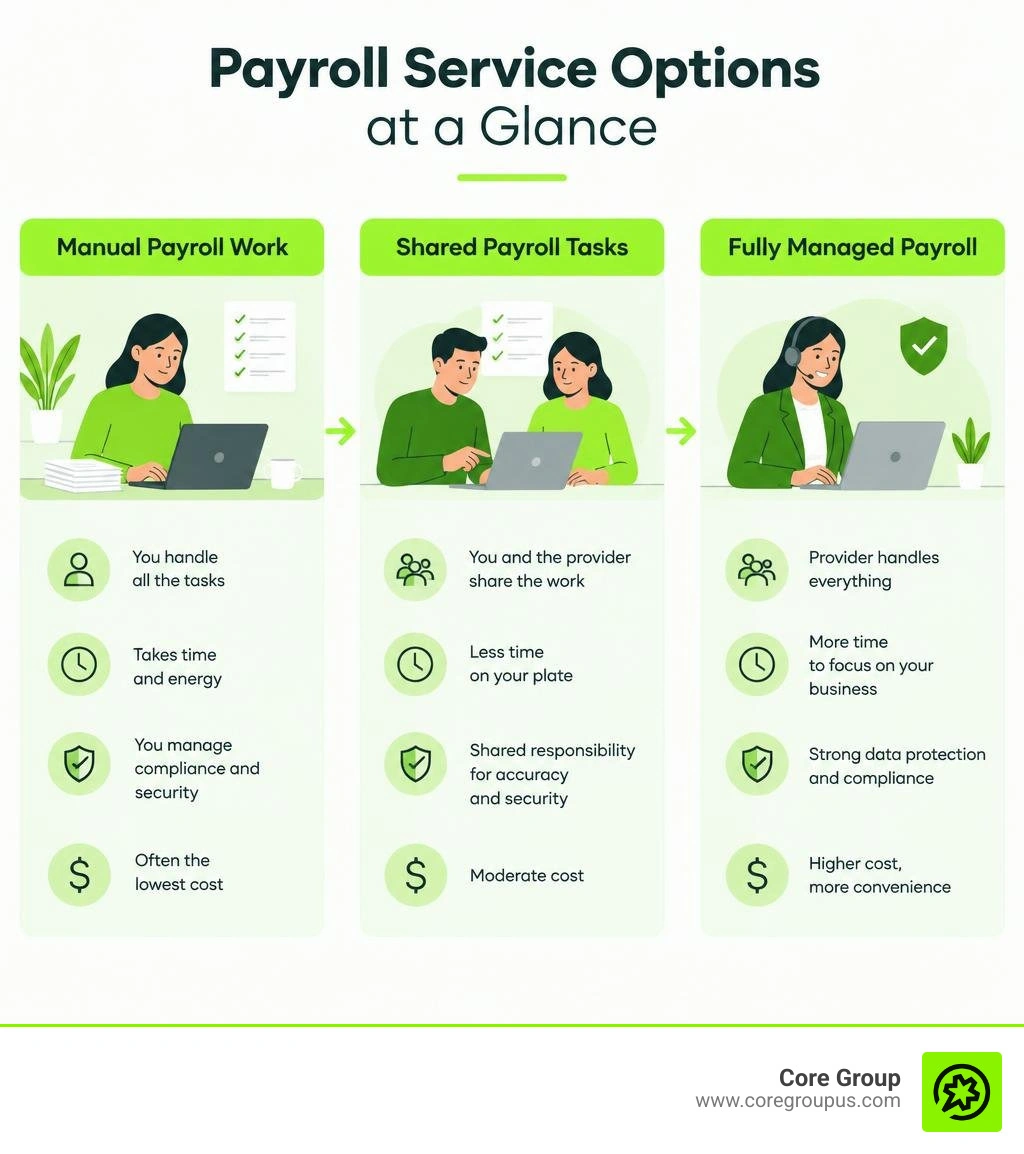
Managed payroll services let you hand off some or all of the work of paying your team. To compare providers, start with the tasks you want them to handle, such as pay calculations, tax filings, and employee questions. Then check what you still need to approve, how they protect payroll data, and what each service tier costs.
For a creative business, the right fit should take routine work off your plate without leaving you unsure who is responsible when something goes wrong.
I'm Christian Brim, and I'll walk you through the choices so you can find a service that fits your team and your budget.
Managed payroll services further reading
Understanding Managed Payroll Services vs Traditional Outsourcing
Running payroll inside a growing business often begins as a quick administrative chore, but it quickly turns into a complex operational bottleneck. In a typical in-house setup, your team handles every gross-to-net calculation, manually tracks legislative updates, coordinates tax deductions, and corrects timecard discrepancies. Traditional payroll outsourcing bureaus only offer basic calculation engines. You enter the raw figures into their portal, and their software processes checks or direct deposits without verifying your entries or giving you personalized advice.

A managed payroll service changes that relationship completely. Instead of handing off data to an unmonitored processing queue, you partner with dedicated specialists who actively organize, review, and execute your payroll operations. This collaborative model preserves your internal control over company pay rates while transferring administrative execution and compliance oversight to experts.
Industry data reveals that 87% of payroll professionals surveyed made errors over a twelve-month span that caused employees to receive late or incorrect pay. Operational teams lose nearly five hours every week dealing with administrative challenges, manual spreadsheet re-entry, and disjointed systems. Transitioning to professional third-party payroll administration can cut the risk of payroll errors by up to 85%, protecting team trust and eliminating costly penalty notices.
Distinct Differences in Service Delivery and Oversight
The primary difference between standard outsourcing and a managed service lies in operational accountability. Traditional bureaus provide processing software, but your staff remains on the hook for identifying calculation errors, applying garnishment orders, and troubleshooting failed direct deposits.
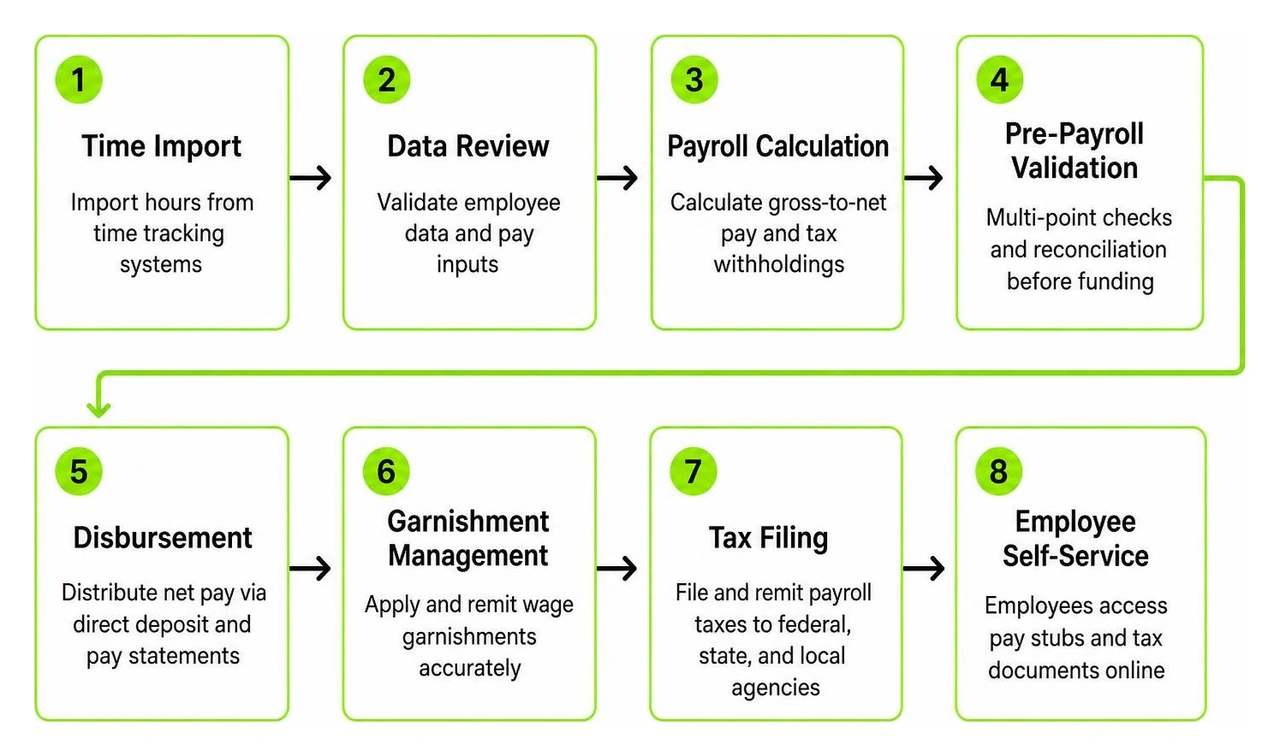
Managed service providers operate under formal Service Level Agreements (SLAs). Dedicated payroll specialists validate gross-to-net amounts before funds leave your accounts, conduct multi-point reconciliations, manage wage garnishments, and directly answer employee tax withholding queries. By implementing proven payroll management best practices, your company gains a continuous compliance review system rather than a passive software subscription.
Business Drivers for Transitioning to Managed Support
Manual payroll management creates operational friction as your business expands. Research shows that 56% of payroll professionals duplicate records across multiple systems, while 49% manually input payroll numbers by hand. This double entry introduces calculation risks, leaves zero margin for error, and drains executive bandwidth.
When businesses add distributed contractors or open positions across multiple states, local tax withholding rules multiply. Operating without dedicated payroll continuity leaves you vulnerable if an internal bookkeeper suddenly takes leave or resigns during a quarter-end tax filing period. Managed services eliminate single-point-of-failure risks, streamline your technology stack, and give creative founders the freedom to focus entirely on revenue and client service.
Core Tiers and Capabilities of Modern Payroll Solutions
Modern payroll services offer flexible engagement levels so you can match their support to your internal capacity.
| Service Tier | Who Prepares and Inputs Data? | Who Calculates and Verifies? | Who Manages Tax Filing and Garnishments? | Best Fit For |
|---|---|---|---|---|
| Fully Managed | External Provider with Minimal Client Review | Dedicated External Specialist | Fully Handled by Provider | Companies wanting zero internal payroll administration |
| Co-Managed (Partially Managed) | Internal HR or Operations Team | Shared Verification Protocol | Fully Handled by Provider | Growing firms retaining final salary and bonus approvals |
| Processing-Only (Bureau) | Internal Staff via Portal | Automated Software Engine | Client or Automated Electronic Service | Teams with strong in-house tax and payroll specialists |
Types of Managed Payroll Services. Fully Managed vs. Co-Managed Models
Choosing between fully managed and co-managed payroll depends on how much oversight your internal team wants to keep.
Under a fully managed model, your provider runs the entire payroll cycle from start to finish. They ingest raw time-tracking hours, manage new hire onboarding records, calculate bonuses, disburse net wages, and coordinate employee offboarding adjustments.
Under a co-managed model, responsibilities are split. Your internal staff maintains day-to-day employee updates and approves final compensation amounts, while the external provider manages compliance checks, tax filings, year-end forms, and wage distributions.
Both models support direct disbursements such as small business direct deposit and provide employee self-service portals where your team can view pay stubs and tax statements without messaging management.
Key Operational Workflows Handled by Managed Payroll Services
A managed payroll provider handles multiple recurring tasks that go well beyond calculating regular hourly wages or monthly salaries.
- Statutory Tax Withholdings. Calculating federal income tax, Social Security, Medicare, and applicable state or municipal local taxes across multiple jurisdictions.
- Wage Garnishments and Court Orders. Administering child support withholdings, tax levies, and creditor garnishments according to strict legal timelines.
- Off-Cycle Disbursements and Severance. Processing spot bonuses, expense reimbursements, commissions, and final wages that fall outside regular payroll runs.
- Benefit Deductions and Pre-Tax Reconciliations. Coordinating pre-tax healthcare premiums, retirement contributions, and health savings accounts using unified payroll and benefits integration.
- Entity-Specific Ownership Draws. Managing owner compensation guidelines and reasonable salary rules under complex S-corp payroll requirements.
- Year-End Form Production. Generating, verifying, and distributing employee W-2s and independent contractor 1099 statements alongside annual government tax reconciliations.
Evaluating Costs, Data Security, and Regulatory Compliance
Comparing managed payroll providers requires looking closely at pricing structures, multi-state compliance systems, and data protection standards.

Navigating Tax Regulations and Multi-Jurisdiction Filings
Regulatory changes create major headaches for business leaders. In fact, 34% of payroll professionals cite changing government regulations as their biggest operational hurdle. Managing taxes becomes even more complicated when you hire remote workers across state lines, where local tax jurisdictions, state disability insurance funds, and mandatory paid leave programs all differ.
Top providers stay ahead of state statutory reporting standards across all fifty states. They register your business with state tax agencies, calculate correct regional withholdings, and file quarterly tax returns on your behalf. Maintaining strict payroll tax compliance alongside specialized protocols for remote team payroll compliance shields your company from costly misclassification audits and late-payment penalties.
Ensuring Enterprise-Grade Data Security and Privacy
Payroll records contain some of your company's most sensitive data, including bank account details, Social Security numbers, salary histories, and home addresses. Top-tier providers protect this data with robust security practices such as these.
- SOC 2 Type II Audits. Third-party verification confirming that customer data is securely managed and protected against unauthorized access.
- AES-256 Encryption. Industry-standard encryption applied to all payroll data both in transit across networks and at rest in secure cloud databases.
- Role-Based Access Control. Granular permission settings that ensure managers and staff only see the specific payroll information needed for their roles.
- Two-Factor Authentication. Mandatory multi-factor sign-in controls across all client and employee dashboards to prevent credential theft.
- Automated Disaster Recovery. Geographically distributed server backups that ensure payroll runs smoothly even during unexpected technical outages.
Understanding Managed Payroll Cost Structures
Managed payroll pricing balances software access with hands-on human expertise. Providers generally structure their fees using three standard components.
- Base Platform Fee. A flat monthly administrative charge that covers your account maintenance, client portal access, and software platform licenses.
- Per-Employee-Per-Month (PEPM) Fee. A variable charge scaled to your total active headcount each billing cycle, making it easy to budget as your team grows.
- Specialized Service Add-Ons. Optional fees for specific administrative tasks, such as multi-state tax registrations, custom accounting software integrations, or handling complex year-end filings.
Investing in managed support provides a strong return on investment by eliminating internal bookkeeping payroll hours, cutting software subscription bloat, and preventing expensive compliance penalties.
Selecting and Transitioning to the Right Managed Provider
Transitioning to an external payroll partner does not have to disrupt your daily operations. A structured evaluation and onboarding plan ensures a smooth handover with zero missed paydays.
Critical Selection Criteria and Vetting Questions
When interviewing managed payroll partners, look beyond sales demos and ask detailed questions about their operational workflows.
- Are your payroll specialists certified by industry associations such as PayrollOrg with Certified Payroll Professional credentials?
- Does your platform feature direct QuickBooks payroll integration or integrate cleanly with our accounting ledger?
- What are your guaranteed response times when an employee has an urgent question about their pay stub?
- Do you provide comprehensive tax penalty protection if a filing error occurs on your end?
- How do you manage off-cycle pay runs or urgent same-day wire transfers when emergency payroll changes happen?
The Step-by-Step Onboarding and Parallel Run Process
A professional onboarding process follows a clear five-step path designed to protect your payroll data and confirm calculation accuracy.
- Data Discovery and Extraction. Exporting historical employee profiles, tax withholding elections, year-to-date earnings, and wage garnishment orders from your previous system.
- System Configuration and Mapping. Setting up earning codes, custom PTO policies, general ledger accounts, and direct deposit links inside the new payroll platform.
- Historical Tax Reconciliation. Auditing your prior tax filings and year-to-date payments to spot and fix any historical discrepancies before running live pay cycles.
- Parallel Payroll Run. Running test payroll cycles in the new system alongside your existing process to compare net pay amounts and verify calculations down to the penny.
- Final Go-Live and Team Training. Transitioning live payment operations over to your managed provider and giving employees access to their self-service portals.
Frequently Asked Questions about Managed Payroll
Is managed payroll suitable for small businesses or only large enterprises?
Managed payroll works well for small businesses, micro-agencies, and solo creative entrepreneurs. While large enterprises use managed providers to navigate complex global workforces, small businesses benefit by accessing enterprise-level compliance expertise without having to hire a full-time in-house payroll director.
How does switching to a managed payroll provider impact in-house HR roles?
Handing off payroll processing frees your in-house HR staff from repetitive spreadsheet calculations and manual data entry. This shift gives them the time to focus on strategic work like talent acquisition, team culture, employee retention, and creative project delivery.
What happens if an error occurs during a managed payroll run?
Top managed providers use multi-tier validation checks to catch errors before payments go out. If an error does slip through, their support team acts quickly under established SLAs to issue corrective off-cycle direct deposits, fix ledger entries, and handle any necessary tax adjustments at no extra cost to your business.
Conclusion
Managing payroll takes up valuable time and creative energy that you could be using to grow your business. When you partner with Core Group, you get access to our proven profit-first playbook built specifically for creative entrepreneurs. We handle your back-office financial administration, bookkeeping, and payroll complexities with absolute precision, backed by our MacBook Pro guarantee. Take the next step toward financial clarity and operational freedom by exploring our comprehensive guide to small business payroll solutions, and let our team give you complete peace of mind.