Detailed Guide to Comparing Payroll Outsourcing Options
Third Party Payroll Can Free Up Time Without Removing Your Responsibility
Third party payroll means hiring an outside provider to handle payroll tasks such as calculating wages, issuing direct deposits, withholding taxes, and preparing tax filings. It can reduce the admin load for a growing creative business, but it does not automatically shift your legal responsibility for payroll taxes.
Before choosing a provider, compare:
- The services included, from basic payroll processing to tax filing, benefits, and HR support.
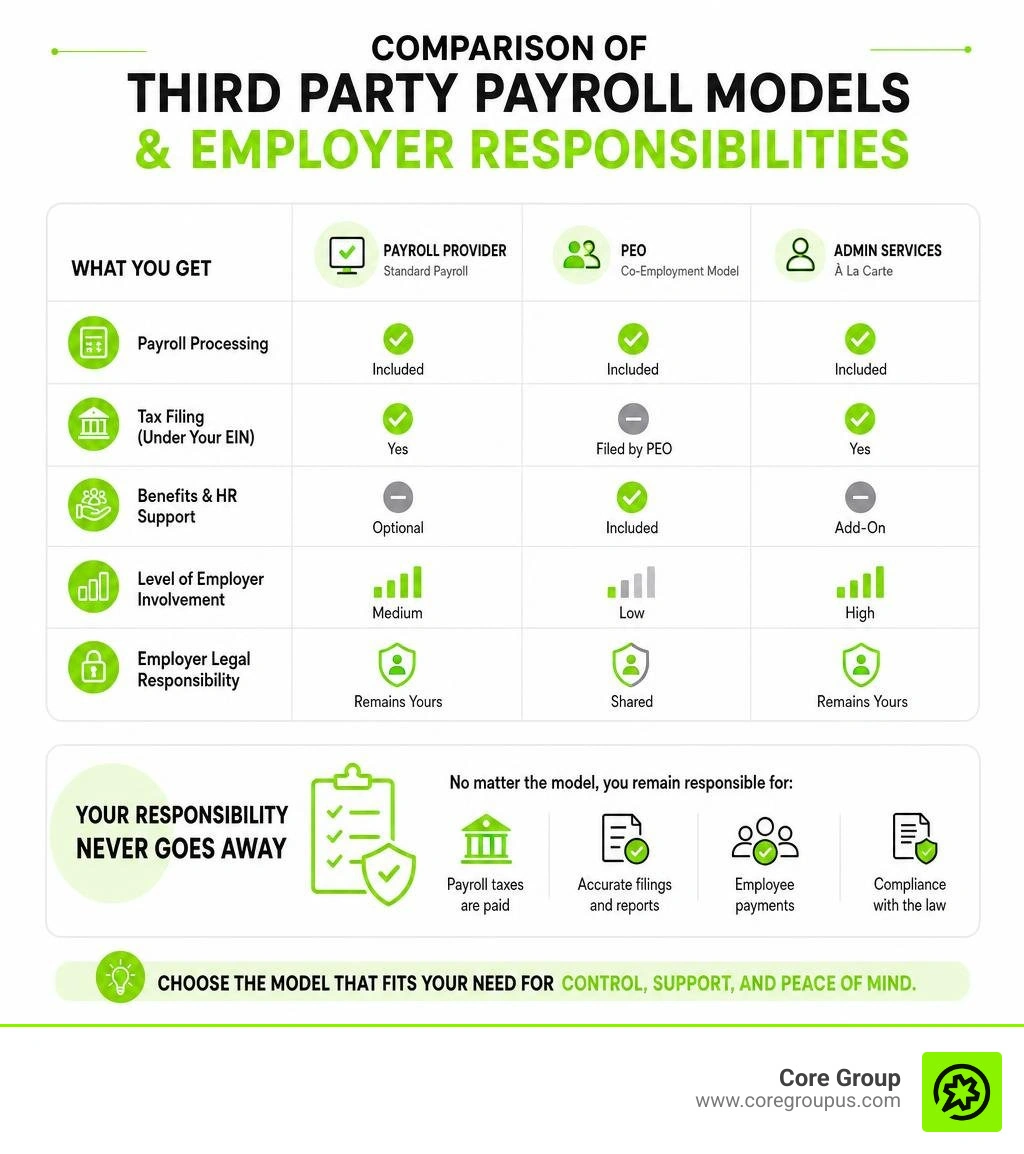
- The tax arrangement, since standard payroll providers usually file under your EIN while some PEO models use co-employment.
- Your visibility into deposits, filings, reports, and employee data.
- Security controls for bank details, Social Security numbers, and pay records.
For many film, media, and creative teams, outsourcing can replace spreadsheet stress with a clearer system. But the right option depends on how much control, compliance support, and hands-on help you need.
I am Christian Brim, and this guide will help you compare payroll outsourcing options with a clear view of the costs, risks, and responsibilities involved.
Third party payroll word roundup:
Understanding How Third Party Payroll Works
When running a busy studio or agency, calculating payroll manually is one of the easiest ways to burn hours that should go toward serving clients. Industry data shows that 1 in 5 payrolls contain errors, and tracking changes across multiple tax jurisdictions quickly drains operational energy. Outsourcing shifts the heavy lifting of wage calculations, deductions, and tax withholdings to specialized systems.
The standard outsourced workflow separates daily operational inputs from backend processing. You collect timesheets and approve milestone payments, while the external provider executes gross to net calculations, generates electronic pay stubs, and coordinates banking distributions. Setting up payroll direct deposit ensures employees and contractors receive timely funds without manual checks.
| Workflow Step | In-House Payroll Processing | Outsourced Third-Party Payroll |
|---|---|---|
| Time Tracking and Approvals | Manual spreadsheet entry or internal software review | Integrated digital portals with direct manager approvals |
| Gross-to-Net Calculations | Internal staff calculates taxes, benefits, and garnishments | Automated calculation engines apply current federal, state, and local rates |
| Wage Disbursement | Manual check printing or individual bank transfers | Automated multi-day direct deposit and pay card distribution |
| Payroll Tax Filing | Internal team prepares and submits Forms 941, 940, and state returns | Provider automates filing, tax deposits, and year-end forms |
| Regulatory Monitoring | Leadership tracks shifting state and federal labor laws internally | Provider incorporates legislative updates and standard reporting forms |
Internal Revenue Service Payer Designations
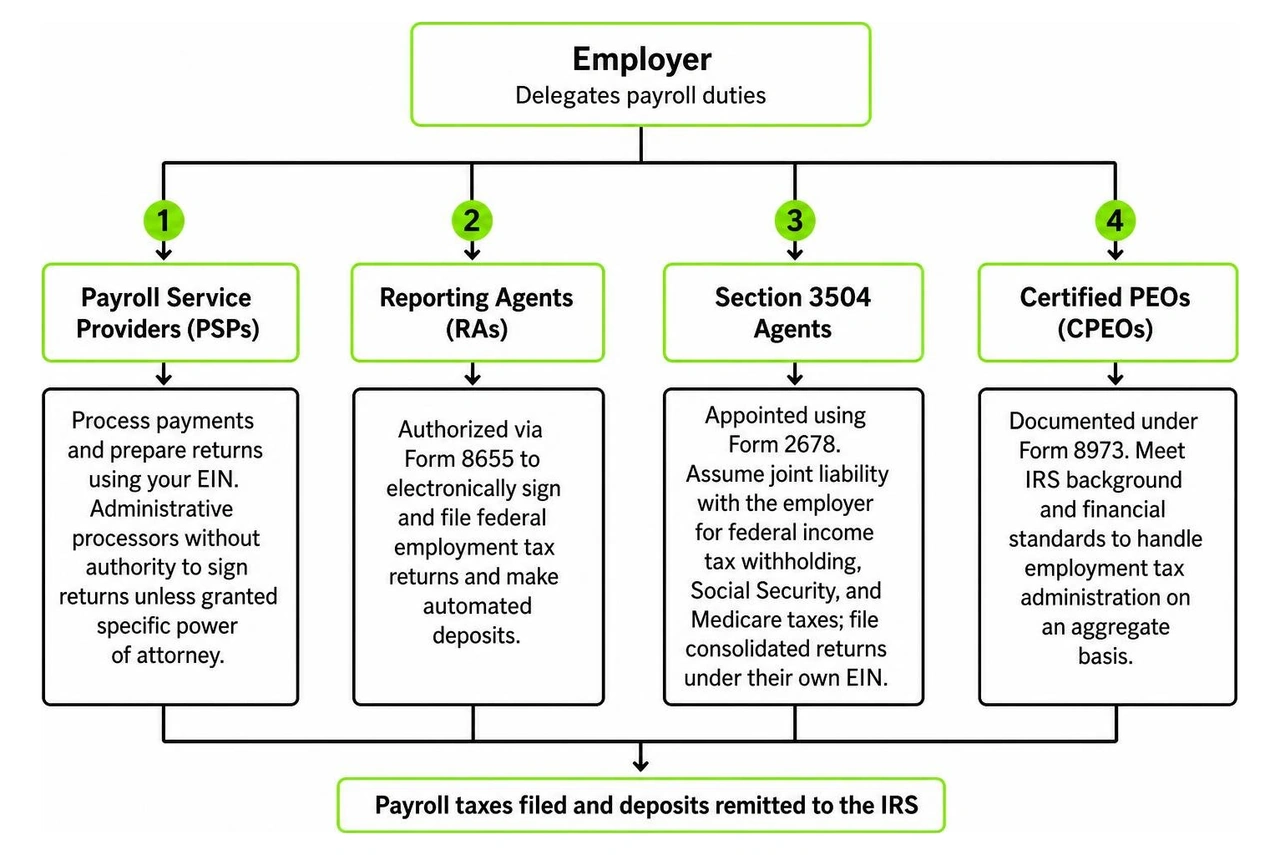
The federal government recognizes several operational structures when businesses delegate payroll duties. Knowing which framework your provider uses is critical for understanding legal oversight. The IRS guidance on third party payer arrangements outlines four distinct entities:
- Payroll Service Providers (PSPs). These vendors process payments and prepare returns using your Employer Identification Number (EIN). They operate strictly as administrative processors without legal authority to sign returns unless granted specific power of attorney.
- Reporting Agents (RAs). Authorized through Form 8655 (Reporting Agent Authorization), these providers can electronically sign and file federal employment tax returns on your behalf while making automated deposits.
- Section 3504 Agents. Appointed using Form 2678, these agents assume joint liability with the employer for federal income tax withholding, Social Security, and Medicare taxes, filing consolidated returns under their own EIN.
- Certified Professional Employer Organizations (CPEOs). Documented under Form 8973, these entities meet rigorous IRS background and financial standards to handle employment tax administration on an aggregate basis.
Full Service Payroll Providers Versus Professional Employer Organizations
Full-service payroll companies handle calculations, tax remittances, and reporting under your company EIN. You retain complete operational direction over your workforce, maintain your own insurance policies, and decide how human resources policies run daily.
In contrast, a Professional Employer Organization operates through a co-employment relationship. Under this arrangement, the provider serves as the employer of record for administrative tax purposes, filing payroll reports under their identification numbers using aggregate Schedule R attachments. This structure enables small agencies to access enterprise health benefits, workers compensation coverage, and retirement plans by pooling worker headcounts. For growing creative studios, pairing payroll and benefits through a coordinated framework provides competitive compensation packages without building massive internal HR departments.
Legal Tax Liabilities and Compliance Realities

Many business owners mistakenly believe that handing payroll over to an outside vendor absolves them of tax compliance duties. In reality, the IRS maintains that employers remain responsible for ensuring withheld taxes reach government accounts. Federal law requires the timely withholding and remittance of employee income taxes along with matching FICA contributions for Social Security and Medicare.
Failure to remit these funds can trigger severe enforcement actions, including the Trust Fund Recovery Penalty. This statute allows tax authorities to hold business owners and corporate officers personally liable for unpaid payroll taxes. Understanding the details of payroll tax compliance and reviewing official IRS rules on third party arrangements protects your company from unexpected balance assessments.
Legal Responsibilities in Third Party Payroll Models
The degree of legal protection you receive depends directly on the legal structure of your provider agreement. Standard payroll providers and reporting agents manage tasks on your behalf, but statutory liability stays entirely with your business. If a standard provider misses a filing deadline or miscalculates a deposit, tax agencies look to you for the missing balance, penalties, and accrued interest.
A Section 3504 agent assumes joint and several liability with your firm for employment taxes, though Federal Unemployment Tax Act (FUTA) obligations generally remain with the primary employer. The only arrangement where the IRS provides statutory relief from employment tax liability is with a Certified Professional Employer Organization (CPEO). When a verified CPEO receives payment from you for wages and taxes, the IRS holds that provider solely responsible for remitting those payroll funds.
For owners structured as corporate entities, maintaining proper distributions alongside regular wages is essential. Following correct S-Corp payroll rules ensures executive salaries meet reasonable compensation standards without triggering IRS audits. If an uncertified vendor mishandles tax deposits or engages in fraudulent behavior, businesses must immediately file IRS Form 14157 to report preparer misconduct and seek expedited agency review.
Monitoring Deposits and Managing Multi State Requirements
As creative teams hire talent across the country, managing payroll compliance across different jurisdictions becomes complicated. Each state enforces unique withholding brackets, distinct state unemployment tax assessment rates, and separate paid family leave rules.
Using the IRS Taxpayer Identification Number matching service allows businesses and payroll agents to verify worker details before submitting end-of-year documents. If your company relies on distributed production staff, our guide to payroll compliance for remote teams provides clear frameworks for tracking nexus rules and keeping multi-state filings accurate.
Operational Advantages and Potential Risks of Outsourcing

Transitioning to an external payroll partner delivers meaningful efficiency improvements for growing organizations. Research indicates that businesses save roughly 18 percent on administrative overhead when outsourcing payroll compared to maintaining dedicated internal payroll staff. Over a three-year period, businesses utilizing integrated payroll and HR solutions report approximately $234,000 in administrative time savings, giving leadership room to focus on high-margin client work.
However, outsourcing also introduces operational variables that require proactive management:
- Loss of direct process control when last-minute payroll modifications arise.
- Potential communication delays when resolving pay discrepancies with third-party support desks.
- Hidden administrative fees for custom payroll reports, out-of-cycle pay runs, or year-end Form W-2 generation.
- Lingering statutory liability if an unvetted vendor defaults on federal or state tax deposits.
- Data synchronization mismatches between external payroll tools and core financial books.
Pairing payroll with structured accounting workflows prevents these operational hiccups. Consulting our bookkeeping and payroll complete guide helps you align wage disbursements with your overall financial structure.
Data Security and Employee Privacy Standards
Payroll records contain highly sensitive Personally Identifiable Information, including banking account numbers, home addresses, compensation histories, and Social Security numbers. Securing this data against unauthorized exposure is essential.
Reputable payroll platforms implement robust security measures, such as SOC 1 and SOC 2 Type II certifications, 256-bit encryption for stored and transmitted records, and mandatory multi-factor authentication. Granular role-based user permissions ensure that department managers only see project-specific hours without accessing confidential company compensation records or executive salaries.
Accounting Software Synchronization and General Ledger Accuracy
An efficient payroll system should integrate directly with your general ledger. Without direct system communication, accounting teams must enter payroll data manually, which invites calculation mistakes and misallocates operational expenses.
Modern payroll platforms map wage categories, employer payroll taxes, benefit deductions, and reimbursements directly to your chart of accounts. Wage expenses for creative deliverables should be categorized appropriately to reflect true production costs, while third-party disability or non-job payments flow into general operating accounts. Establishing automated payroll integration with QuickBooks eliminates repetitive journal entries and keeps your balance sheet current after every pay cycle.
Evaluating Outsourced Payroll Providers for Growing Teams
Selecting a payroll partner requires reviewing how their pricing and capabilities match your production cycles. Providers charge using several distinct fee models:
- Per Employee Per Month (PEPM). A fixed base rate paired with a flat per-worker fee, ideal for businesses with stable, full-time headcount.
- Per Payroll Run. Billing that applies each time payroll processes, which works well for simple monthly pay schedules.
- Pay As You Go Billing. Variable pricing structured for seasonal creative projects and variable contractor rosters.
- Tiered Service Packages. Bundled packages that combine basic payroll processing with advanced HR compliance, time tracking, and recruitment modules.
Choosing the Best Third Party Payroll Solution for Your Business
To pick the right partner, assess how prospective providers handle specialized workflows:
- Frictionless onboarding workflows that allow new creative hires to self-enroll, enter direct deposit details, and sign digital W-4 forms.
- Integrated contractor support to process 1099 payments, collect W-9 documents, and distribute annual summaries on the same platform as W-2 staff.
- Responsive customer support with access to qualified payroll specialists rather than automated chat trees.
- Mobile self-service tools that give workers instant access to historical pay stubs, benefits summaries, and tax forms.
Frequently Asked Questions About Payroll Outsourcing
Who is legally liable if an outsourced payroll provider fails to pay taxes?
In standard payroll outsourcing arrangements, the employer remains legally liable for all unpaid employment taxes, penalties, and interest charges. Using a standard payroll provider or reporting agent does not transfer your statutory obligation to the government.
The only exception occurs when using an IRS-certified Professional Employer Organization (CPEO). Under federal law, a CPEO assumes sole statutory liability for federal employment taxes on wages paid to client workers, protecting the business from double-payment risks if the certified organization fails to deposit funds.
How does payroll outsourcing impact data security and employee privacy?
Outsourcing payroll generally improves data security for small and mid-sized businesses by replacing vulnerable spreadsheets and local documents with enterprise-grade cloud protection. Reputable providers maintain dedicated cybersecurity teams, automated vulnerability testing, and secure data facilities with strict physical access controls.
To maintain employee privacy, select vendors that enforce end-to-end encryption, multi-factor authentication, and customizable role-based permissions that limit administrative access strictly to authorized personnel.
How can employers verify that payroll tax deposits are being made?
Employers can monitor tax deposits independently by enrolling directly in the Electronic Federal Tax Payment System (EFTPS). Through an independent EFTPS account, you can review payment records and confirm that federal tax deposits are being made on time under your company EIN.
Additionally, you can contact the IRS Business and Specialty Tax Line to confirm account balances, review quarterly statements provided by authorized reporting agents, and request official tax transcripts to verify filings.
Conclusion
Handing off payroll calculations and multi-state tax withholdings eliminates administrative drag and protects your business from expensive operational errors. While outsourcing saves valuable leadership time, remaining proactive about your legal responsibilities, verifying third-party tax remittances, and connecting your wage data to your core accounting records ensures complete operational stability.
At Core Group, we help creative entrepreneurs, agencies, and media producers build predictable, profitable businesses using our profit-first playbook. We take the friction out of bookkeeping, tax strategy, and payroll management so you can focus entirely on producing outstanding creative work. To build a reliable payroll and financial system for your growing business, read our small business payroll services guide and partner with our team today.