Taxing Questions: What Your Financial Advisor Can Actually Do for Your Tax Plan
What a Financial Advisor Can Actually Do for Your Tax Plan
Financial advisor tax planning is the practice of using proactive, forward-looking strategies to reduce what you owe in taxes over your lifetime, not just this year. It is different from tax preparation, which simply files what already happened.
Here is a quick breakdown of what a financial advisor can do for your taxes.
- Reduce lifetime tax burden by planning withdrawals, conversions, and income timing across multiple years
- Spot opportunities like Roth conversions, tax-gap-year strategies, and charitable giving tools
- Coordinate with your CPA so your strategy actually shows up correctly on your return
- Model future scenarios using software that projects your tax bill years into the future
- Adapt your plan when tax laws change, like they did with the One Big Beautiful Bill Act in 2025
Most people think of taxes once a year, right before the deadline. But by then, most of the decisions that affect your tax bill have already been made. The difference between paying less and paying more often comes down to decisions made months, or even years, earlier.
This is especially true for creative entrepreneurs. When your income fluctuates, your business structure matters, and your time is already stretched thin, a reactive approach to taxes is expensive. An advisor who builds tax strategy into your overall financial plan can change that.
I am Christian Brim, and in this guide I will walk you through exactly how financial advisor tax planning works, what to look for in an advisor, and which strategies matter most for people like you.
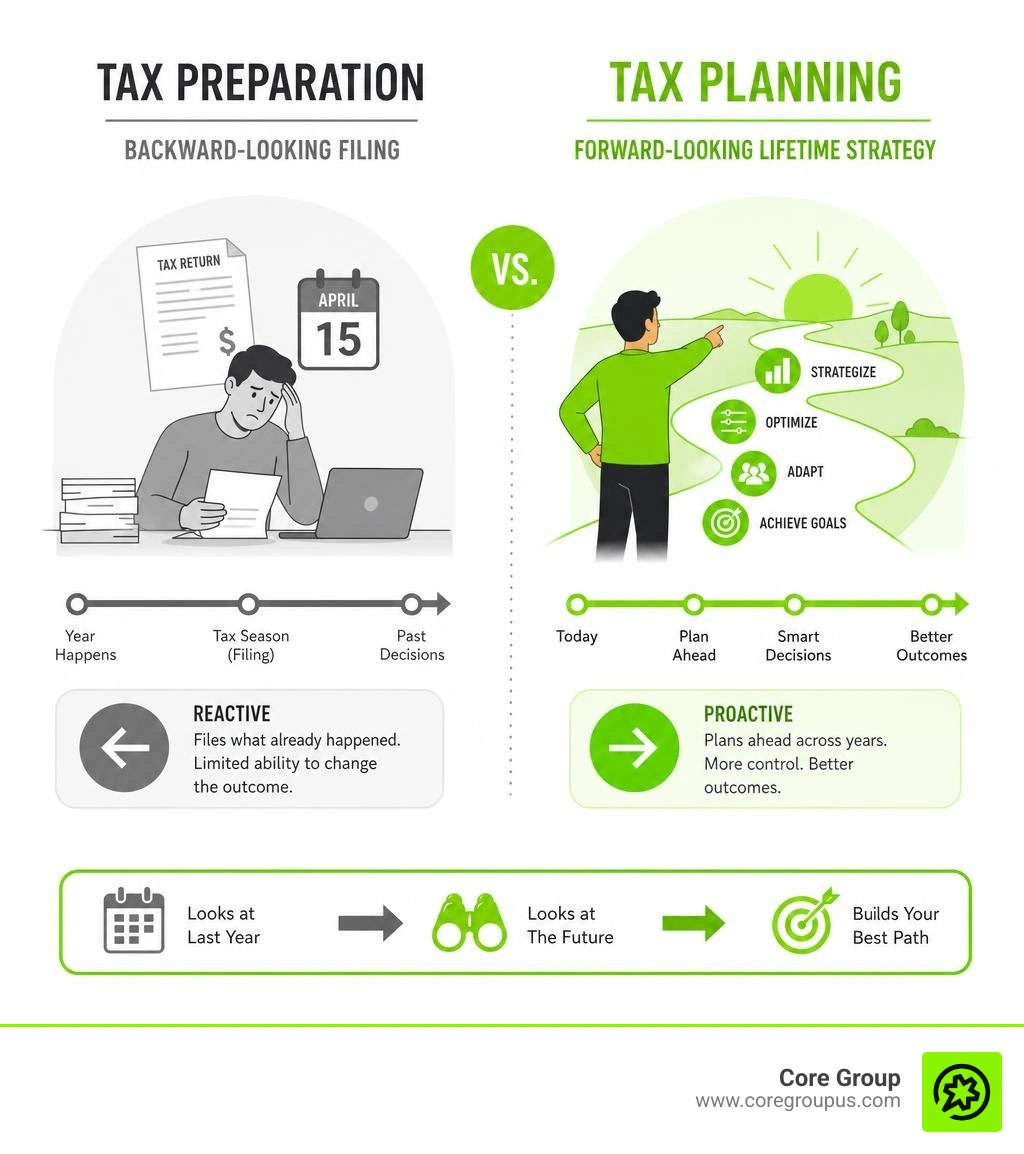
Financial advisor tax planning terms explained below.
The Difference Between Tax Planning and Tax Preparation
Many people use the terms tax planning and tax preparation interchangeably, but they represent two entirely different functions. Understanding this distinction is vital for anyone who wants to protect their wealth.
Tax preparation is a backward-looking compliance exercise. When you work with a traditional tax preparer, they look at the financial year that has already concluded. They gather your W-2s, 1099s, receipts, and business expense records to calculate your exact liability for that specific year. Their primary goal is to ensure you comply with the law and file your return accurately. While this is necessary, it does little to change the amount of tax you actually owe because the underlying transactions are already set in stone.
Tax planning is a forward-looking, strategic process. It focuses on the future, analyzing how different financial decisions will impact your tax liability over several decades. Rather than asking how to report last year's income, tax planning asks how to structure your income, investments, and business transactions today to minimize your lifetime tax burden.
To help visualize this, consider the difference between tax planning and tax management as part of your strategic financial planning. Tax management focuses on the day-to-day execution of tax-efficient moves, while tax planning builds the overarching blueprint.
| Feature | Tax Preparation | Tax Planning |
|---|---|---|
| Focus | Backward-looking compliance | Forward-looking strategy |
| Timeframe | Past calendar year | Multi-year and lifetime horizon |
| Goal | Accurate filing and compliance | Minimizing lifetime tax liability |
| Action | Gathering historical documents | Structuring investments and income |
| Timing | Once a year during tax season | Ongoing throughout the entire year |
By integrating tax planning into your broader wealth strategy, you shift from a defensive posture to an offensive one. You stop wondering what your tax bill will be and start designing it.
How to Integrate Financial Advisor Tax Planning Into Your Wealth Strategy
Integrating tax planning into your financial strategy requires a holistic view of your wealth. It is not enough to look at your investments in a vacuum. Your business revenue, retirement accounts, real estate holdings, and estate plans must all work in harmony.

When we look at tax planning strategies for our clients, we examine how every financial decision ripples through their tax brackets. This is why searching for tax planning services near me often leads individuals to wealth managers who specialize in comprehensive planning rather than basic tax filing.
A truly integrated approach looks at how firms integrate estate investment tax planning strategies to protect wealth across generations. This means coordinating your current investment portfolio with your long-term legacy goals, ensuring your beneficiaries do not inherit an unnecessary tax burden.
Why Clients Demand Financial Advisor Tax Planning Today
The demand for tax-smart financial advice is at an all-time high. Investors are increasingly aware that investment performance is only half the battle. What matters is not just what you make, but what you keep after taxes.
Recent industry data highlights this shift in consumer expectations.
- A staggering 80% of investors believe their financial advisors should be actively focused on minimizing their tax obligations.
- Approximately 70% of consumers with at least $250,000 in investable assets want professional help with tax and retirement planning.
- Despite this high demand, 50% of independent advisors identified advanced tax planning as a significant knowledge gap in their own practices.
This gap between what clients want and what typical advisors can deliver is why specialized tax knowledge is so critical. To build a secure financial future, you must understand what should be considered in tax planning strategies to ensure your advisor is not leaving money on the table.
Choosing the Right Credentials for Financial Advisor Tax Planning
Because of the knowledge gap among traditional planners, it is important to check credentials when looking for an advisor who can handle complex tax scenarios.
Several designations indicate that a professional has undergone rigorous training in tax-informed wealth management.
- Tax Planning Certified Professional (TPCP®) represents a specialized designation focused entirely on forward-looking tax planning rather than backward-looking compliance. In fact, 87% of TPCP® designees say the program was extremely useful to their career and ability to serve clients.
- Certified Financial Planner (CFP®) professionals are trained in holistic wealth management, which includes retirement, estate, investment, and tax planning.
- Certified Public Accountant (CPA) and Enrolled Agent (EA) designations also bring deep technical knowledge. While many CPAs and EAs focus primarily on tax preparation, those who also practice wealth management bring a deep, technical understanding of the tax code to the planning table.
When selecting a professional, look for individuals who combine these disciplines. For instance, some advisors hold dual credentials such as being both a CPA and a CFP®, allowing them to bridge the gap between compliance and long-term strategy. Many professionals combine these skillsets to bridge the gap between compliance and long-term strategy.
Advanced Tax Planning Strategies for Retirees and High Net Worth Individuals
As you accumulate wealth and approach retirement, tax planning becomes more complex and far more impactful. A single mistake in your withdrawal strategy can cost you hundreds of thousands of dollars in unnecessary taxes.

To protect your hard-earned savings, you must understand the best strategies to minimize taxes and master how to save on taxes during your golden years.
Strategic Roth Conversions and Required Minimum Distributions
One of the most powerful windows for tax planning occurs during the tax gap years. These are the years between when you retire and when you must start taking Required Minimum Distributions (RMDs) and Social Security. During this period, your ordinary income often drops significantly, putting you in a historically low tax bracket.
This low-income window is the perfect time to execute strategic Roth conversions. By moving money from a traditional IRA to a Roth IRA, you pay taxes on the converted amount at your current low tax rate. The money then grows tax-free and can be withdrawn completely tax-free in the future.
This strategy also helps optimize your future RMDs. Under the SECURE 2.0 Act, the starting age for RMDs has increased to 73, and it will rise to 75 for individuals born in 1960 or later. If you do not manage your traditional IRA balances before reaching this age, your mandatory distributions could push you into a much higher tax bracket.
To avoid this, advisors use careful withdrawal sequencing, pulling from taxable, tax-deferred, and tax-free accounts in a specific order. Additionally, retirees can utilize Qualified Charitable Distributions (QCDs) starting at age 70 and a half. This allows you to send up to $105,000 per year directly from your IRA to a qualified charity, satisfying your RMD requirements without adding a single dollar to your adjusted gross income.
Failing to plan these moves can also trigger the Medicare Income Related Monthly Adjustment Amount (IRMAA) surcharges. Because IRMAA brackets have a strict two-year lookback, a poorly timed withdrawal or large Roth conversion today can cause your Medicare premiums to spike unexpectedly two years down the road.
Tax Planning for Business Owners and Special Situations
If you are a business owner or a freelancer, your tax planning needs are even more urgent. Your business structure directly dictates how you are taxed, making proactive planning essential for survival.
For independent creators, tax planning for freelancers is critical to managing fluctuating monthly income and handling quarterly estimated payments without stress. As your business grows, you may need to transition to more complex structures, requiring specialized tax planning strategies for partnerships or a comprehensive corporate tax planning and strategy to keep your liabilities low.
Every business should focus on continuous business tax optimization to ensure you are taking advantage of every legal deduction, retirement plan contribution, and business credit available.
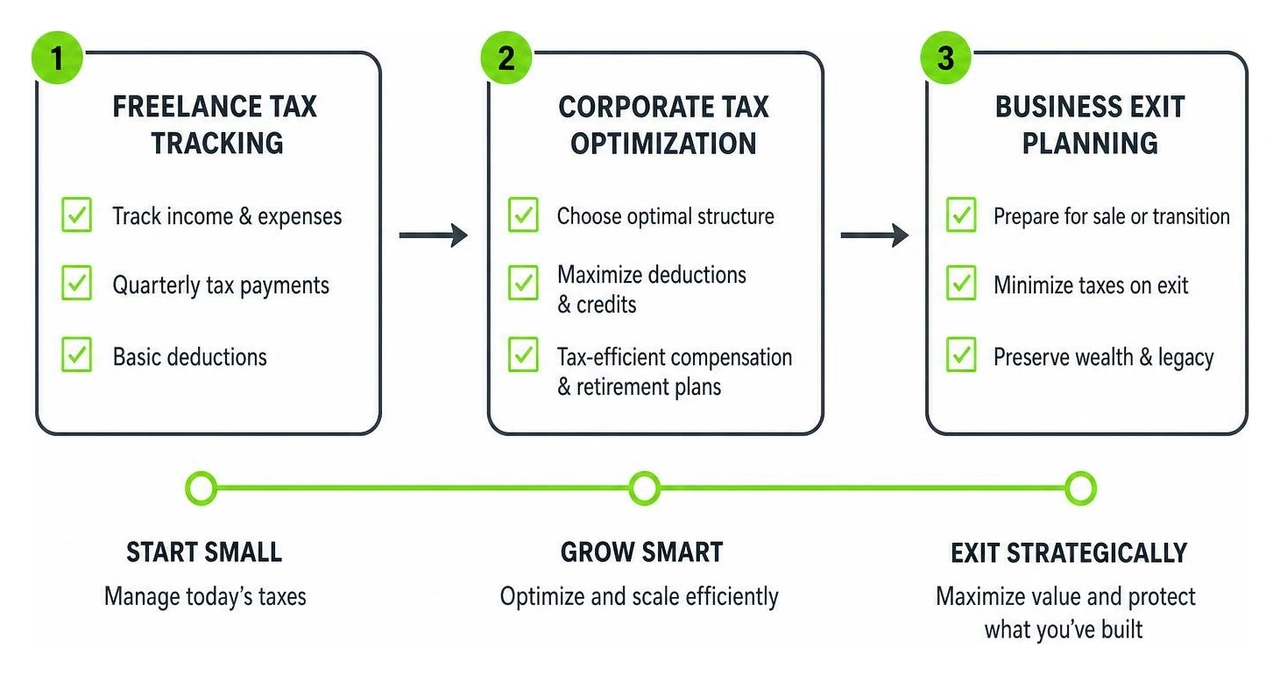
Special situations also require advanced planning.
- Divorce involves dividing assets, retirement accounts, and business interests, which can trigger massive tax penalties if not structured correctly.
- Inheritance of a sudden windfall requires careful management to avoid immediate tax hits, especially when dealing with inherited IRAs that must be fully distributed within ten years.
- Business Exit Planning is crucial when it comes time to sell your business. Structuring the sale over multiple years or utilizing specific tax exemptions can preserve millions of dollars of your hard-earned equity.
Navigating the One Big Beautiful Bill Act and State Specific Rules
Tax planning is never static because the tax code is constantly changing. Advisors must stay ahead of legislative shifts to protect their clients from sudden tax hikes.
Staying up to date on these changes is especially important when executing business year end tax planning, as year-end moves must align with the latest federal and state laws.
Understanding the Impact of the One Big Beautiful Bill Act
The tax landscape experienced a major shift when the One Big Beautiful Bill Act (OBBBA) was signed into law on July 4, 2025. This landmark legislation combined permanent tax provisions with brand-new rules, requiring advisors to immediately rewrite their clients' year-end tax strategies.
The OBBBA introduced significant adjustments to federal tax brackets, standard deductions, and corporate tax rates. For business owners and retirees alike, these changes mean that old assumptions about tax brackets are no longer accurate. Proactive advisors are currently busy recalculating multi-year projections to ensure their clients do not accidentally cross into higher tax brackets under the new rules.
State Specific Tax Rules and Estate Planning Considerations
Federal taxes are only part of the equation. State-specific tax rules can have an equally large impact on your long-term wealth, particularly in retirement.
For example, Massachusetts has unique tax rules that retirees must navigate. The state imposes a flat 5% income tax on most retirement income, including traditional IRA and 401(k) distributions, though it does exempt Social Security benefits.
Furthermore, Massachusetts has a state-level estate tax threshold of just $2 million per person. This is dramatically lower than the federal estate tax exemption, meaning many middle-class families with a home and a modest retirement nest egg could face a significant state estate tax bill if they do not plan ahead. An advisor familiar with these regional nuances can implement trust strategies and gifting plans to protect your estate from these local taxes.
Frequently Asked Questions About Advisor Tax Services
What is the difference between tax planning and tax preparation
Tax preparation is a backward-looking compliance service that focuses on filing an accurate tax return for the previous year. Tax planning is a forward-looking, multi-year strategy that analyzes your complete financial picture to minimize the total amount of tax you pay over your lifetime. While a tax preparer records history, a tax planner helps shape it.
How do financial advisors coordinate with CPAs
Seamless collaboration between your financial advisor and your CPA is the key to a successful financial plan. Your advisor can model long-term strategies, run tax projections, and identify opportunities, while your CPA can verify the technical accuracy of those strategies and execute them on your tax return. This collaborative approach is often referred to as a personal CFO model. You can listen to an in-depth discussion on how these professionals work together by checking out James Daniel on Financial Planning and Tax Strategies - Business RadioX ® - .
What software do advisors use for tax planning
Modern financial advisors utilize advanced technology to run complex tax scenarios. Tools like Holistiplan allow advisors to upload your tax return and instantly identify tax-saving opportunities, model Roth conversions, and calculate IRMAA thresholds. Advisors also use comprehensive platforms like eMoney for multi-year cash flow and estate planning projections. If you want to explore the technology available for managing your own tax projections, you can read about tax planning software for individuals.
Conclusion
At Core Group, we understand that creative entrepreneurs do not have time to waste on complex, confusing financial jargon. You need clear, actionable strategies that protect your business, minimize your taxes, and give you back your time so you can focus on what you do best.
That is why we created our no-fluff, profit-first playbook. We combine expert financial management, bookkeeping, and proactive tax services into a single, seamless package. We are so confident in our ability to streamline your finances and bring you peace of mind that we back our services with our unique MacBook Pro guarantee.
If you are ready to stop worrying about tax season and start building a proactive, lifetime tax strategy, explore our Resources/Tax Planning hub today to take control of your financial future.