Overtax Filing Deadlines 101
Overtime Tax Filing Deadlines Artists Need to Track
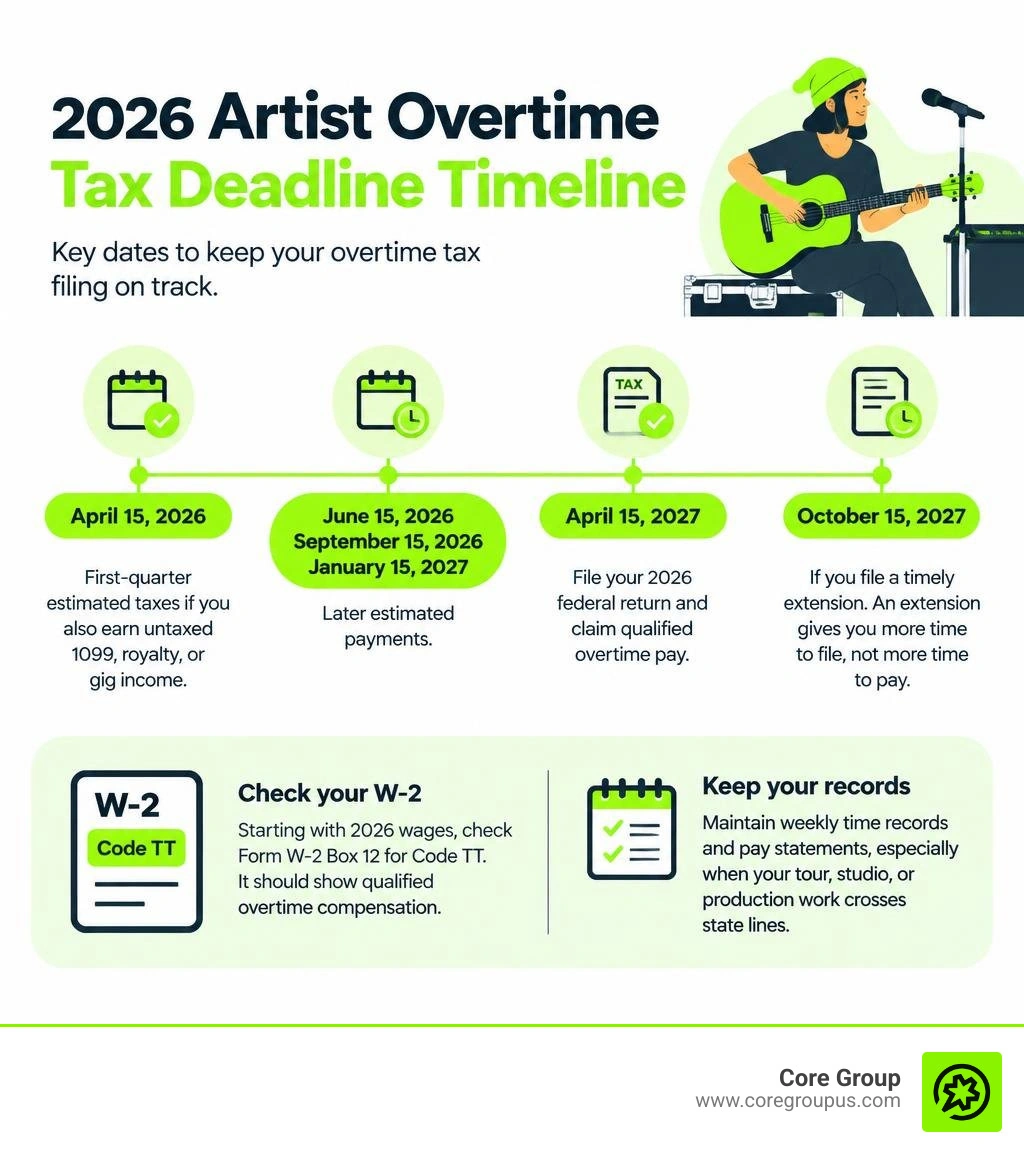
For the 2026 tax year, artists claiming the federal overtime deduction should track these dates now.
- April 15, 2026 for first-quarter estimated taxes if you also earn untaxed 1099, royalty, or gig income.
- June 15 and September 15, 2026, plus January 15, 2027, for later estimated payments.
- April 15, 2027 to file your 2026 federal return and claim qualified overtime pay.
- October 15, 2027 if you file a timely extension. An extension gives you more time to file, not more time to pay.
Starting with 2026 wages, check Form W-2 Box 12 for Code TT. It should show qualified overtime compensation. Keep weekly time records and pay statements anyway, especially when your tour, studio, or production work crosses state lines.
I am Christian Brim, and the next sections break down what counts as qualified overtime and how to keep your filing calendar under control.
Overtime tax filing deadlines artists vocabulary.
- overtime tax audit protection artists
- overtime tax savings for artists
- managing overtime taxes small creative business
Understanding the Federal "No Tax on Overtime" Deduction for Creatives
The One Big Beautiful Bill Act introduced a landmark federal deduction under Internal Revenue Code Section 225. This provision allows eligible workers to deduct the premium portion of their overtime wages directly from their taxable income. More than 29 million individual tax filers claimed this deduction in its inaugural 2025 tax year, representing roughly 20 percent of all returns processed by the IRS by early May 2026. The average deduction claimed exceeded $3,100 per worker, delivering meaningful financial relief across creative and technical production sectors.
For touring artists, session players, theatrical technicians, and studio crew members, this deduction provides substantial tax savings. However, strict statutory guidelines govern who qualifies. The deduction only applies to overtime required under Section 7 of the Fair Labor Standards Act. You must be classified as a non-exempt employee who receives overtime pay for hours worked beyond 40 in a standard workweek.
The Joint Committee on Taxation estimated that the overtime deduction will reduce federal revenues by $89.6 billion through fiscal year 2029. This tax break is temporary, currently running for tax years 2025 through 2028 unless extended by Congress. Creatives seeking to benefit must learn how to calculate qualified overtime accurately while consulting IRS guidance on overtime deductions to remain compliant.
Qualified Overtime Premium Calculations (The Extra "Half")
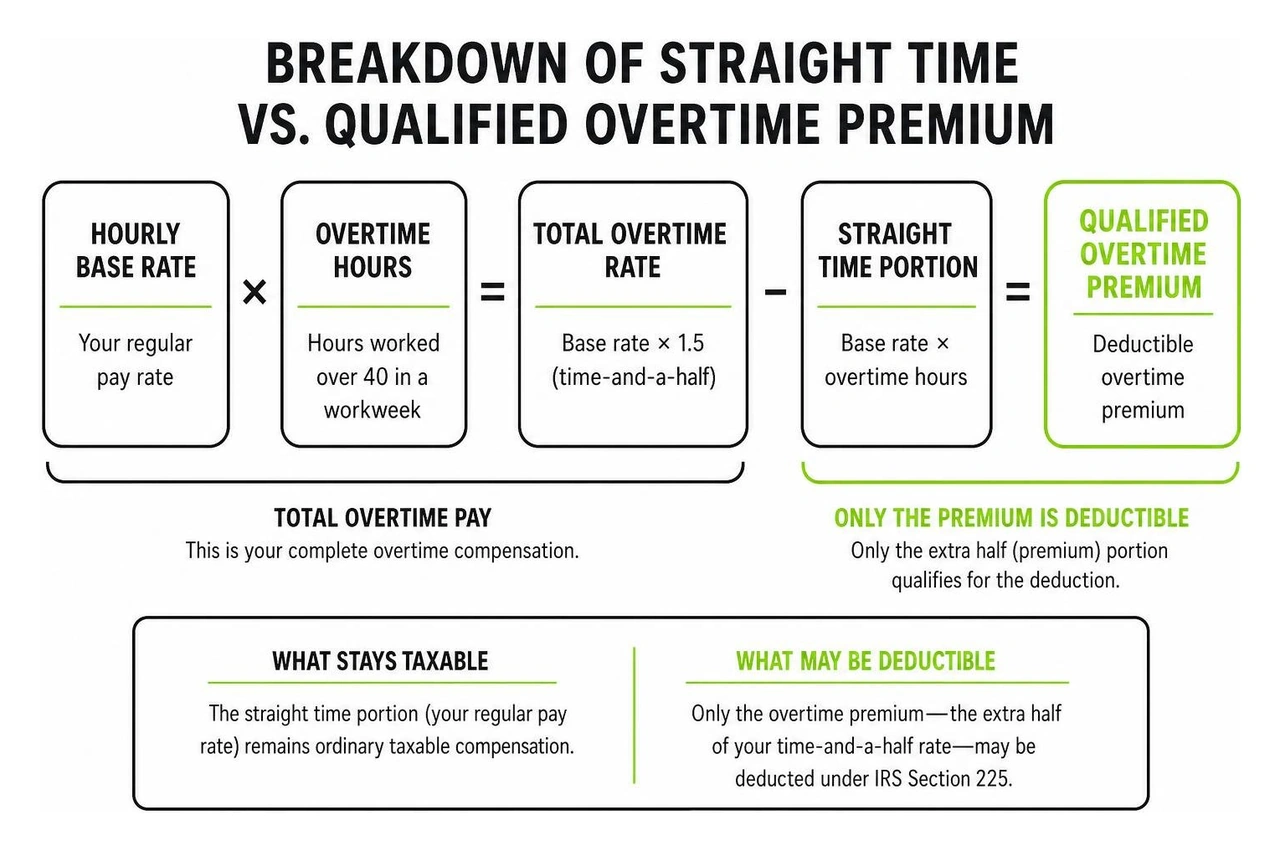
A common misconception among creative workers is that the entire paycheck earned during overtime hours is tax-free. Under federal law, only the overtime premium qualifies for the deduction. The overtime premium is the extra half portion of your standard time-and-a-half rate.
When an audio technician earns a base rate of $30 per hour, their overtime rate for hours worked beyond 40 in a workweek becomes $45 per hour. The $30 base amount remains ordinary taxable compensation. Only the additional $15 per hour premium qualifies for the deduction. This means roughly one-third of your total overtime wages can be deducted from your adjusted gross income.
To simplify these calculations across varied hourly production rates, creative professionals frequently use a paycheck calculator with overtime to separate standard straight-time earnings from deductible premium pay. Qualified amounts are claimed on Form 1040 Schedule 1-A when preparing annual tax returns.
W-2 Employees vs. 1099 Freelance Contractors
Employment classification plays a pivotal role in whether you can claim the Section 225 overtime deduction. The Fair Labor Standards Act applies strictly to employer-employee relationships. Non-exempt creative professionals receiving Form W-2 wages qualify for the deduction when working eligible overtime hours.
Independent contractors, sole proprietors, and freelance creatives receiving Form 1099-NEC compensation are generally excluded from FLSA Section 7 overtime protections. Freelancers billing project rates, day rates, or self-determined rush fees cannot classify those premium charges as FLSA-qualified overtime on Schedule 1-A. Creatives operating under mixed income models must separate their W-2 wages from freelance earnings and incorporate strategic tax planning for freelancers to lower their overall self-employment liabilities.
Statutory Caps and Income Phase-Out Thresholds
Congress established annual dollar caps and income-based phase-out ranges to target the tax relief to low and middle-income earners. The maximum qualified overtime deduction is.
- $12,500 per tax year for single filers and heads of household
- $25,000 per tax year for married couples filing a joint return
- $12,500 per tax year for married individuals filing separately
These deduction caps phase out once your Modified Adjusted Gross Income exceeds certain limits. The phase-out begins at $150,000 of MAGI for single filers and $300,000 for married couples filing jointly. The allowable deduction is reduced by $100 for every $1,000 of income earned above the threshold. Single taxpayers with a MAGI of $275,000 or higher, and joint filers with a MAGI of $550,000 or higher, are fully phased out from claiming the benefit. You can consult our no tax on overtime phase out chart to determine your exact deduction threshold.
2026 Overtime Tax Filing Deadlines Artists Need on Their Calendar

Navigating tax obligations as an artist requires tracking multiple deadlines throughout the calendar year. Touring schedules, festival runs, and recording sessions create irregular cash flows that complicate tax planning. Failing to align your filing schedule with state and federal deadlines risks steep late-filing fees and interest charges.
The table below outlines the primary federal tax deadlines for the 2026 tax year.
| Tax Obligation | Tax Period Covered | Official Due Date | Extended Due Date |
|---|---|---|---|
| Q1 Estimated Payment | Jan 1, 2026 – Mar 31, 2026 | April 15, 2026 | Not Applicable |
| Q2 Estimated Payment | Apr 1, 2026 – May 31, 2026 | June 15, 2026 | Not Applicable |
| Q3 Estimated Payment | Jun 1, 2026 – Aug 31, 2026 | September 15, 2026 | Not Applicable |
| Q4 Estimated Payment | Sep 1, 2026 – Dec 31, 2026 | January 15, 2027 | Not Applicable |
| Annual Form 1040 | Full 2026 Tax Year | April 15, 2027 | October 15, 2027 |
Critical Overtime Tax Filing Deadlines Artists Must Track for 2026
The definitive federal filing deadline to submit your 2026 individual income tax return and claim your overtime deduction is April 15, 2027. If you require additional time to aggregate multi-state pay stubs or reconcile touring statements, you can submit Form 4868 by April 15, 2027, to receive an automatic six-month extension to October 15, 2027.
An extension of time to file is never an extension of time to pay. Any unpaid tax on overtime pay or general income owed for 2026 must be remitted by April 15, 2027, to prevent IRS failure-to-pay penalties. Transition-year penalty relief has expired, making timely tax payments and accurate reporting essential.
Quarterly Estimated Tax Payment Schedule for Creative Income
Many artists balance W-2 stage crew or touring employment with independent creative work, merchandise sales, and royalty income. Because taxes are not withheld from 1099 or royalty payouts, you must make quarterly estimated payments using Form 1040-ES.
The four statutory deadlines are April 15, 2026, June 15, 2026, September 15, 2026, and January 15, 2027. To avoid underpayment penalties, artists must satisfy safe-harbor standards by paying at least 90 percent of their current year tax liability or 100 percent of their prior year tax liability (110 percent if your prior year Adjusted Gross Income exceeded $150,000). Implementing actionable year end tax planning tips 2026 helps balance your quarterly estimates while incorporating your W-2 overtime deduction benefits.
Documenting and Reporting Overtime in 2026 Post-Transition Rules
During the 2025 transition year, the IRS offered penalty relief to employers who were unable to update their payroll systems immediately. As a result, millions of workers had to manually audit weekly pay stubs to calculate their qualified overtime premium.
For the 2026 tax year, transition relief has ended. Employers are now legally required to track FLSA overtime premiums separately and report them on Form W-2, Box 12, using Code TT. Independent contractors receiving qualifying payments through specialized production arrangements will see these amounts reflected on Form 1099-MISC (Box 14) or Form 1099-NEC (Box 1d). You can explore our creative deduction maximization guide to learn how to organize these forms effectively.
Reconciling Missing Box 12 Code TT on Form W-2
If you receive your 2026 Form W-2 and discover that your employer left Box 12 Code TT blank despite paying you FLSA overtime, take action promptly.
- Review your year-end pay stubs to confirm the exact hours worked over 40 per week and the overtime premium rate received.
- Contact the employer or production payroll department in writing, requesting a corrected Form W-2c with Box 12 Code TT populated.
- If the employer fails to issue a corrected form by late February, use Form 4852 (Substitute for Form W-2) to compute your qualified overtime deduction manually on Schedule 1-A based on verifiable pay stubs.
- Maintain full timesheets, tour itinerary logs, and pay statements for at least seven years to ensure comprehensive overtime tax audit protection artists require during IRS reviews.
Stacking Overtime Deductions with "No Tax on Tips"
The One Big Beautiful Bill Act also established a deduction for qualified tips up to $25,000 per return. The IRS published a list of 71 qualifying occupations across hospitality, personal services, and entertainment that can claim this deduction.
Visual artists, sculptors, and select freelance designers who receive voluntary client gratuities are eligible for the tip deduction using Form 4137. However, the statute explicitly excludes Specified Service Trades or Businesses, which excludes traditional performing arts occupations like actors, touring musicians, and dancers from claiming tip deductions.
Creative professionals working dual roles, such as a visual illustrator who also earns W-2 overtime as an event production technician, can claim both the tip deduction and the overtime deduction on the same Form 1040 return. Combining these deductions with valid creative business expenses provides a powerful method for lowering your net taxable income.
Touring Across State Lines - Multi-State Apportionment and Nonresident Returns
Touring performers and road crews rarely perform in a single jurisdiction. A single national tour often covers dozens of states within a few months. As highlighted in industry discussions on how Tax Season Is a Mess for Touring Music Artists, live performance travel triggers aggressive multi-state filing obligations.
States enforce nonresident entertainer statutes, colloquially called the "jock tax." Under these rules, states tax visiting performers on the income earned within their borders. Most state revenue agencies allocate performance compensation using a duty-day formula.
$$\text{State Taxable Wages} = \text{Total Tour Wages} \times \left( \frac{\text{Duty Days Worked in State}}{\text{Total Tour Duty Days}} \right)$$
Duty days include performance dates, soundcheck days, rehearsal days, and scheduled travel days within the state. Touring artists must file a nonresident return in every state where they crossed the filing threshold. Your home state will generally offer a resident tax credit to offset taxes paid to other states, preventing double taxation. Maintaining an accounting for artists complete guide helps track daily tour itineraries and verify that state tax credits are calculated correctly.
State-Level Overtime Tax Filing Deadlines Artists Face on Multi-State Tours
Nonresident state income tax returns generally share the federal annual filing deadline of April 15, 2027. However, state tax laws vary significantly in how they treat the federal overtime deduction.
Some states automatically conform to the Internal Revenue Code, adopting the federal Section 225 deduction on state returns. Other states, such as Colorado, decouple from certain federal changes, requiring taxpayers to add back the deduction on their state returns. Additionally, artists often ask is overtime taxed at a higher rate in california when planning West Coast tour dates. California treats all overtime pay as regular taxable income subject to standard progressive brackets, and employers must withhold state income taxes accordingly.
Frequently Asked Questions about Overtime Tax Deductions for Artists
Can 1099 independent contractors claim the "No Tax on Overtime" deduction?
No. The federal overtime deduction created under IRC Section 225 applies exclusively to non-exempt employees covered by the Fair Labor Standards Act. Independent contractors, freelancers, and sole proprietors who report earnings on Schedule C cannot claim the overtime premium deduction. Freelancers can still reduce their taxable income by writing off ordinary and necessary business expenses.
What happens if an employer does not include Code TT in Box 12 of Form W-2?
If your employer leaves Box 12 Code TT blank, first ask their payroll department for a corrected Form W-2c. If the employer does not provide one before the filing deadline, you can compute your qualified overtime premium using your final 2026 pay stubs and attach Form 4852 to your Form 1040. Keep copies of all timesheets and pay stubs to substantiate your calculation if audited.
Does claiming the overtime deduction reduce payroll taxes like Medicare and Social Security?
No. The Section 225 deduction applies only to federal individual income tax. It does not reduce FICA payroll taxes. You and your employer remain responsible for the standard 6.2 percent Social Security tax up to the statutory wage base limit and the 1.49 percent Medicare tax on all overtime earnings.
Conclusion
Mastering the 2026 federal overtime deduction requires diligence, precise record-keeping, and an awareness of upcoming filing dates. By tracking your qualified overtime premiums on Form W-2 Box 12 Code TT and monitoring quarterly estimated deadlines, you can claim every dollar you are entitled to while remaining fully compliant with state and federal tax authorities.
At Core Group, we help creative entrepreneurs, performers, and production professionals manage their finances with our no-fluff, profit-first playbook. We handle your bookkeeping, multi-state tour allocations, and tax filings so you can focus on your art with complete peace of mind, all backed by our MacBook Pro guarantee. Take control of your career today by managing your overtime tax rate with our dedicated team of creative financial professionals.