How to Set Up an S Corp in 7 Simple Steps
How to Set Up an S Corp
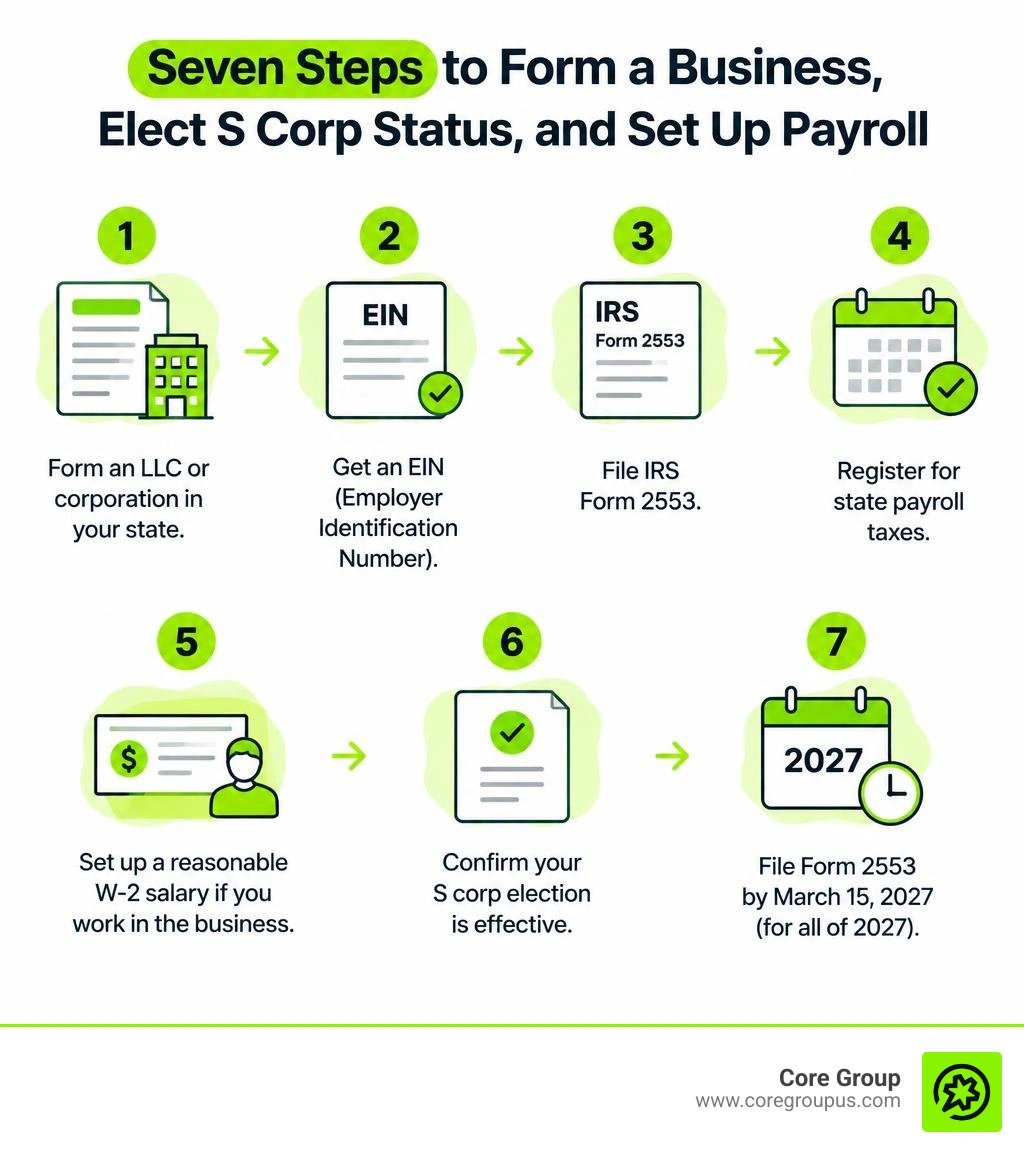
To set up an S corp, form an LLC or corporation in your state, get an EIN, and file IRS Form 2553. Then register for state payroll taxes and set up a reasonable W-2 salary if you work in the business. S corp status is a tax election, not a separate type of business.
If you want the election to cover all of 2027 for a calendar-year business, file Form 2553 by March 15, 2027.
I'm Christian Brim, and I'll walk you through the seven steps, including the costs to check before you elect.
Explore these resources to learn more about how do you set up an s corp.
What Is an S Corp and Who Is Eligible?
An S corporation is not a distinct legal entity that you form with your secretary of state. It is a special federal tax status created under Subchapter S of the Internal Revenue Code. Under standard federal rules, a traditional C corporation pays taxes at the entity level, and then owners pay personal income taxes on dividends, creating double taxation.
When you elect S corporation status, your business gains pass-through taxation. This means profits and losses flow directly to the shareholders' individual tax returns without entity-level federal corporate income tax.
| Feature | Limited Liability Company (Default) | C Corporation | S Corporation (Tax Election) |
|---|---|---|---|
| Legal Formation | Articles of Organization | Articles of Incorporation | Formed as LLC or C Corp |
| Federal Tax Status | Pass-through (Sole Prop or Partnership) | Entity-level corporate tax | Pass-through entity |
| Double Taxation Risk | No | Yes | No |
| Owner Compensation | Owner draws | W-2 Salary and dividends | W-2 Salary plus distributions |
| Self-Employment Tax | Paid on 100% of net profit | None on dividends | Paid only on W-2 salary |
| Ownership Limits | Unlimited | Unlimited | Maximum 100 shareholders |
S Corp Eligibility Requirements and Restrictions
The IRS enforces strict rules regarding which companies qualify for Subchapter S status. If you violate any of these rules, the IRS can revoke your election and tax you as a standard C corporation.
To qualify, your company must be a domestic entity created under the laws of a United States jurisdiction. The company can have no more than 100 shareholders. Family members can often be treated as a single shareholder for this limit. Every shareholder must be an individual, an estate, or a qualifying trust. Partnerships, corporations, and non-resident aliens cannot hold shares.
Additionally, the business can issue only one class of stock. You can have voting and non-voting common shares, but you cannot distribute unequal financial rights or liquidation preferences. Checking all S Corp eligibility requirements ensures you avoid double taxation safely.
Deciding How Do You Set Up an S Corp, LLC vs. C Corp Path
Before you file any tax elections, you must form a baseline legal business. You have two main routes, creating a limited liability company or creating a standard corporation.
For most creative entrepreneurs, starting with an LLC is the preferred path. An LLC provides strong personal liability protection while avoiding corporate formalities like mandatory shareholder meetings and rigid director structures. Once registered, the LLC files an election with the IRS to be taxed as an S corporation.
Alternatively, you can incorporate as a C corporation under state law and elect S status. This path requires formal corporate bylaws, stock certificates, and board resolutions. Entrepreneurs establishing a new venture often review state resources like the Arizona Commerce guide on starting your business to decide which foundational S Corp business structure best matches their goals when exploring what is an S Corporation.
How Do You Set Up an S Corp in 7 Actionable Steps

Understanding the complete S Corp setup process gives you clarity from day one. Here are the practical steps to establish your entity and secure federal tax benefits.
Steps 1 to 4, Business Formation, Registered Agent, Operating Agreement, and EIN
- Select a compliant business name. Choose a name that is unique and distinguishable in your formation state. You can check state business databases such as the Arkansas Secretary of State corporate search tools to ensure your desired name is available.
- Designate a registered agent. Every state requires a registered agent with a physical street address in the state who is available during normal business hours to receive official notices and service of process.
- File your formation documents. Submit Articles of Organization for an LLC or Articles of Incorporation for a corporation to your state filing agency. Pay the required filing fee, which varies depending on your jurisdiction.
- Draft governing agreements and obtain an EIN. If you formed an LLC, create a thorough operating agreement. If you formed a corporation, adopt corporate bylaws and issue stock. Our S Corp operating agreement ultimate guide covers how to prevent creating a prohibited second class of stock. Following a clear S Corp formation checklist helps you keep these structural records organized before securing your federal Employer Identification Number from the IRS website.
Step 5, How Do You Set Up an S Corp by Filing Form 2553 with the IRS
To turn your standard state entity into an S corp for tax purposes, you must submit IRS Form 2553, Election by a Small Business Corporation. Every shareholder must sign the consent statement on the form.
The deadline is strict. If you are an existing calendar-year business electing status for the upcoming year, you must submit Form 2553 no later than two months and fifteen days after the start of that tax year. For calendar-year 2027 status, the filing deadline is March 15, 2027. If you are a brand new business, you have exactly 75 days from your official formation date.
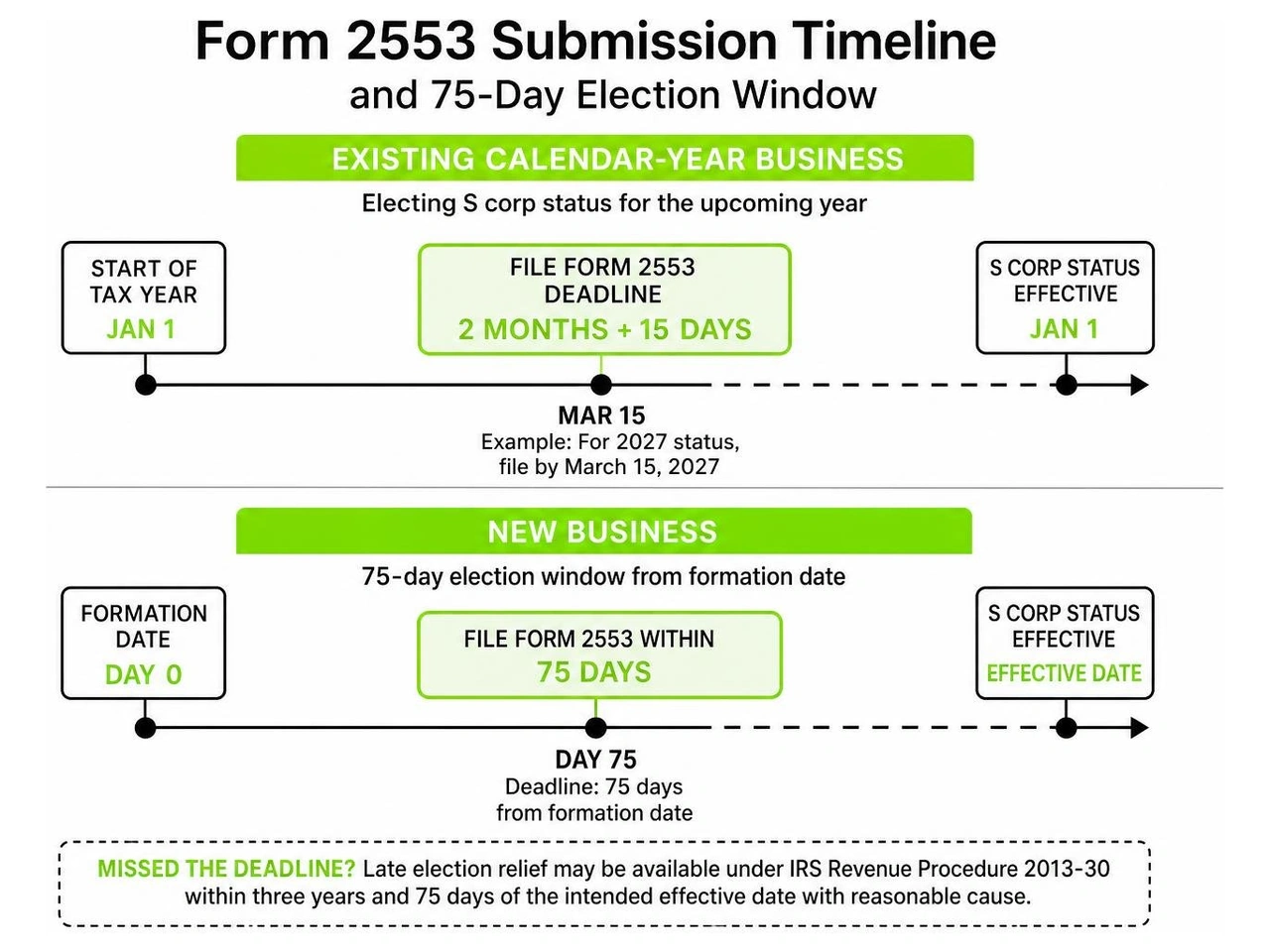
If you miss the deadline due to an oversight, you do not have to panic. Under IRS Revenue Procedure 2013-30, late election relief is available within three years and 75 days of the intended effective date, provided you had reasonable cause for missing the deadline. Many founders ask can I set up an S Corp myself, and while self-filing is possible, careful review of how to set up an S Corp prevents procedural delays.
Steps 6 and 7, Register for State Payroll Taxes and Establish W-2 Payroll
- Register with state tax and labor departments. Register your business with your state department of revenue for state income tax withholding and with your state department of labor for state unemployment tax.
- Set up formal W-2 payroll. As an active owner-employee, you cannot take all your earnings as casual bank transfers. You must establish automated payroll that deducts federal income tax, Social Security, Medicare, and applicable state taxes. Reviewing fundamental S Corp payroll rules and understanding how to handle S Corp health insurance on your W-2 keeps your compensation fully compliant.
Understanding S Corp Taxes, Reasonable Salary, and Savings

The primary reason business owners elect S corporation treatment is self-employment tax reduction. In a standard sole proprietorship or single-member LLC, 100% of your net business profit is subject to the 15.3% self-employment tax, which covers Social Security and Medicare.
With an S corp, you split your net earnings into two distinct categories.
- W-2 Salary is subject to standard payroll taxes (FICA).
- Shareholder Distributions are paid out from remaining profits, subject to ordinary income tax but free from the 15.3% self-employment tax.
Reviewing a comprehensive S Corp tax planning guide 2026 helps you model these savings across various income tiers.
Setting a Reasonable Salary and Profit Distributions
The IRS strictly requires shareholder-employees to pay themselves a reasonable salary for the services they provide before taking distributions. You cannot pay yourself a nominal $10,000 salary if market rates for your position are $75,000.
To establish defensible compensation, evaluate market data, your duties, your training, and the time devoted to operations. Profits remaining after payroll can be taken as an S Corp profit distribution. Maximizing allowable S Corp business deductions lowers your overall corporate net income, keeping your tax position lean and defensible during audits.
When Does an S Corp Make Financial Sense?
An S corp is not beneficial for every business level. Running an S corporation introduces ongoing administrative expenses, including payroll processing software, state franchise fees, and specialized tax return preparation.

In a practical example, an owner paying themselves a $65,000 reasonable salary typically reaches a break-even point at roughly $115,800 in net business profit. Below this threshold, administrative costs often outweigh self-employment tax savings.
Consulting a detailed S Corp cost guide 2026 helps you determine if your revenue justifies the move. When deciding should creative entrepreneurs become an S Corp, looking closely at your net earnings after operational expenses gives you the answer.
Ongoing Compliance, State Nuances, and Revoking S Status
Running an S corporation requires ongoing governance to protect your tax standing and liability shield. You must treat your business finances with diligence to manage your S Corp business taxes efficiently.
Annual Filings, Bookkeeping, and Compliance Maintenance
Every S corp must file an annual federal return on Form 1120-S by the 15th day of the third month following the close of the tax year, which is March 15 for calendar-year entities. The corporation issues a Schedule K-1 to each shareholder, detailing their share of profits and losses to include on their personal Form 1040.
The IRS estimates the average out-of-pocket compliance cost for small S corporations filing Form 1120-S is around $4,200. Maintaining clean, accurate ledgers through reliable S Corp bookkeeping near me streamlines this tax filing and protects S corporations from costly penalties.
State-Specific S Corp Rules and Revoking S Status
State tax laws treat S corporations differently across the country. In California, S corporations must pay an annual state tax of 1.5% on California net income, with a mandatory minimum tax of $800, rather than the standard LLC fee structure.
Some local jurisdictions do not recognize federal S corp status at all. New York City and Washington D.C. impose entity-level taxes on S corps, diminishing pass-through benefits within city borders.
If your business structure changes or you want to return to standard taxation, you can voluntarily revoke your election. Revocation requires the consent of shareholders holding more than 50% of the total issued shares. Once revoked, you generally cannot re-elect S corporation status for five years without IRS approval.
Frequently Asked Questions About S Corp Setup
What is the deadline to file Form 2553 for the tax year?
For an existing calendar-year business wanting S corp status for all of 2027, the deadline to file Form 2553 is March 15, 2027. New entities must file within 75 days of formation. If you missed the deadline, you may request late election relief under IRS Revenue Procedure 2013-30.
Do all states recognize federal S corp status?
Most states honor federal S corporation status automatically, but exceptions exist. New York City and Washington D.C. do not recognize S corp pass-through status for local business tax purposes and assess corporate-level income taxes. States like California impose minimum franchise taxes alongside entity-level net income taxes.
What happens if an S corp fails to pay a reasonable salary?
If you take owner distributions without paying a reasonable W-2 salary, the IRS can reclassify your distributions as employee wages. This triggers assessments for unpaid payroll taxes, substantial accuracy penalties, late-filing fines, and statutory interest charges.
Conclusion
Setting up an S corporation gives creative entrepreneurs a tested path to reduce self-employment taxes while protecting their personal assets. By completing state entity formation, obtaining an EIN, and timely submitting Form 2553, you set your business up for sustainable financial success.
At Core Group, we help creative business owners take control of their finances using our no-fluff, profit-first playbook. We deliver comprehensive bookkeeping, payroll, and tax management backed by our MacBook Pro guarantee, giving you complete peace of mind to focus on your creative work. If you want expert support on how to form an S Corp, reach out to our team today to evaluate your business savings.